
The phrase “Technique is a technique and without technique, there is no victory” appears to have been originally said by Cuban Olympic triple champion Teófilo Stevenson; however, the phrase became famous a little later when told by former boxer Félix Savón, with only a slight change: “Technique is a technique and without technique, there is no technique,” a play on words that eventually became a frequent joke that underscored the importance of practice and skill as a strategy to ensure victory. And I mention this because the proposal by Ecuadorian artist Raymundo Valdez reminds me of it when observing his “players” flaunting their strength and technical mastery, while they naively become hostile objects, participants of human contests that are not free from being precarious, selfish, and banal.
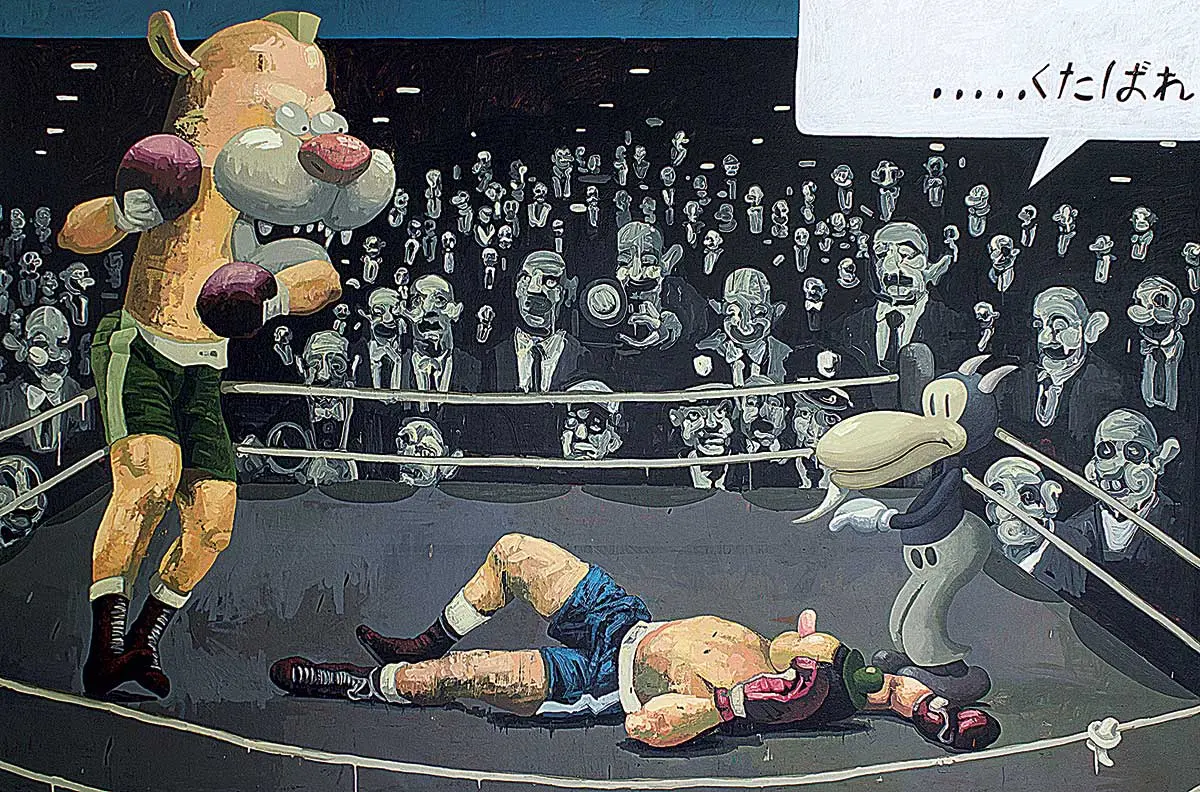
From September 30 to October 30, the Galería DPM in Guayaquil, Ecuador, presented the solo exhibition by Valdez titled Punch Pown that consists of paintings, watercolors, mixed media, sculpture, and an installation, where boxers, characters from the world of anime, manga, and sumo wrestling—shown in close combat and dimensioned with their discrepancies through a zoomorphic appearance that generates discomfort because of its grotesque nature—often remind us of our assiduous and vicious way of coping with life through disputes. In Philippians 2:3-5 the bible tells us: “Do nothing out of selfish ambition or vain conceit." It would appear that the whole world is reduced to the plasticity of these beings immersed in an eternal struggle to achieve victory as they subscribe to the belief that the end justifies the means. However, Raymundo Valdez tells me that he is interested in the processes and that he does not begin his artistic inquiries by looking for a result a priori. He has never cared for working in series. In this sense, Valdez asks in his thesis: Is success worthwhile if what we are after is affected by a process of reification, of moral or ethical distortion, or an oversimplification of our intentions no matter how sublime these are?
He tells me that when he started the first bodies he looked for any metaphors that they could generate based on a study on human carnality. At that time, Valdez was still not sure about the array of possibilities that he would eventually favor as part of a discourse in which the material itself became a central aspect of his critical pronouncements on the human condition, our desires, and goals; as he also did not know that his formal experiments would enter a universe of folds, tensions, miseries, and perversions. The works of artists like Lucian Freud, Jenny Saville, and Alyssa Monks were part of his primary referents.
During his research process Valdez avidly sought images on the internet that could help him structure simple narratives and that, in turn, could be combined with onomatopoeic titles whose lightness could attract the public without falling into discursive alliterations. He gathered characters seen in boxing matches, subtle heroes from anime, voluptuous sumo wrestlers, to mention a few prototypes. There is no peace in these scenes, no waiting period, always in attack mode, hooks, and punches in all of their variations. What few know about Raymundo Valdez—which he articulates through the unspoken language of his light and small figure, rather than through his wild, violent and rough work—is his reliance on a spiritual life based on the recognition of what he regards as sacred synchrony with a particular creed. He is one of those artists that when one gets to know him one realizes that he is nothing like his work.
How do we get “hooked” on the battles envisioned by this Ecuadorian artist? The sublimation process takes place through humor, satire, and sarcasm. His departure from the chaos and fighting is patented through the caricaturization of contenders whose anthropomorphous bodies are sometimes topped with heads from the Japanese world of manga, anime, comics, or even mainstream cartoon strips and, in the most grotesque cases, the bodies are crowned with animal faces. The deformation, the thick impastos, the voluminous flesh, the game of humanity that is apparently strong because of its belligerent, impulsive, irrational, and exaggerated nature, are contrivances of an intrigue that compels because of the childlike nature of the characters. The doses of eschatology and ingenuity are similar because Valdez seeks complicity from the audience as he shows the struggles of beings who want to triumph but who also fall victims to their own desires. One of the paratexts of the proposal has to do with the compulsive consumption and invasion of images that we traffic with every day, without even realizing that in most cases they contain subliminal messages laden with morbidity, violence, and high doses of showmanship.
The word “contention’ derives from the verb “to contend,” which in turn comes from the Latin contenderé, meaning to completely pursue something, to strive, to give something one hundred percent, to face-off (in a hostile sense), to brawl, to fight. And that is one of the morals suggested by Valdez: it is not always about winning. Victory is often overrated. It is also about knowing how to lose, how to avoid confrontation, how to compromise in order to achieve a common goal. Often feared and obsessed about, failure is the necessary step one must sometimes take in order to grow and learn from one’s mistakes, while still enjoying the experiment, the training, and remaining curious. Above all, we need to focus more on our inner life and avoid the attention that we give to the appearance.
AMALINA BOMNIN