
Visiting an exhibition by Brazilian artist Regina Silveira will always mean encountering a series of perceptual games where two-dimensional planes turn and unfold to reveal sculptural forms that mislead the viewer. We must remember that Silveira works mainly with computer-designed cuts of adhesive vinyl that are affixed to walls and interstices in the exhibition space. In this way, she draws a different space in it, changes the perspective of a staircase, projects a shadow that does not belong to the object from which emerges or transforms the direction of any given corner, moving from absolute neutrality to readings with clearly political undertones. It is interesting to note how two-dimensional drawings in vinyl begin to generate spatial shifts, promoting a gaze that transcends the plane and suggests three-dimensional objects, occasionally even prompting bodily readings. This is no longer an approximation to a sculptural “falsity”, the simulation of a non-existing object, but a relationship through which the viewer’s own body sustains communication with that universe.
When we look at a work like Scissors (2007), we're a long, well-defined, yet distorted, the shadow is projected by small metal clothes to hook, what shadows are not distorted? The visuality of the object is altered by the shadow it projects. Is it a game that mixes time past and time present? Is it, rather, the fusion of two objects, a hybrid between the clothes hook and its “strange” shadow? Let’s remember Merleau-Ponty’s question about the existence of a beautiful flower in the middle of a forest, regardless of whether someone sees it. Does it truly exist? In Silveira, many of the things we see are the specters of objects that emerge from “nothing”, or that come from other objects to question their very materiality. Yet, they exist. Thus, an object’s shadow materializes the object, renders it real, and brings it into an apparent three-dimensionality.
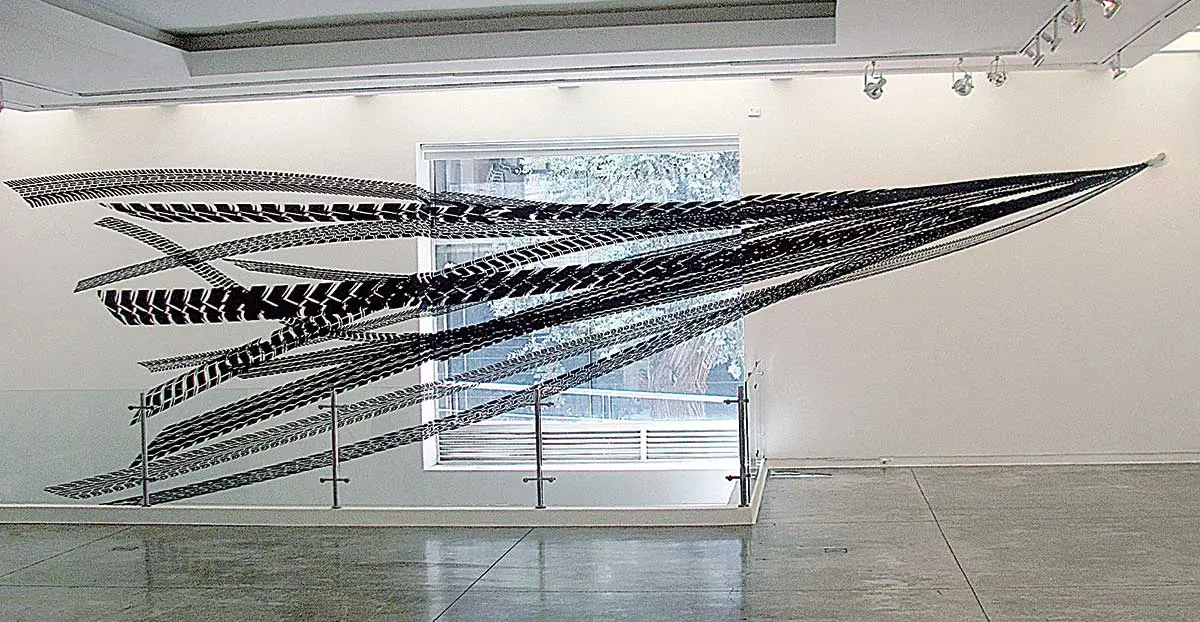
As we engage in the game of perception proposed by the artist, it is important to reflect on the temporal dimension of her work, teasing out from it a conjunction of times, objects, and their memories brought together. On a large wall with windows, the perspective generated by the imprints left by a small car launches the object, as though in an anamorphic action, towards a different place, perhaps further away, perhaps into the future. We are left only with the traces, which overlap as if the small car were following different pathways to arrive at the same place, or as if different memories of past trajectories converged on the same grey, anodyne, sad, everyday point. In this work (Featherdust, 2005), Silveira plays with time and takes us poetically to a silent, possibly psychological location that interrogates the apparent liberty with which we all “draw” the same trajectories to reach the same destinations or locations. These are illusions generated by the market, by the way of life itself, by the homogenization of taste and—in consequence—of the decisions we make.
It is necessary at this point to refer to the installation Mundus Admirabilis (2008), where a large number of insects copied from old encyclopedias take over space (floor, walls, and ceiling), cover a table with its plates, cups, and tablecloth, and even become tiresome and redundant in their “insectness”, in the sense of a plague, of that against which humanity has struggled from time immemorial (and continues to struggle). Insects have never been welcome because they are taken to represent a voracious evil, something that must be kept at bay but will never, as García Márquez noted in a speech, disappear. Insects will outsurvive humanity and its most lethal weapons. They come from the past and will remain forever. In their anachronism, and this is what this work by Silveira posits, insects are a simile for corruption, an evil that afflicts every country today and which has been gaining strength, developing more tentacles. Corruption can’t be controlled because it seeps into every space, invades territories, spills over everyday life, and—like a ghost of a shadow of ancient plagues— we consume and incorporate it into our existence. In this way, Silveira sets for us a mirror that reveals the amorphous beings we are.
ANDRÉS GAITÁN T.