
Since discovering, back in the 1990s, abstraction as one of the most potent languages of modern and contemporary painting, Rigoberto Mena has not ceased to explore it. His earliest abstract works came about in connection to the tangible architecture of Old Havana streets, and they showed a predilection for the stains left by humidity and time on walls, doors, and floors, and for the often indecipherable signs and symbols human beings cheerfully leave in their trail, among which we find numbers and rather unexpected figures. Mena’s painting also evolved in connection to the umbrageous presence of our colonial and modern buildings, partially submerged in shadows thanks to the impressive hallways and vestibules muffling the bustle of hundreds of lives happening inside so many compacted housing units.
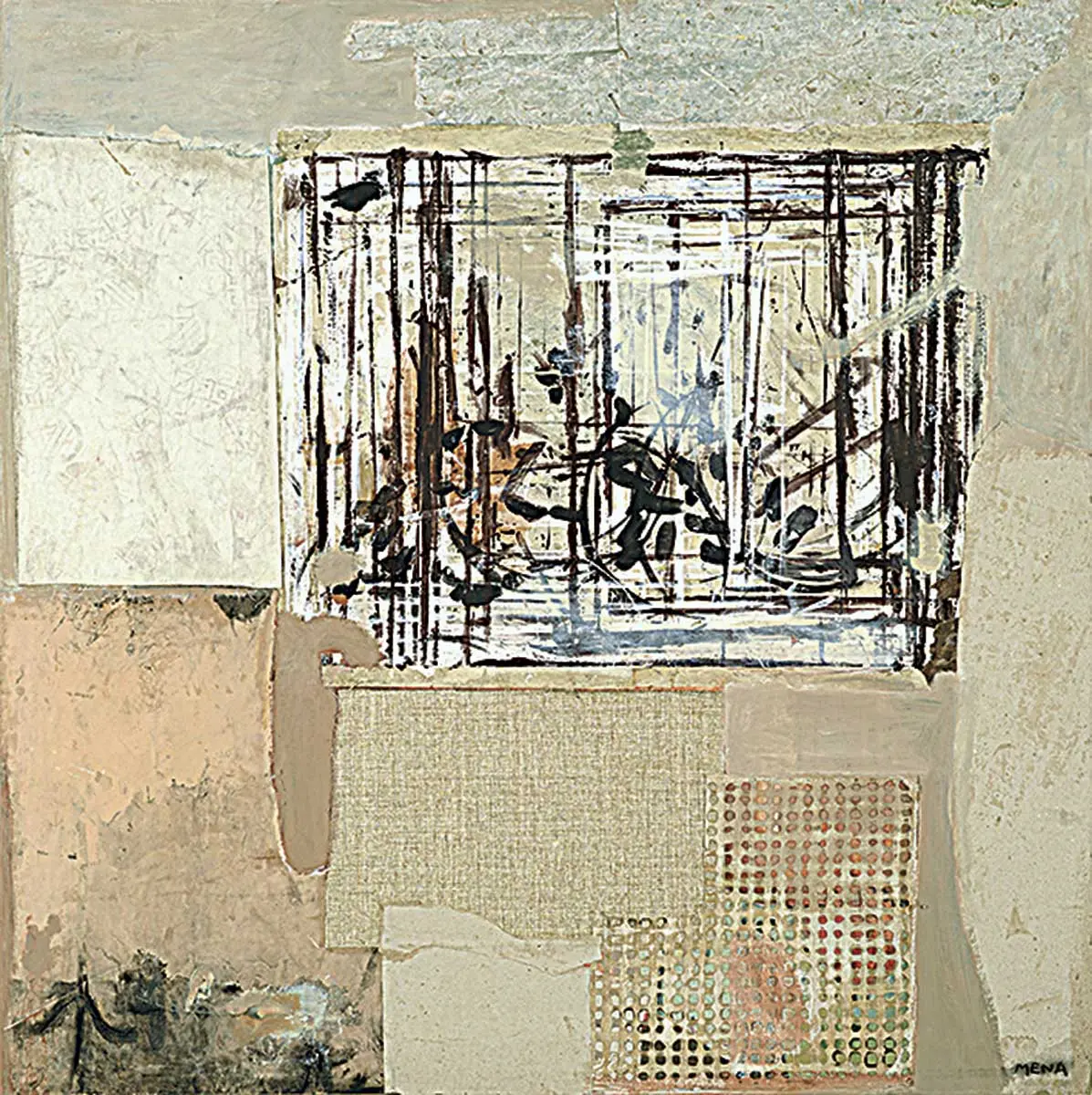
Over the years, Mena’s work began to dissipate the densities of those shadows, the dramatic colors, the designed architecture of the buildings, giving way to more intense movements and to a greater understanding of expressive freedom. Mena traveled to different countries in the Americas and Europe, and also visited the Far East in search of different codes. He discovered the variety of ancient, modern, and contemporary art across the globe, and was able to take advantage of the many tongues that painting, and art in general, have used throughout history. He launched into the creation of large-format canvases and, especially, papers and new materials. He even began to use for his raw materials images found in old publications and family archives, and he incorporated into his painting elements like child drawings and any natural or artificial graphism.
Mena’s ceaseless thirst for experimentation now announces a new period in his dense and fruitful career, exhibited last July at the Lois Lambert Gallery in Santa Monica, California under the title of Bamboo Garden. There he displayed a surprising interest in ochre and yellow tones, and a special mode of accentuating pictorial spaces via the use of brown or black hues framed to define a zone, a fragment acting as a counterpoint to the whole. He freely assumes circles, dots, blotches, and random lines that remind us of archaeological sites, sketches on scientific notebooks, or scattered notes taken on an ecstatic state. A private register of chromatic and tactile experiences emerges from these canvases, where Japanese paper, made both manually and industrially, fascinates the artist’s sensibility as the texture has now moved to the fore. The titles of some of his works are eloquent: El monje (The Monk), Equilibrio (Equilibrium), Flor de cerezo (Cherry Bloom), Jardín de bamboo (Bamboo Garden), all bringing to mind the state of quietude and piece of someone sitting on the shore of a lake to meditate while listening to delicate flute music or the arpeggios of one-string instruments.
Some collages from print materials, photographs, or texts combine with acrylics and oils to organize visual structures of incomparable beauty and to prompt our thoughts. Occasionally, Mena splits the canvas into two pictorial pairs; at other times, he leaves open all possibilities of enunciation and mystery, as if we were looking through a microscope, freed from prejudice, at a universe of minuscule forms in the bacterial and viral state. Mena has no qualms with hiding significant influences in his work, such as the early Kandinsky or Cy Twombly beyond his country’s borders, or, in Cuba, Julio Girona (with a wink to Antonio Vidal). And nothing seduces him more than the mysterious, formidable act of artistic creation.
Bamboo Garden alludes to Asia’s natural wonders. Mena’s experience in China years ago, and his study of ancient and modern Japanese art, guided him towards the contemplation of his natural surroundings, observing the fixedness and motion of all that lives. This contemplative, wise attitude was already present in his interest for the latent energy and the matteric force of architecture in the early Twenty-First century; now it turns towards the nature around us and to that which we are incapable of detecting because of its microscopic size. From the large urban scale, Mena moves now to universes unknown to the unaided human eye, inscribing them on the “invisible gardens” mentioned by the great Cuban poet José Lezama Lima.
For Mena, there are no small materials or matter in painting, and there is no major or minor art. This US exhibition proves this, and confirms him as one of the most restless and persistent in today’s Cuba. His mature period continues to be guided, however—and it seems this will be the case for the rest of his career—by a dazzling intuition, sensibility, and imagination, cultivated without giving in to the many visual expressions that now crowd mega-exhibitions and events across the world. The new languages resulting from new technologies are not as interesting to him as a branch fallen from a tree, the expression of a child with a crayon on his hand, or the lightness and transparency of a sheet of paper manufactured from natural fibers inside a humble workshop.
NELSON HERRERA YSLA