
The Centre Pompidou presents Wifredo Lam, featuring more than 300 works between drawings, paintings, engravings, inks, gouaches on cardboard, and terra-cottas, accompanied by important print and photographic documents on loan from many collections and archives around the world.
The show’s curator, Catherine David (with Cécile Zoonens), proposes a reading of the complex and nourishing artistic trajectory followed by Wifredo Lam, who weaves through his own life (1902-1982) an aesthetic discourse emitted during the second half of the Twentieth Century, a time when the world was being reconceptualized as hybrid and filled with effervescent transcultural relationships.
Lam personifies the rhizomatic model of testing territories, advancing and interweaving open spaces. He moves on a new game board, a flattened map that relativizes all hegemonic statuses of power.
Five sequences guide us, chronologically, along with the exhibition, signaling towards Lam’s work as a poetic and political manifesto in itself and making us part of his ocean-crossing trajectory as he leaves Havana en route to Spain (1923-1938); Paris-Marseille (1938-1941); Cuba and Martinique (1941-1952); Paris, Caracas, Havana, Albissola and Zurich (1952-1967); Paris and Albissola (1962-1982).
These locations deliberately organize a selection of works connected, to varying degrees, to the most important poets, writers, and artists of Lam’s generation. From his formative years in Havana and his studies at the Royal Academy of Art in Madrid, towards 1923, we witness the artist’s disregard for academic rigor and the way he confronts the postulates of the Avant-Garde masters, from Gaugin and Gris to Miró. Picasso’s influence is notable, as is the parallel ways in which both artists imbibed African art around 1906: Picasso as an adult artist giving form to exoticism in Paris; Lam in his native Cuba, where he was naturally in contact with African culture, on his mother’s side.
An important and irreverent theoretical component is shared with the Surrealists, as Lam made beautiful exquisite corpse compositions (exhibited in the show). Lam traveled to Martinique with Breton and met Aimé Cesaire, the “poet of Negritude.” It needs to be added that Lam was moving towards a new “Sun of Consciousness,” as the Martinican poet and philosopher Édouard Glissant titled one of his books (Soleil de la conscience, 1956). In that sense, Lam outlines a stylistic, conceptual, and aesthetic dialog with the marginality to which Caribbean cultures had been traditionally condemned, and pushes forward the creole richness that permeates the region, of which he feels a part.
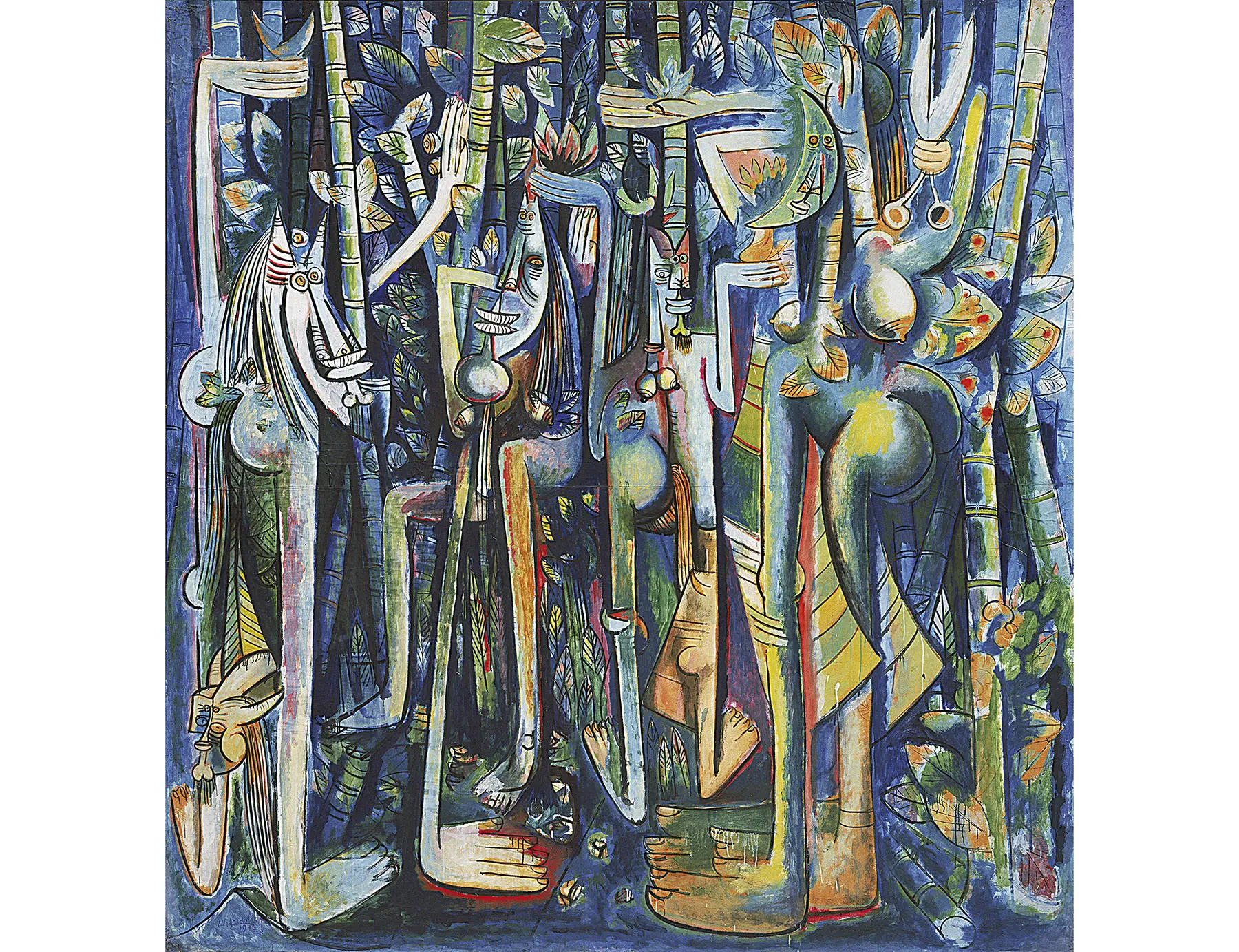
At the heart of the exhibition is La jungla (The Jungle, 1943), a living organism that cements its foundations on the chaotic, multicolor vegetation of the Caribbean, where different characters gain an intensely iridescent coloring and, with their enormous feet, insist on asserting themselves on the scene.
Using a unique set of references, Lam builds his compositions on a refined sugarcane field, where tools pay tribute to labor and the vegetation seems to propose a burst of chlorophyll and life to be absorbed and exuded by Lam. The artist is able to conjure up a magical scene, exorcising demons and beings that seem to grab onto one another with pointed hooks, coloring everything on the canvas in visceral purple hues. Lam also created nearly three hundred ceramic works in Albissola (Italy), where he settled towards the end of his life and alternated with trips to Egypt, India, Thailand, and Mexico.
Lam attests to the model of an artist who far from canceling the great issues of the modern era, is able to render them relative. He moves to the encounter of sociological, ethnographic, geopolitical, and identity concerns. These alternate trajectories through Lam’s life and oeuvre definitely unsettle all the absolutes and labels that have been used so far to contain the art of this contemporary genius.
ELISA RODRÍGUEZ CAMPO