January – March 1993
artnexus #7
Arte in Colombia #53
In 1992, José Bedia participated in some of the most outstanding shows ever presented of Latin American art, including America, Bride of the Sun, Latin American Artists of the XXth Century, and Ante América. See articles "Ante América" by Ivonne Pini, pg. 60; "Indian Summer" by Carlos Jiménez, pg. 47, and Elizabeth Ferrer's review on the Bedia exhibition at the Museo Carrillo Gil in Mexico City.
Let us begin with Bedia’s own conception of art as a way of looking at his work. “I admit that I am unable to give a general definition of art, beyond what I try to do with my own work, which is essentially directed towards emphasizing the continuity of the past in the present. It is an attempt at communication and communion between the material and spiritual universes of 'modern' and 'primitive' man. The 'works' that result are merely objective testimonies which enable people to participate in my experience.
The process —which is a transcultural one— which is currently underway in many autochthonous cultures is something which I try to reproduce in my work, but in a reverse manner. I am someone with a 'Western' training who, by means of a personal, deliberate and premeditated system, tries to examine these cultures and I feel their influence on me in an equally transcultural manner. We are both here, halfway between 'modernity' and 'primitiveness,' between what is 'civilized' and what is 'barabarious,' between the West and the non-West, but only because of opposite directions and situations. It is out of this recognition that my work springs, at this frontier which is now tending to disintegrate."1
These views which are at the center of Bedia’s art are to a large extent the result of his training and education. From the time of his studies at the San Alejandro School of Plastic Arts to his subsequent work at the Higher Institute of Art in Havana, Bedia developed an interest in indigenous culture, which flourished as he became familiar with the drawings of the Sioux Indians of Dakota, and in particular, as he established a special relationship with Afro-Cuban santería. His many travels, his contacts with indigenous groups of Mexico as well as the Maya Chontales group from Tabasco, as well as his visit to Angola —which allowed him to experience in situ some of the African roots present in contemporary Cuban culture— all contributed to the development of his artistic proposals, which are based on the criteria of universality, a distance from anecdote, and the desire to...
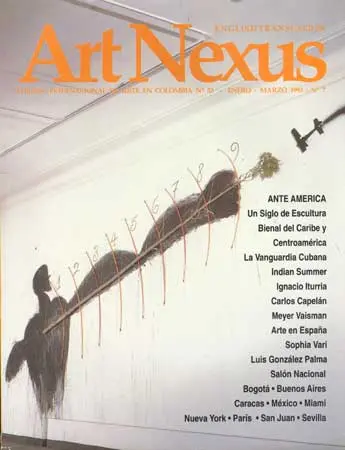
Issue Number: 7
Arte in Colombia: #53
Period: January – March 1993
You have 3 free articles remaining this month. Sign up for unlimited access.
Content

Individual exhibitions
Group exhibitions