
Usually associated with self-sacrifice and patience in the face of adversity, the card of the Hanged Man in the Tarot depicts a male figure hanging upside-down from a tree by one foot while his free leg is bent at the knee to form the number four. It is with this in mind that we enter the retrospective exhibition titled “The Hanged,” by Colombian-French street artist Alberto Vejarano, aka Chanoir—acronym derived from French that links the words chat (cat) with noir (black)—at the Museo de Arte Contemporáneo in Bogota (MAC). The work that gives the exhibition its name consists of a giant figure of the Sesame Street character Count von Count posing in the same manner as shown in the Tarot card: the character is presented hanging from the central dome of the museum looking over the rotunda. The combination of existential intensity, playful irony, and a touch of good humor capture in this first work the essence of the exhibition. Alberto Vejarano Chanoir takes over much of the museum to deploy an ample selection of works that go beyond his street artworks: sculptures, photographs, paintings on canvas, video, and performance complement the invasion on the walls that the artist presented at the MAC’s space.
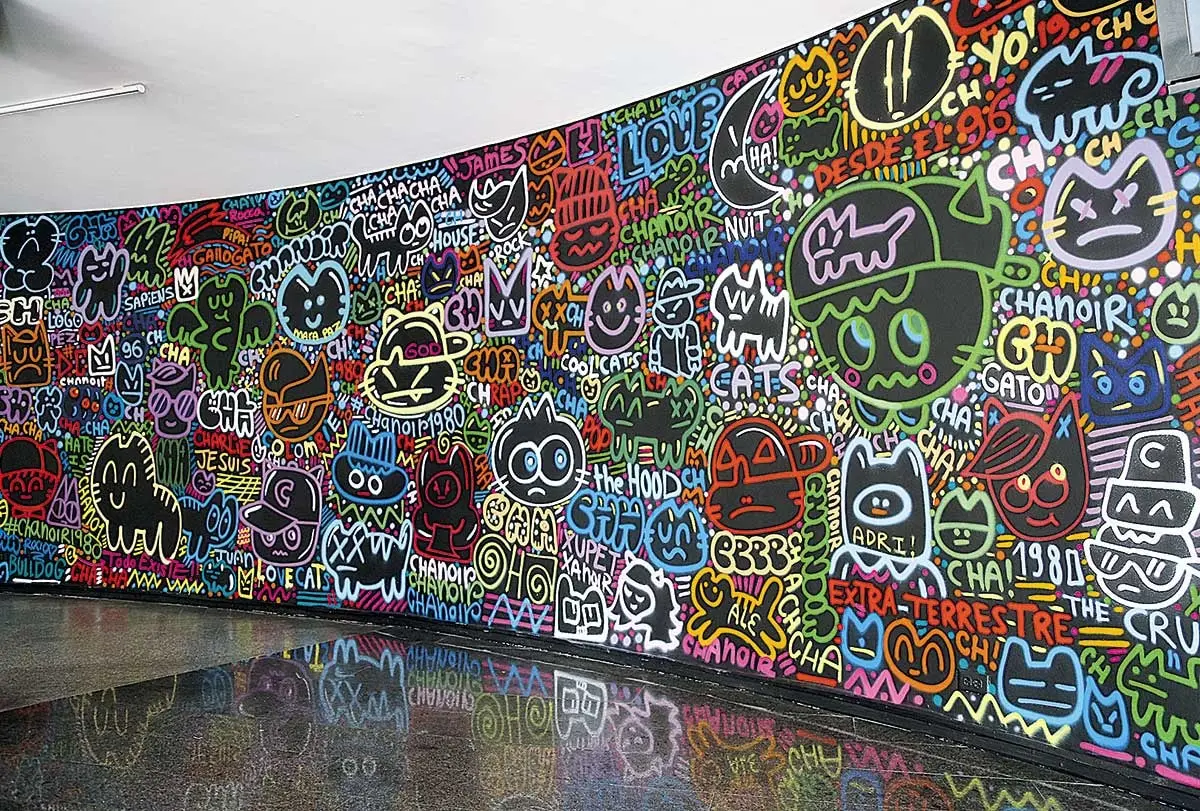
According to Juan David Quintero, curator of the museum, the curatorship “explores and invites reflection on the forms of appropriation present in his work in different artistic venues, with the goal of becoming part of a process that incorporates graffiti in institutional, communal, and local spaces in the city of Bogota.” After a long international career, Chanoir arrives at the town of Engativá where graffiti and urban art are present on the walls of almost every street, becoming part of the town’s street culture. In this sense, the MAC has remained true to its commitment to give a voice to the different communities living in this locality to which the Minuto de Dios neighborhood is part. As the director of the museum, Gustavo Ortiz, explains in the show’s catalog, “The Hanged” is the second exhibition that the museum has dedicated to graffiti and urban art in order to broaden the concept of public art.
Graffiti and street art are bound to suffer the tension between the freedom of the street and the constrictive nature of institutions once they jump from one to the other occurs. Chanoir was allowed to use an important part of the museum for a mural in order to approach the institutional setting as if it were the street. The artist also presents a series of installations—including some involving sculptures of characters from Sesame Street—a series of dolls from popular culture that is tied and hung from the ceiling, as well as a group of photographs, paintings on canvas, and a video that reflect the work that he creates in the studio. The large mural—clearly influenced by the naïve and colorful style of Keith Haring—that covers the entire curved wall on the first floor, represents a horror vacui-styled compendium of the figures with which the artist has bombarded the streets of cities like São Paulo, Mexico City, and Barcelona. In this mural—which we are compelled to observe for hours—Chanoir brings urban art closer to graffiti by using both the image of a cat and the words that populate the wall with the various types of letters that are characteristic of graffiti as his signature. The mural shouts words—like Cha, Cha, Cha, Cat, Chanoir, and Love—and names with which the artist gives voice to the colors on a black background that fill the wall. The same fear of emptiness and accumulation of characters appears in the photographic work titled Peluches o Muñecos de Acción Muscular (Stuffed Toys or Muscular Action Figures), which Chanoir renders like a mural.
Chanoir, who studied at the École des Beaux-Arts in Paris, began his career painting Pop Art, but returned to urban art in the early 2000s when it began to take over the streets around the world. Although he stopped painting Pop, pop culture permeates his work as a double-edged sword. His work with stuffed animals, for example, offers plenty of subversive and morbid elements that bring to mind the work by French artist Annette Messager. On the other hand, he has created a figure screaming from the walls with color and energy that already belongs to our street visual culture worldwide. Chanoir re-contextualizes the heroes of popular culture and turns them into something strange, while his cat, a new hero, invades our streets and becomes familiar. The idea of the hero, a character committed to self-sacrifice and adversity, serves as the connecting thread of an exhibition that succeeds in incorporating street art and graffiti in a reflection about popular culture in a contemporary art context.
CARIDAD BOTELLA