
Plenty has been written about the ethical problem art encounters when the pain of others is turned into an aesthetic experience. The issue becomes even more acute when photojournalism enters the museum or the gallery in large formats and with exquisite quality, representing in a “transparent” manner—as its so-called indicial ontology would have it—unbelievable scenes of human suffering. Susan Sontag wrote famously about this in 2003, a year before her death.
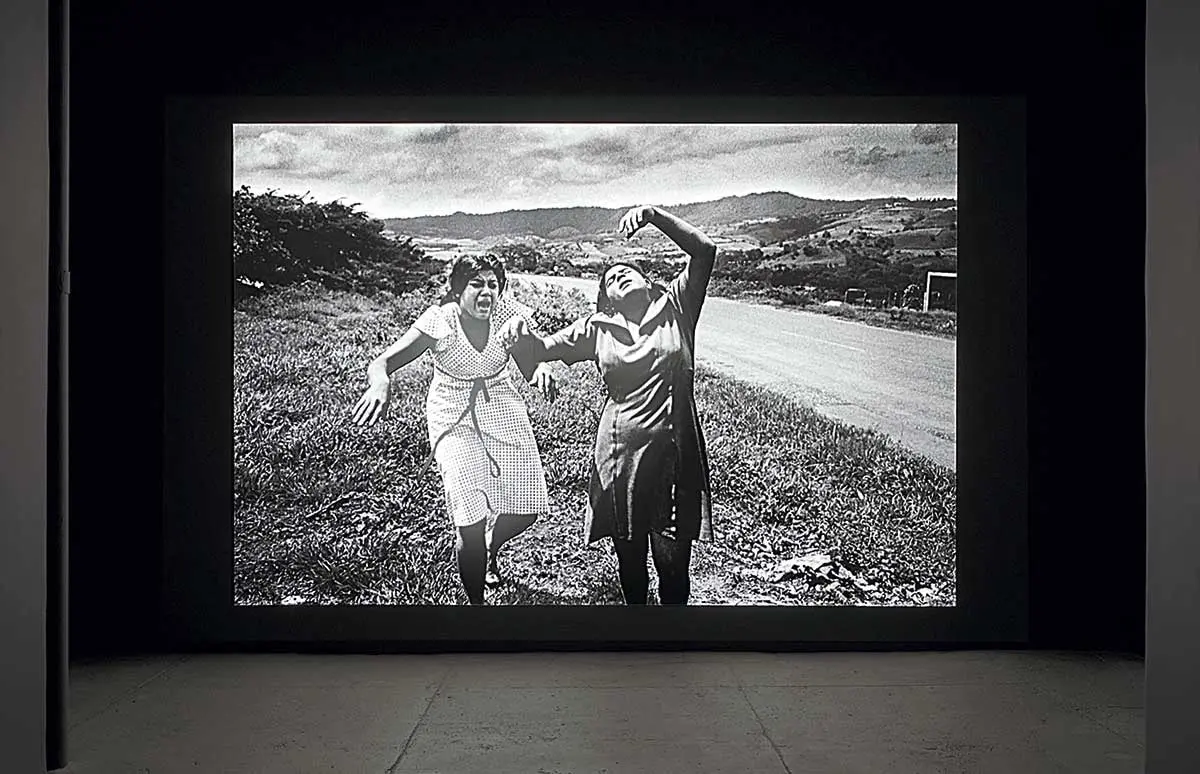
Shadows, an exhibition of works by Alfredo Jaar (Chile, 1956) at Galerie Lelong, revolves around the photograph of two women who cry in terrible pain after the death of their father, assassinated by the armed forces during the Sandinista revolution in Nicaragua. Shot in 1978 by Dutch photojournalist Koen Wessing, the image is acknowledged as a significant piece in the history of the genre during the Twentieth Century. Yet, rather than the capture of “the moment of death of the instant just before, forever embalming it as only masks and photographers can”—the controversial case of the Spanish militiaman who dies at the very moment when Robert Capa “shoots” him with his camera is emblematic—this image presents the instant immediately after the death of a person; a moment that, like photography itself, remains eternally irreparable in time.1 But, is what is known as the ontology of the photographic medium—beyond its current validity, after the arrival of the digital—perfectly irreparable when it incorporates images produced during the analog era? Faced with this question, Jaar offers a clear answer: no. The collective memory of the Nicaraguan people comes into play through a series of decisions that derive from minimalism and from Brechtian drama and involve the viewer in the image’s time, space, and narrative, but above all its light, its blindness, giving new meaning to Wessing’s photographs almost 40 years later, and at the same time paying tribute to the photographer.
The second work in a trilogy about the politics of images, begun in 2006 with El sonido del silencio—for which Jaar appropriated Kevin Carter’s controversial photographs of a hungry little Sudanese girl stalked by a vulture—Shadows, besides incorporating an iconic photojournalistic image, alludes to a dual geopolitics: Nicaragua’s, but also Chile’s in the convulsions of the 1970s. Wessing’s photographs in Chile during the 1973 Pinochet coup and the early days of the State of Siege are known the world over, apprehended both through sensationalistic reports and studies of memory and human rights. An important, eloquent item in the history of the medium is a book by Wessing, titled Chile, Septiembre 1973, which provides a visual chronicle of wounded ghost-people behind bars in the National Stadium and in pained, traumatized streets across the country. Chile, Septiembre 1973 could convincingly be revisited by visitors to Galerie Lelong not only as a historical document, but also as the narrative source for the structure of the Shadows exhibition. Thus, in the absence of text and of the strategies inherited from conceptual art—which Jaar’s oeuvre knows very well—the exhibition emulated the photo-book, a rather significant format in 1970s Latin America.
The narrative goes as follows: after watching a documentary where the photographer talks about his work, viewers walked along a dark, narrow passage to find at the end a small light box containing a photograph by Wessing about the peasant experience of the Sandinista revolution. Guided by the lighting and the architecture, visitors reached a second room, which added more photographs of the same series, always revealing their negative: the photographic cut at the moment of the shot. Once in the main room, viewers found the image of those women mourning their father; soon, this became a drawing of their outline. Having erased the names, the faces of the daughters and their immense pain, the screen turned towards an uncomfortable, intense whiteness that confronted with violence the viewer’s gaze. Dazzling us—a strategy already known in Jaar works such as El lamento de las imágenes (2002) and La geometría de la conciencia (2008)—the artist emphasizes, over individual experience, the collective way in which people subjugated and tortured by totalitarian regimes in Latin America negotiate the contingencies of their history.
All considered, it is inexact to say that “Atrocities of this magnitude are happening today, but they’re just as often captured by civilians with cellphones instead of auteurs of photojournalism,” as Martha Schwendener wrote in her review of Shadows for The New York Times.2 On the contrary, if Shadows refers to the death of photography, it does so not only with regards to the explosion of the digital and its many instances of diffusion and capture, but also its permanent confrontation with life, since its inception in 1839, which, in certain instances of photojournalism, is a viable means for the work of memory in the visual arts, as in the case of Alfredo Jaar.
NOTES
1. Sontag, Susan. Regarding the Pain of Others.
2. Martha Schwendener: “Art in Review. Alfredo Jaar: ‘Shadows’”. http://www.nytimes.com/2015/03/20/arts/design/alfredo-jaar-shadows.html?_r=2. Accessed in May, 2015.
FLORENCIA SAN MARTÍN