
An event that received little attention but that in the long run will have greater resonance, the exhibition titled “Ex+istence” by Allan Jeffs at the Espacio del 281 de la Calle San José in Old San Juan, Puerto Rico, remained open until January of 2015. The show included some works that Jeffs, an Ecuador-based Chilean artist who studied at the Escuela de Artes Plásticas in Puerto Rico, created during several expeditions he made to Antarctica.
A lover of the polar landscape, Jeff joined a 2013 scientific mission organized by the Instituto Antártico Ecuatoriano bound for Antarctica with the goal of studying extremophiles and other microorganisms from the Ecuadorian station Pedro Vicente Maldonado. There, in the icy and spectacular natural environment of Antarctica, Jeffs mounted an installation that he titled Ex+sistencia (Ex+istence). The work consisted of twelve large pieces shaped like kneeling or seated human figures that look like penitents. Empty shells made with fiberglass, these figures were produced by the Cruz family—headed by José Cruz—from the southern area of the city of Guayaquil, Ecuador, a family dedicated to making años viejos (old years), the Ecuadorian version of the Spanish Falles. The cloaks or headdresses that cover the figures were hand woven from toquilla straw by coastal communities.
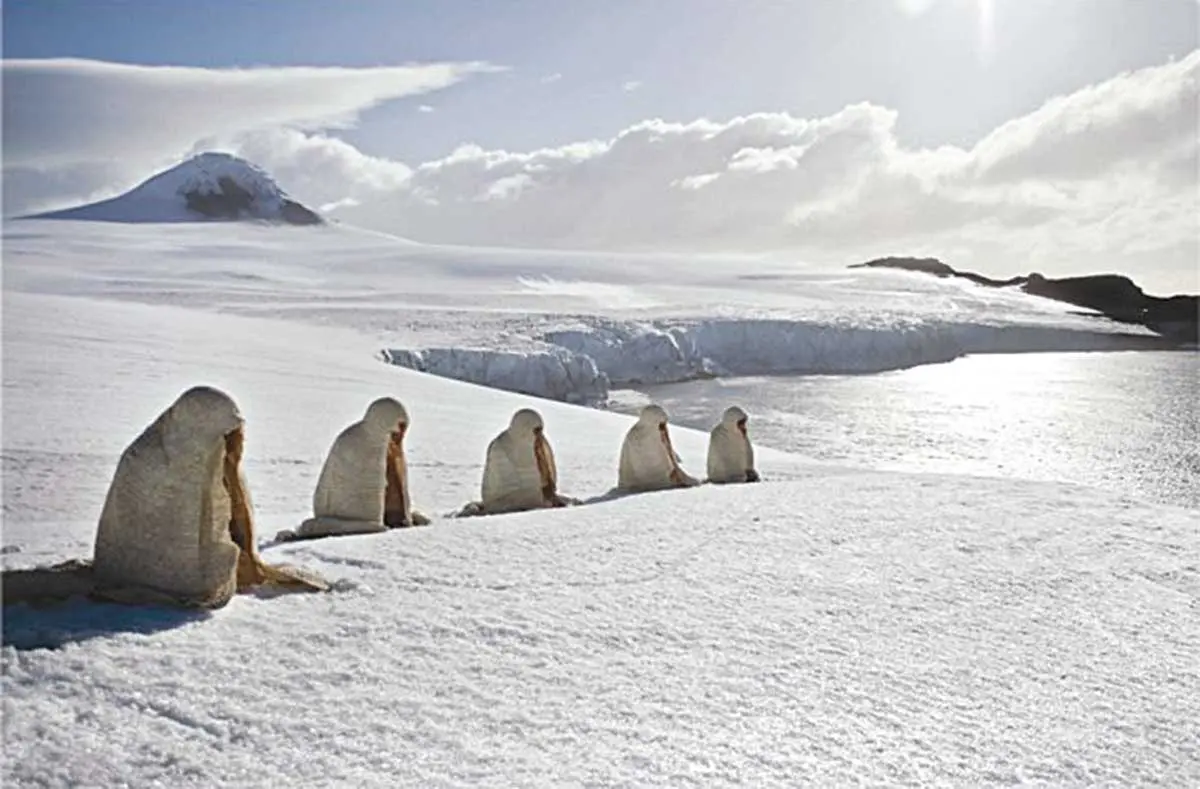
Overcoming strong wind, low temperatures and continually feeling the dangers of the unpredictable environment, Jeffs placed the sculptures with great effort in eight points across an area that includes Fort William Point, Traub Glacier, Quito Glacier and Barrientos Island, among others. In the process of installing the penitents, Jeffs appears in some pictures tied to a big rock to avoid falling into the depths of rivers and glaciers. The photographs of the penitents surrounded by the southern ice are impressive because they highlight human isolation in these inhospitable places. They emphasize the feeling of smallness and helplessness that human beings can experience when confronted with an overwhelming and sublime natural environment.
Some of the sculptures of the penitents were part of the exhibition in San Juan, along with about 20 drawings and watercolors made in situ that showed the places traveled by Jeffs. Due to the strong wind and the speed with which he had to work, Jeffs kept the drawings folded in the pocket of his coat or in his backpack. These same drawings are part of the exhibition and still show the folding lines—like those in maps or cartographies of places already visited. They are reminiscent of drawings by Alexander von Humboldt, Salvador Rizo or Francisco Javier Matís, who accompanied José Celestino Mutis in his expeditions across the South American continent.
In the San Juan exhibition, Jeffs also showed a documentary on the drawings he made with culture medium in Petri dishes at the Ecuadorian station Pedro Vicente Maldonado. During the long hours that he spent in that research station, he learned from Ecuadorian scientists some of the laboratory techniques used to study micro specimens.
The work by Allan Jeffs is a combination between art and science that, as result of a journey of exploration to one of the most extraordinary natural scenarios in the world, refer us to the meaning of life, to the dangers that man can face and his confrontation with death. Jeffs’ penitents seem to suggest that even in this age of technology, kneeling before the white vastness of the polar territory is a reminder that the sacred and the human can still merge into a timeless whole.
INGRID MARÍA JIMÉNEZ MARTÍNEZ