
How can the repercussions of violence on human beings be represented? Can horror be made visible? Colombian artist Doris Salcedo (1958) has successfully engaged these issues for over 30 years.
Does loss have a language? read the monumental billboards posted around Chicago. The answer to this question is found in Salcedo’s first large retrospective at the Museum of Contemporary Art, Chicago*: Yes, the loss of human life because of political violence can be properly represented in art. The artist, wearing a slightly vibrant afro that fluctuates between seductive and picturesque blues, grays, and blacks, expresses her ideas with a thin voice during the opening ceremony, and concludes: I want to make people cry.
The exhibition, curated by Madeleine Grynsztejn and Julie Rodrigues Widholm, features more than 100 works, dated between 1986 and 2014, and presents audiences with the opportunity to create their own image of Salcedo’s struggle, over many decades, against the omnipresent indolence and oblivion and to give remembrance the required artistic space. Doris Salcedo gives voice to the many “disappeared” of the world. In her native Colombia alone, a still-ongoing civil war has raged for more than six decades.
Doris Salcedo transforms simple everyday objects in her art, and this contributes decisively to an understanding of her work. Bed frames, tables, and chairs, doors and armoires, shoes and shirts, objects used everywhere. Salcedo used the artistic transformation of such objects to speak about the irrevocable absence of their former owners. All of her series are represented in the exhibition, from her early Sin título, La casa viuda, of the 1990s, Unland, the Atrabiliarios, and Thou-less, to Plegaria muda, Disremembered and A flor de piel. A video focused on Salcedo’s large site-specific works, such as those for Tate London, Istanbul, and Castello di Rivoli, near Turin, was expressly made for the exhibition.
Already in her early works of the 1980s, we can clearly recognize some of Salcedo’s key stylistic resources. Bed Frames leaning on walls, delicately wrapped on translucent animal skin; a child’s hospital bed hermetically sealed by fine wire, resembling something like a coffin. All of these subtle interventions carry Salcedo’s personal signature. The artist avoids, from the start, any romantic or kitsch pitfalls, thanks to the sustained coldness and outwardly minimalistic elements of her works, which leave on their viewers a somewhat unspecific, elegiac impression of past violence. The violence that remains invisible but becomes perceptible. All the way through the present time, when the artist follows a strategy of working the surface of her objects, regardless of size, in-depth, minutely, and to the most exact nuance. Her delicate, even microscopic interventions regularly become, for all who share in their production, a veritable test where the result, in the end, justifies the means.
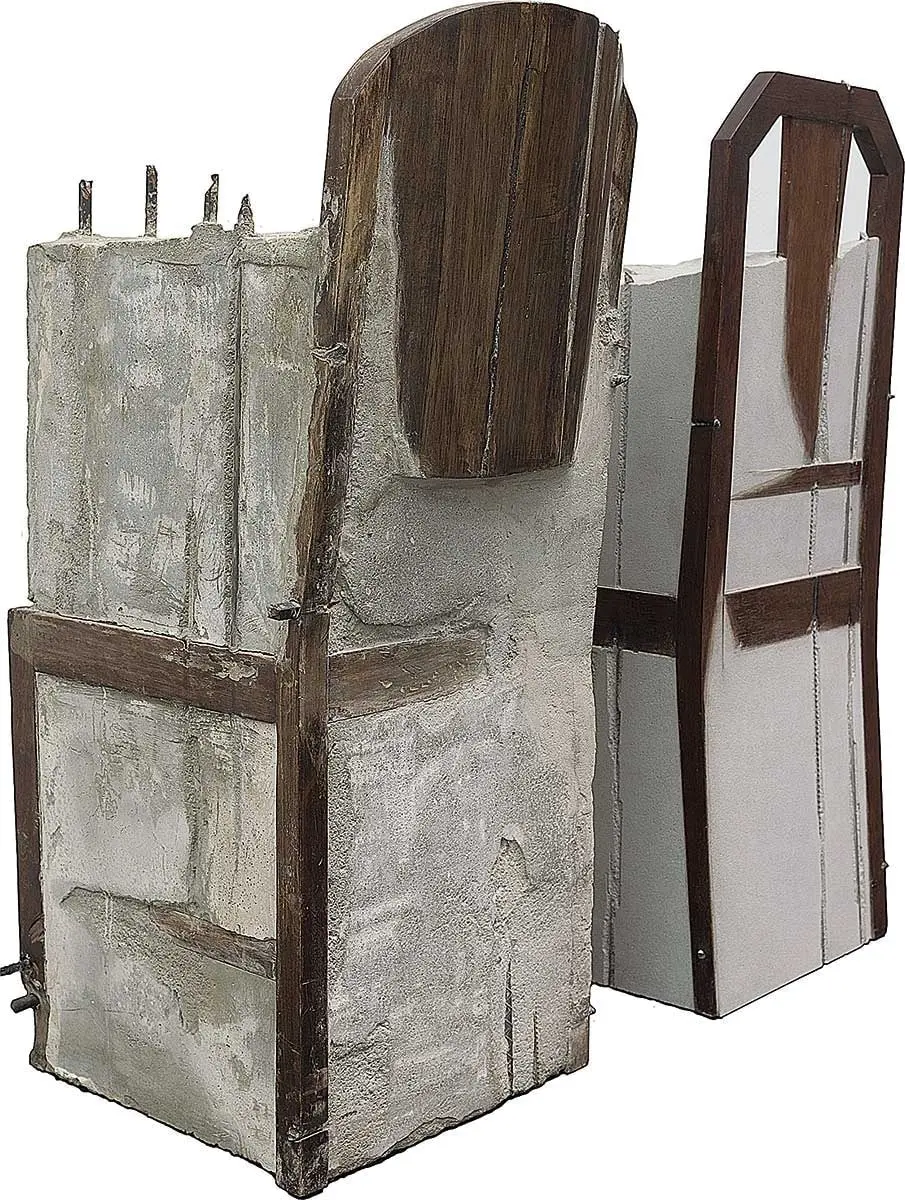
The series Sin título began around the 1990s. Doris Salcedo pours concrete on chairs, tables, and armoires. Any possible use of these items of furniture is made radically impossible. Any possibility of returning them to their former function is precluded. The presence of the people who once owned them is suffused in the cold, solid concrete, which like hardened lava interrupts life by spreading inside and over everything. The heartbreaking character of this series is amplified also by the presentation of sets of concrete-covered furniture that clarify the impossibility of any kind of communication. Once full of life, this furniture is now presented as fitting brutally together, abandoned and obsolete, transformed into silent monuments, and witness of a human existence that is already in the past.
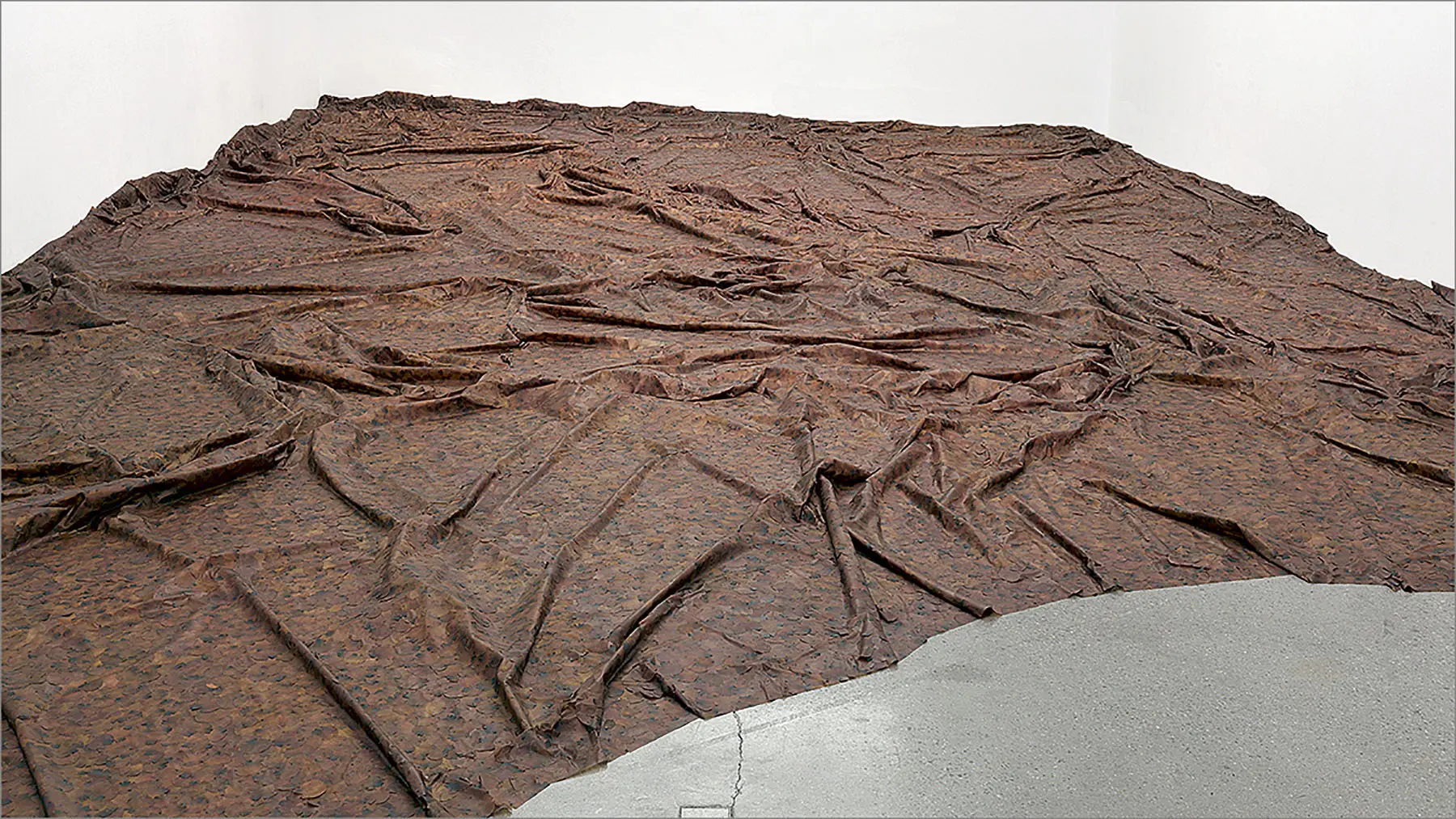
Between 1995 and 1998 came Unland, one of Doris Salcedo most astonishing works, two old wooden tables, different in size, sawed transversally and fitted one into the other so that together they form an extra-long table. At the point where their surfaces touch, they are joined by thousands of very thin threads (made with human hair and virgin silk) that supposedly attempt to support their precarious balance. A symbol of the definitive interruption of any kind of communitarian family unity. This is a work of great poeticism, of tragic and poignant beauty. A flor de piel emerged in 2014, a thin, transparent piece of cloth, measuring approximately 10 X 6,5 meters, filled with several thousand rose leaves sewn together with microscopic stitches. The surface of the fragile leaves is chemically treated so that they retain their natural structure and color. Forty people worked for two years in the realization of this work. It, as none other, translates the tremendous fragility and pure unprotected state of the human body. At the same time, it is one of Salcedo’s most sensorial works. This apparently wet cloth (shroud) gives off an air of magnificent opulence: on the one hand, the complete earthly beauty of blood and life as they beat directly under the skin (A flor de piel), represented by the enchanting colors and veins of the rose leaves; on the other, the shroud that forever covers all the unburied dead.
Like very few artists, Doris Salcedo possesses the ability to express horror with efficiency, without sentimentalism or kitsch. Her argument is to give human absence a new presence, denouncing in profound mourning but without falling into pathos, rendering silence eloquent. She speaks of a Song of Impotence in reference to her entire oeuvre, in an act of great modesty.
* Doris Salcedo. Museum of Contemporary Art, Chicago, through May 24th, 2015. Solomon R. Guggenheim Museum, New York, June 26th through October 14th, 2015. Pérez Art Museum Miami, Spring 2016. 240-page catalog, University of Chicago Press.
HANS-MICHAEL HERZOG
Artistic Director, Daros Latinamerica Collection.