
Carlos Estévez is a collector. Through the years his work in all media has revealed a fascination for “things” that range from insects to toys to mechanical parts to objects of such a wide variety, they are difficult to describe. He collects spools and timepieces and toy soldiers and chess pieces and surgical instruments and thread, and books. He is the consummate researcher giving meaning to all the little pieces we take for granted in an erudite manner that is never pretentious, but just as fascinating to the viewer as it must be to him. He can open our eyes to the most basic of parts that work together to become something as complex as a watch, or a doll, or a diorama replicating nature. He sees inside of us, of humanity, just as he sees inside the mechanism of a timepiece, and it is all related when you think about it – we are all timepieces of amazing complexity. Time is the essence of life. The passage of time marks the passage of life and the universe.
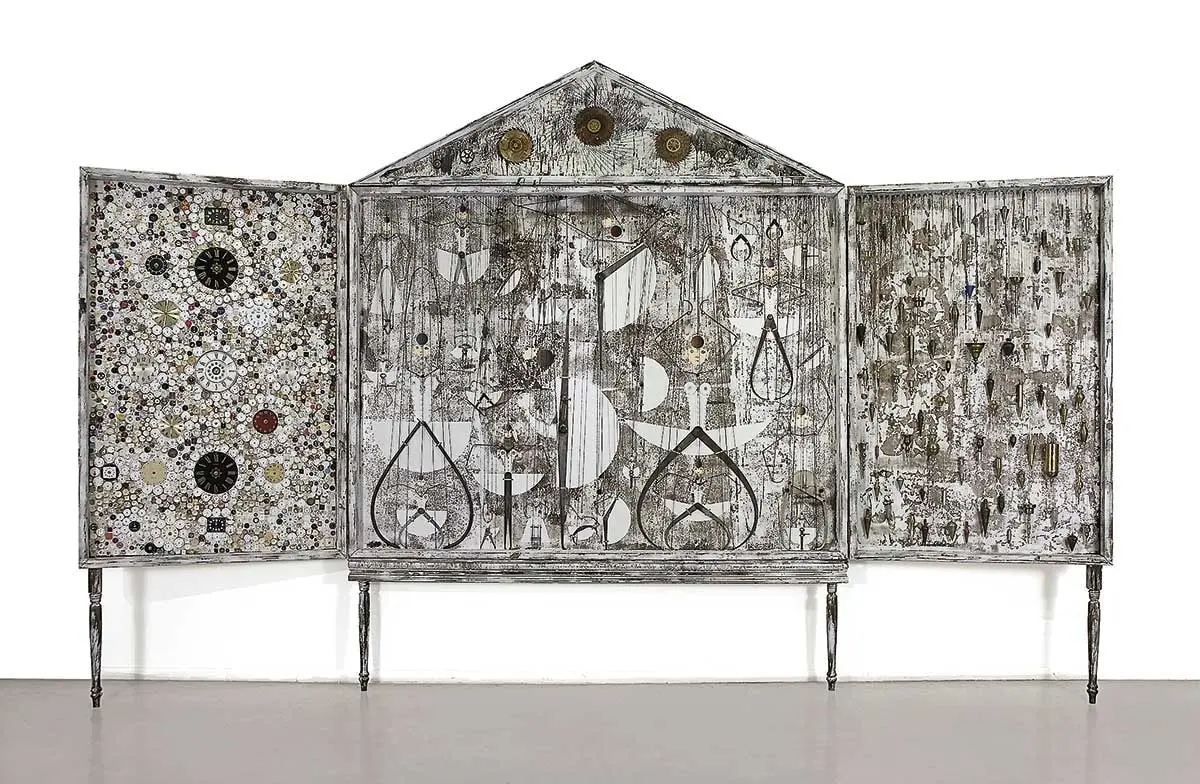
For this exhibition, he has created a collection of 12 assemblages in boxes and wall pieces inspired by reliquaries of the medieval world. He describes these reliquaries as “works which contain the remains of the artist, spiritual rather than physical remains.” Reliquaries were also objects for collecting – collecting the remains of saints and martyrs in small ornamented boxes or caskets; shrines used as sacred repositories. The designs on the outside related to the nature of the relic contained within and also served to enhance the significance of memory it housed. Relics were a way of honoring time and the past. Carlos Estévez uses his collection of objects, and their frameworks, as “containers of symbols, memories, dreams and thoughts.”
The focus of the installation is Sempiternal Ballet Rehearsal, a large assemblage of found objects, drawing and pigment on wood, encased in a wooden “house” that resembles, not coincidentally, a triptych (3-part altarpiece). “Sempiternal” means something of never-ending duration. His beginning was a large compass caliper that he found and envisioned as the legs of a ballerina. In this work, the corps de ballet is suspended in time at the moment of rehearsal. The dancers occupy the central space and are made of calipers of different sizes and the extremely intricate drawing that has become associated with Estévez’ work. The side doors contain elegant collections of timepieces and their inner mechanisms, as well as a careful arrangement of plumb lines, suspended like Foucault’s Pendulum. As they dance in perfect harmony in their magical space, the dancers recreate the rhythms of life: time, movement, space.
There are other smaller works that celebrate a Tiny Time Ballet in an assemblage of small instruments, tiny watch pieces and even the mini-hands of the clock. The Optometry of the Invisible uses eye pieces and testing lenses from optometry shops with a mannequin head in the center displaying a single eye on the forehead. It is provocative and layered with symbolism and metaphors of life. Timepiece is another assemblage of found objects that includes extraordinary collections of carefully arranged surgical clips and lines of little specimen bottles holding another array of objects. The man drawn in the center is the measure of all things, of time and memory as interchangeable.
With each assemblage, the memories contained as relics of the past foretell the future as it hangs in the balance of the universe, beyond the reach of man who is nothing but another cog in the wheel of time, but will be remembered by the objects he creates, possesses and passes to the next generation. The reliquaries created by Carlos Estévez are profound commentaries on the human condition.
CAROL DAMIAN