
It is the first time that Carmen Perrin (La Paz, 1953)—who arrived in Switzerland in 1960 at the age of six—has the opportunity to express her happiness about finally seeing the name “Amérique latine” associated with one of her exhibitions. Indeed, Perrin’s Bolivian origin has really never been mentioned in her work before, nor has it ever raised (abroad) the echo of a memory whose palpable and growing reality she now begins to feel inside. Her artistic activity rests on a series of contradictory concepts whose dialectic, reflected in the title of the exhibition “Enter Outside, Exit Inside,” combines form, aesthetic and meaning. This exhibition deals with outdoor spaces used for public art, ephemeral interventions or interventions associated with works of architecture; as well as indoor spaces for constructions, drawings, paintings and collages. She uses natural materials like brick, wood and sand, among others, but also relies on materials associated with technology, such as rubber, tar, concrete, etc., and everyday objects like elastic, hooks, candles, springs and magazines. She is interested in biology, physics and its molecules (CERN project), the teachings of the past, the meta-language of movement developed by the Austro-Hungarian choreographer Rudolf Laban, and the work on color as connective element between interior and exterior proposed by German architect Bruno Taut, to mention only a few references.
Carmen Perrin’s world is therefore an inquiry into time and matter, determined by curiosity, nerve, patience and experimentation. As she herself affirms, if somehow critically, in the following statement: “to make visible the invisibility of the visible.” An essentially manual labor, her work resembles that of a craftsman (in the noble sense) who cannot be denied of the playful and pleasurable dimensions raised by controlled randomness. In proliferation, which like perforation is one of the conceptual and formal roots of her art, there is something telluric that her high mountain origins cannot negate (her childhood in Isla del Sol, an island in the southern part of Lake Titicaca). The almost musical rhythm of her assemblages, the contrasts between empty and full, the velvety texture of her springs—tightened and stretched by hand—create an interesting visual and intellectual play and open an indefinable space to a “landscape” that makes sense beyond the inside and the outside.
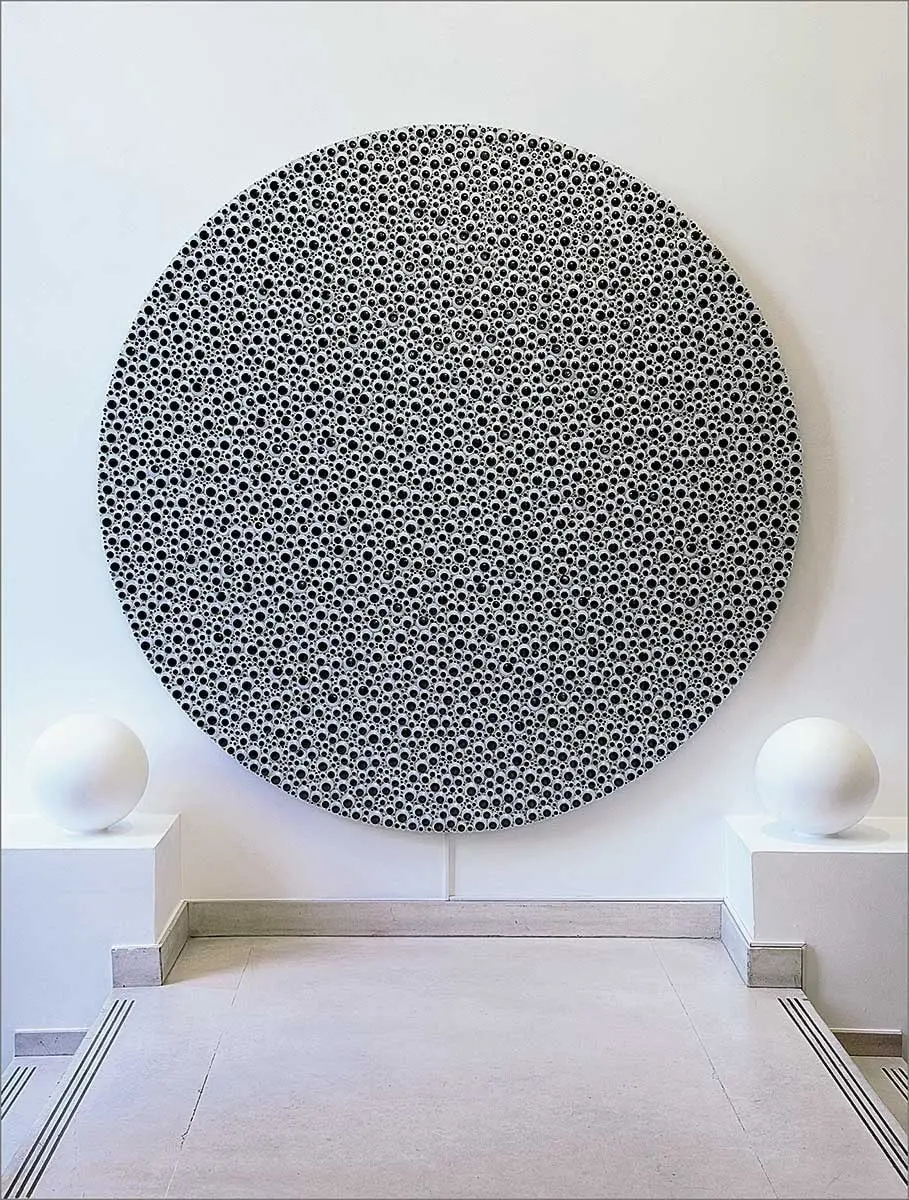
The two exhibitions in Paris brilliantly illustrate these characteristics and reflect the thoughtful work of an original personality that is meaningful beyond any evoked influences or sincerely claimed inheritances. The show at the Maison de l’Amérique Latine is Perrin’s first major solo exhibition organized in France (the Galerie Catherine Putman had presented her drawings in 2010). Twenty-six works created with different supports, techniques and materials, as well as four installations, are exhibited in an uncluttered museology—by curator Lorette Coen—with enough space to allow for pauses and an intelligible temporary observation. The visual coherence of the first three works, visible from the entrance, encourage visitors to question both the choice of the objects used and their transformations: the virtual vibrations in Ensemble Flou (Fussy Assemblage, 2013), a branch with birds perched on it, completely painted with thin black and white stripes, rests on an equally striped stand; and the effects of real movement in Précipitations (precipitations, 2015), a spinning tondo covered with a myriad of plush eyes that move during the rotation producing a dry, short sound.
This recycling and recovery of everyday objects continues with something as mundane as rubber bands. Perrin’s compelling artistic vision transforms them in works on display in the first exhibition room on the lower ground level: the ephemeral installation Rubberbands (1993-2003), covers the entire height of the exhibition room’s 5 meters by 4.5 meters walls. A rhythmic, “woven,” and “musical” environment where the simplicity of the material contrasts the effort invested in the assemblage (8 days). We found the effect of mirrors of ideas and forms in the work Portes Bruno Taut (Bruno Taut Doors, 2012) inspired by the colored doors designed by Bruno Taut for several garden-cities in Berlin during the early 1930s. In creating the series of three tondi titled Tracé Tourné (Rotating Drawing, 2013), Perrin involves her own body, given that, as she draws, her arm follows the circular movement imposed to the paper support by a motor.
Carmen Perrin invites us to a supreme moment of active meditation in which sense and form are inseparable once again: the installation titled Abîme (Abyss, 2013) displayed in a completely dark exhibition room, presents a text written with flickering lighted letters at the bottom of the wall: Au Bord de Moi-MêMe Je M’arrêTe I Je Me Penche (On the Verge of Myself I Stop, I Peer), which echoes the phrase, “I doubt, I hesitate, I fall, but I do not break,” taken from Faust, a Subjective Tragedy by Portuguese writer Fernando Pessoa.
Other works that stand out include the large installation entitled Trophiques (2013) in which rubber bands joined by hooks and dipped in talc infuse sweetness into the violence; there is also the contrast between the “living” material (rubber) organically emerging from a valve-vulva, and the tension-tearing caused by the hook, which evokes a complicity with U.S. artist Eva Hesse whom Perrin admires. Kineticism is present in the piece titled Boom (2014), which consists of beehive-shaped industrial material—often used by architects to allow natural light in—with several colors of paint injected in the cells, creating a sort of pointillist chromatic effect where the work changes with the moving gaze. Another installation from 2015 attests to her obsession with perforations: ¡Chicas! (Girls!) is a group associated with Perrin’s personal story since the furniture shown—now painted in black and white and completely perforated—was part of Perrin’s family’s move from Bolivia to Switzerland in 1960.
The twenty-one works presented at the Galerie Catherine Putman complete this group of high quality works along with the ten “Black Series” (2015), where the artist plays with the titles—Ouvrage de Dame, Machine à Découdre, Les Voraces, Avec un Élastique... (Work of a Lady, Unpick Machine, The Voracious, With Elastic, etc.)—as well as with the relationship that these titles may have with her own painting career. The perforated and painted Masomenos (Moreorless, 2014), appears to be “suspended” like a lacy collar, in a poetic symptom of that game-attitude so appreciated by Carmen Perrin, in which it “frees the void” between disappearance and fragility as she concretizes an in-permanence relationship in-residence on the face of reality.
CHRISTINE FRÈROT