
The exhibition titled “Cristiano Mascaro and the Bom Retiro and Luz Series” at the Pinacoteca do Estado de São Paulo - Museu de São Paulo de Arte Contemporânea, under the curatorship of Pedro Nery, consists of forty-seven silver gelatin photographic prints developed from negatives taken by Mascaro during the 1970s. The photographic series portrays two neighborhoods in the city of São Paulo, Bom Retiro and Luz, which are presently undergoing a process of urban decay. However an enormous effort is underway by the mayor of the city, local institutions, artists and citizens to revitalize the area, which is home of the Pinacoteca.
These photographs were the first images to become part of the photographic collection of the Pinacoteca. They were donated by photographer Cristiano Mascaro in 1976. The bequest occurred on the same year, at the end of the first exhibition of the series commissioned by Aracy Amaral, then director of the Pinacoteca. The images are the result of research and production aimed at establishing connections with the surroundings. In this manner, the museum opened to the two adjacent neighborhoods. Although Cristiano Mascaro edited at the time only forty-one images for the first exhibition, the disturbing theme led the photographer to delve deeper into that exploration after the first exhibition; and, in 2003, the collection was enriched with seven more works created by Mascaro as part of that same series.
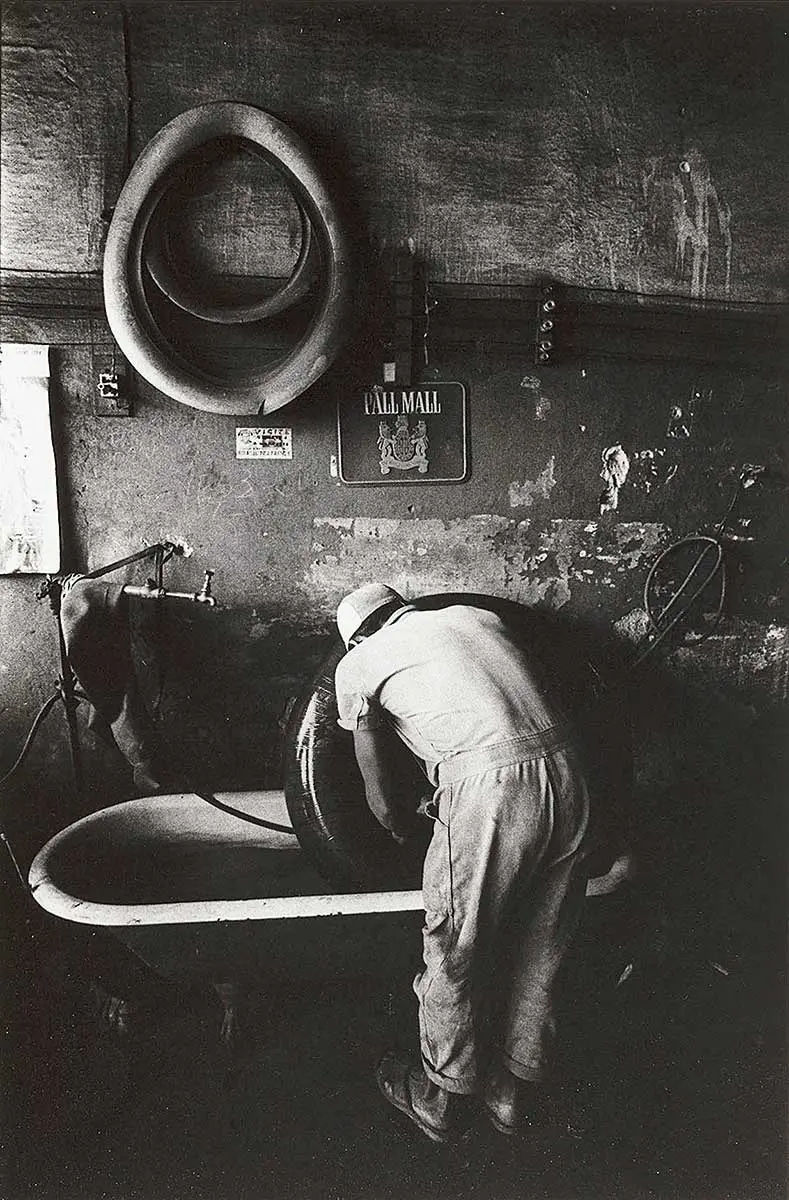
The collection in question does not solely allow a temporary visit to two of the oldest and most traditional neighborhoods in the city, which are symbolically connected through the Pinacoteca that serves as the border between the two, but also allows for an analysis of Mascaro’s aesthetics and urban vision, at a time when his—today prominent—career was just beginning.
They are high contrast photographic images that harmonize with the geometrical construct, in an aesthetic in which the historical diversity of the region is evidenced through the inclusion of urban characters contextualized by the space; the exaltation of ambiguities, the signs of affluence contributed by the archaeological memory, reveal the wealth of a city that resulted from the tradition of the coffee economy; and the crisis, the anthropological vision, in synthesis, of large encounters between multiple cultures and periods; work, leisure and the various brands of urban aesthetics. In sum, Cristiano Mascaro exercised his gaze by weaving the synthesis of an imaginary landscape that settles several temporal stages, always placing great interest on the human. His photographs are characterized by the inter-subjectivity which with the artist sought to understand the role and behavior of citizens.
Mascaro approaches his narratives in an anthropological manner. He contextualizes the individual as he echoes the collective. In this sense, and although intuitively, the photographer brings to mind variables in the way of approaching different aspects associated with citizenry, with places and enclosures in which the events that he chooses unfold. Through his camera, Mascaro draws gestures, everyday life and human actions. Such undertaking results in the staging of social perceptions structured in an imaginary manner and, thus, as mentally sensitive occurrences that prevail over factual nature, as poetic, aesthetic and creative gestures are contained in the work. Paul Klee said: “art does not reproduce the visible; rather, it makes visible.” It is in precisely in this area where the work of Cristiano Mascaro was consolidated. At the time of the development of the project, Mascaro had worked as a photojournalist, and it was precisely his dominion of photojournalism that led him to work with a lightweight 35mm camera. And so, this is the manner in which he discreetly immersed himself into a narrative universe that he wove with urban chronicles.
The powerful result achieved by Cristiano Mascaro in this series reflects the strength of his poetic narrative, of a photographic essay in which the diverse forms of being citizens are presented in a compelling manner. In the more than forty years since this work was created, the evoked space is much changed, something to be expected from a city like São Paulo. Nonetheless, the nature of Mascaro’s work helps to explain the dynamics of the city and its urban imaginary. Here it is important to note the thoughts of Colombian intellectual Armando Silva, author of the “urban imaginaries” concept. According to Silva, imaginaries are not just mere abstract representations for they “embody” and “incorporate” the objects of the city that are out in the public sphere and from which we can infer feelings, emotions. Those feelings can be archived through urban writings in which sensitive ways prevail over the urban object, so that these objects do not solely retain their utilitarian value, but also the imaginary valorization that confers another representative substance. The “Bom Retiro and Luz” series is an example of urban imaginaries.
Cristiano Mascaro (Catanduva, São Paulo, 1944) is a photographer, architect and professor. He graduated in architecture from the Architecture and Urban Planning Department of the Universidade de São Paulo (FAU/USP). He began his photographic career in 1968, when he was invited to be part of the first team of the magazine Veja, where he remained for four years. From 1972 to 1975, he taught Photojournalism at the Enfoco-Escola de Fotografia; directed the Laboratory of Audiovisual Resources of the FAU/USP between 1974 and 1988; taught visual communication at the Department of Architecture and Urban Planning of Santos, between 1976 and 1986. In the latter year he completed an MA and, in 1995, earned a PhD from at the Universidade de São Paulo.