
A forward-pointing artist and an international figure in conceptual Argentina for more than 40 years. His first forays took place in the Buenos Aires art scene of the 1960s. At the time, the Lirolay art, David Lamelas (1946) has lived a nomadic life outside Gallery, the Museo de Arte Moderno, and the Centro de Artes Visuales of the Di Tella Institute were the sites of artistic renewal, and it was there that Lamelas circulated and made his mark. His work was part of the then-fledgling field of conceptual art in Argentina, focused on the process of dematerialization of the work of art. It was a period when art found itself deprived of an object, and also of traditional genres (painting, drawing, sculpture), and the properly artistic had moved to the terrain of action or of concepts.
In 1968, the year when Lamelas participated in the Venice Biennale, he won a study fellowship by the British Council, which took him abroad for the rest of his life. He lived in London through 1974, the year he decided to resettle to Los Angeles. Between 1988 and 1997, he shifted between New York and Brussels, and starting in 1999 he has lived and worked between Los Angeles, Paris, and Buenos Aires.1
During 2014, Lamelas presented three exhibitions in top-layer international galleries, proof not only the importance of his work but also of his presence on the international agenda. At the Jan Mot gallery in Brussels, Le Frac Lorraine in France, and the Kunsthalle in Basel, he presented exhibitions titled, respectively, Selected Works, On the Moon (which included current works), and “V”, featuring works from his early periods, 1960-1970, a significant development when we take into account his current production. This speaks of a need to revisit Lamelas beginnings under the light of Twenty-First Century developments in the arts, a reading that confirms, again, the necessity of his inscription in the narrative of Argentinean and international conceptual art. In this context, we must keep in mind his 2011 and 2012 exhibitions at Ignacio Liprandi Arte Contemporáneo, in Buenos Aires.
Some of the works on display in the exhibitions mentioned were Límite de una proyección (1967), Señalamiento de tres objetos (1968), Study of the Relationships between Inner and Outer Space (1969), Time as activity. Dusseldorf (1969), Interview with Marguerite Duras (1970), Pared doblada (1994-2013), Buenos Aires n´existe pas (2010). In what follows, we shall review some of them in the context of Lamelas’ oeuvre as a whole.
In the early 1960s, a number of avant-garde artists were at work in Argentina: Alberto Grecio with his Vivi Dito, exhibited for the first time in Paris in 1962; Marta Minujín and Rubén Santantonín developed their famous Menesunda, in 1965 (David Lamelas participated as a guest artist), a created environment where viewers had to traverse seventeen spaces; Ricardo Carreira with his Muestrario y objeto señalado, from 1966, consisting of a rope dividing the gallery, a spool with the same length of rope, and its photocopy; and Oscar Bony with Sesenta metros cuadrados y su información, 1967, where a recording device described the gallery and a projector projected the image of wires on the floor. This landscape expressed the climate of dematerialization then occurring in a context familiar to Lamelas.
In the international context, new realism in France and later Pop Art in the United States were brought to the stage mass-media culture; minimalist Dan Flavin worked with neon tubes in the early 1960s; Donald Judd created his large-scale sculptures. In Germany, the Fluxus group (Maciunas, Beuys, Paik, Vostell, among others) made its first appearance in 1962, with interdisciplinary works (music, performance, installations, etc.). Joseph Kosuth’s 1969 manifesto, Art After Philosophy, and Lucy Lippard’s systematization of the period in Six Years: The Dematerialization of The Art Object from 1966 to 1972 were beginning to appear in print; art had changed radically. And Lamelas’ oeuvre begins to develop in that context, thus the presence in it of something from each of the art movements mentioned; thus the fact that one can find in it a critique of the mass media, work with light, film, and interdisciplinary elements.
After a timid start in painting, Lamelas explored different disciplines, such as sculpture, photography, film, performance, and site-specific installations. The tension between the material and immaterial aspects of the object; his themes centered on time and space as they translate into artistic form; the cinematographic device; and Lamelas critical view of the mass media have all been at the core of his reflections and artistic productions.
Gradually, Lamelas abandoned his minimalist sculptures and went after a kind of sculpture without matter, clearly opting for dematerialization. This choice implied a new way of appealing to aesthetic experience, now connected to a theoretical, reflective experience for the viewer.
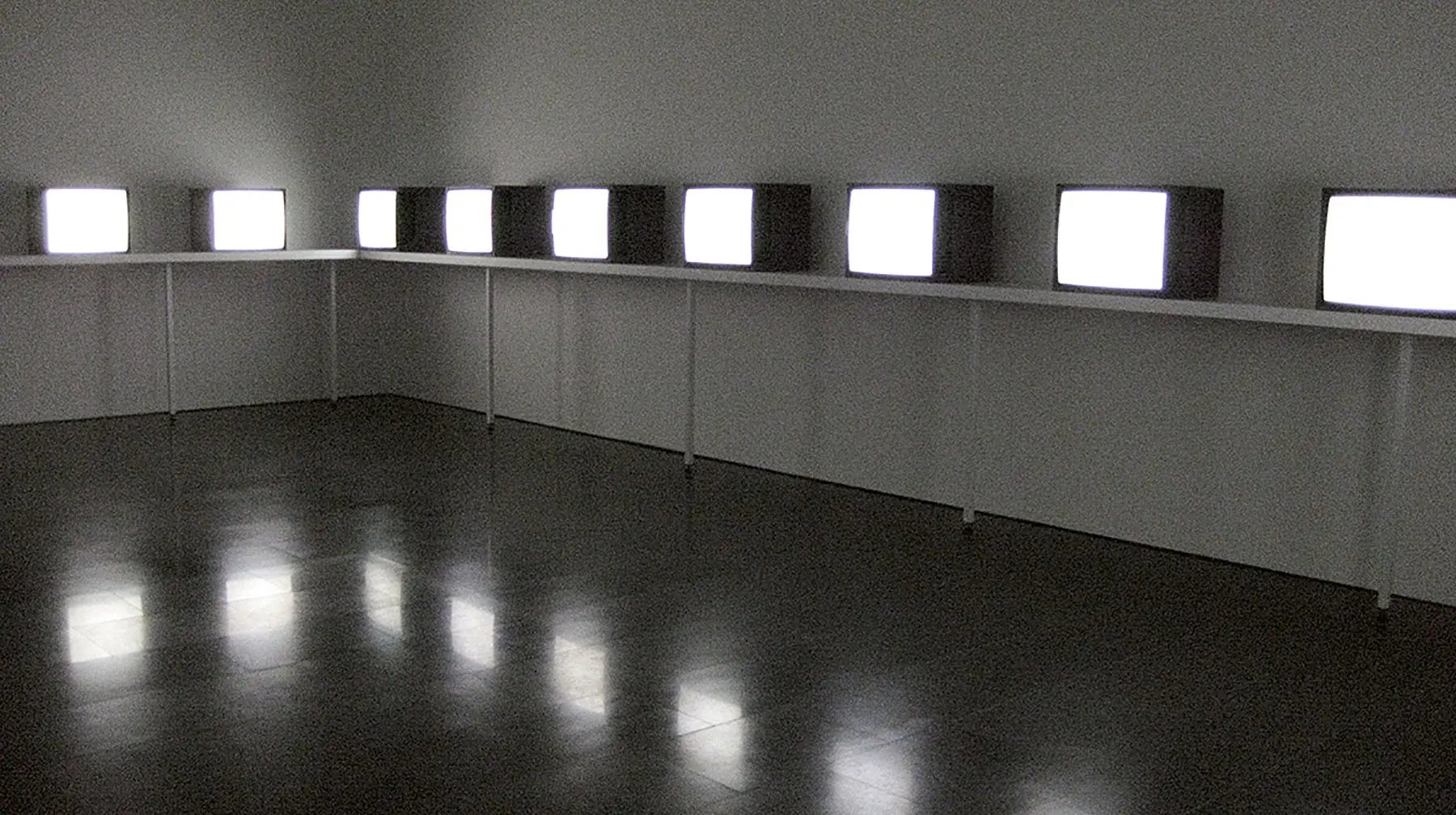
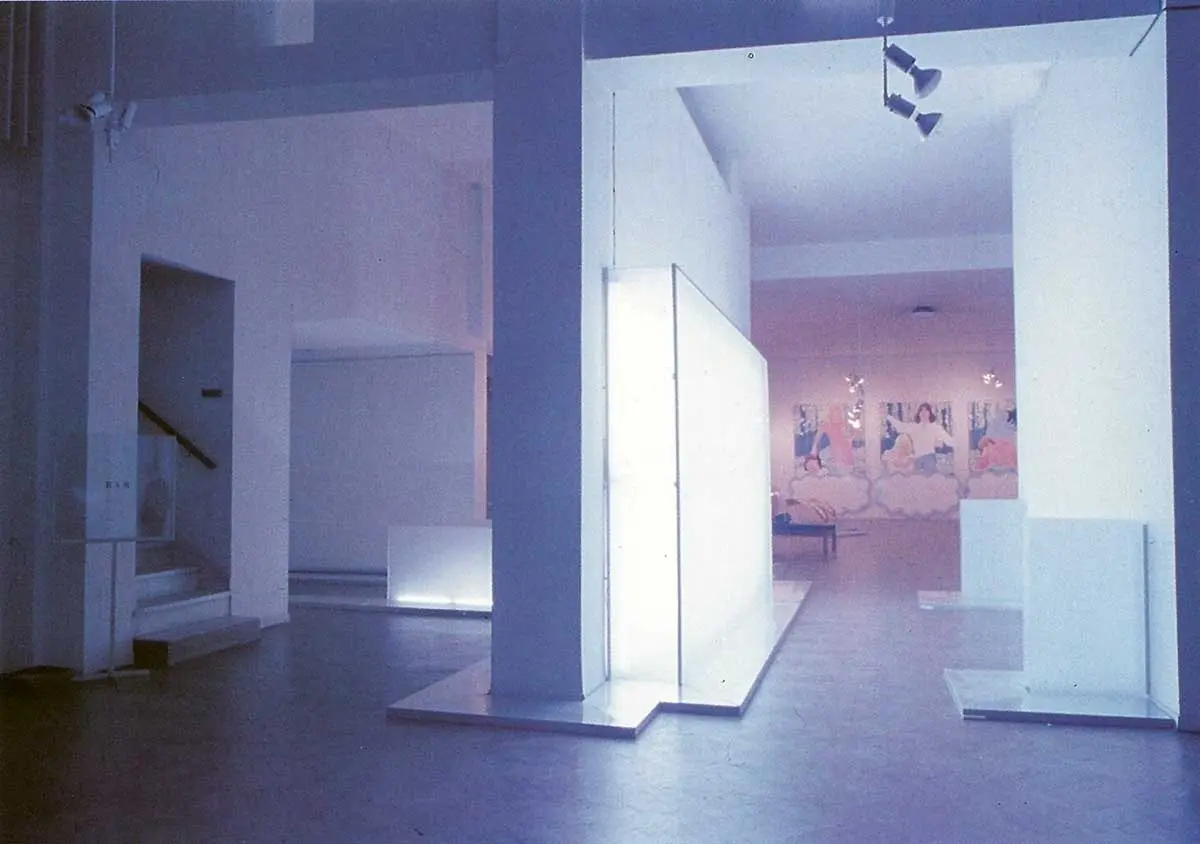
Those two moments in Lamelas’ career as a sculpture, so close in time and so different—sculpture with matter and without it—can be observed in the course of a single year. In 1966, Lamelas received the Special Prize of the Torcuato Di Tella Institute for a minimalist work, Conexión de tres espacios. It occupied three rooms at the Centro de Artes Visuales, each integrated to the whole by means of illuminated acrylic planes leaning on the walls. A year later, he was featured—along with Iommi, Polesello, Kemble, and Silva, among others—in Más allá de la geometría,2 presenting límite de una proyección. In this work, the projection of a circular beam on the floor constructed a light space, or, rather, a light sculpture, with the floor as its support. Here was Lamelas’ notion of sculpture, distanced from any traditional concept of the noble and lasting material (marble, bronze, etc.), since, on the basis of the element “light”—this is to say, an immaterial element—the work reached its highest point of dematerialization. Also in 1967, in Experiencias Visuales, he presented Situación de tiempo, a light environment comprised of 17 TV monitors tuned to an empty channel, so that their screens only showed the vibrating light of the cathode tube. In a short two-year period, Lamelas developed themes that were to accompany him throughout the rest of his career, such as light and time.
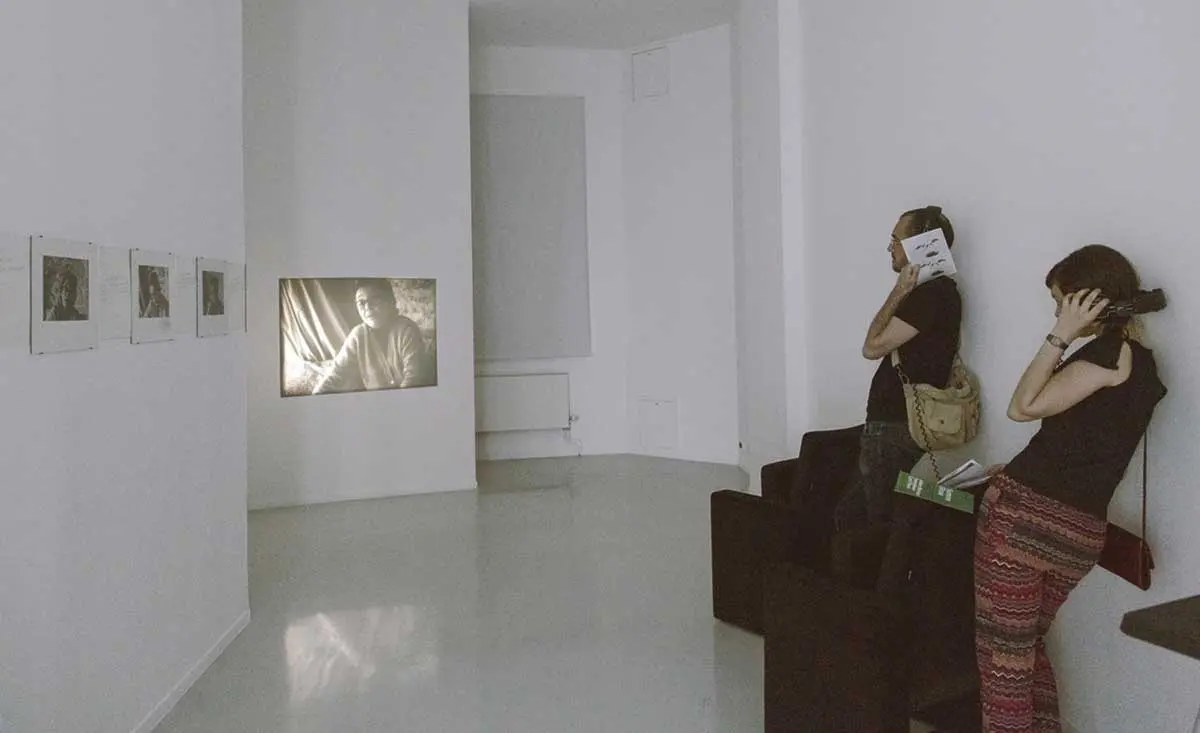
In parallel to the works mentioned, Lamelas began to work in film and brought this art into a gallery. In 1968 he produced a film with images he had captured: Un estudio de las relaciones entre espacio interior y exterior (1968), a 16mm production that generated tension inside the museum, in this case, London’s Camden Arts Center. Documentary in nature, the film had three parts: one devoted to describing the exhibition space, one about the outside space and the activities in it, and finally the transportation systems that connected to the museum and their informational media.
In the specific case of the “exhibition film,” a type of cinema that has left behind the darkened room and entered the white cube, the focus of attention falls on the cinematographic device, which generally reveals its own mechanism. This latter point can be appreciated in pioneering works like Nam June Paik’s Zen for film (1964). In that work, a 16mm projector placed inside the exhibition gallery projected a transparent film (film with no photochemical emulsion). The image projected was that produced by the projector itself, which was thus placed at the core of the work.
With a similar treatment, Lamelas presented at Experiencias Visuales 68 his El efecto pantalla, comprised of two face-to-face projectors, one emitting light into the environment (or, rather, into empty space), the other emitting it against the wall. While the former produced a non-image, given the dissemination of light in space, the latter produced a “screen effect,” unveiling in that way the cinematographic device. This work brings into question the materiality of the projection and produces in us a new awareness of it, but from a critical standpoint. This allows us to stand outside our habitual perceptual automatism, and, in consequence, of the “sensorial alienation” to which we are subjected in urban life, in Walter Benjamin’s terms.
In those years, art could not be understood on the basis of traditional genres, since hybridization seemed to be its new “essence.” The crossing of the film with other visual arts is an example of this: film brought into the museum, an “exhibition film” which, in our interpretation, connects Lamela’s cinema work with that of those avant-garde artists who also made films. What we mean by this is that already in the early Twentieth century, the film already held an artistic potential beyond the mere spectacle, as in the art films created by Marcel Duchamp, René Clair, Man Ray, among many others; and that Lamelas’ films can be interpreted within that historical timeline.
In 1969 he participated in Prospect, in Düsseldorf, with his film Time as activity. Düsseldorf. This was the beginning of a series of works filmed in the cities where the artist lived: New York (2004), Berlin (1999), Los Angeles (2006), Warsaw (2006), London (2011), and Buenos Aires (2011). In the first one, an intertitle informed us of the date and time, and it was followed by a shot of a spot in Düsseldorf until the image froze. The same happened with shots of three other Düsseldorf locations, at different times of the day. The camera captured what was actually taking place in that section of reality that is the frame, shot in real-time. In this way, viewers again had the experience of time through an effect of estrangement. Along the same lines, Lamelas made, in 1972, To pour milk into a glass, which presented us the simple action described in the title and the difference generated with a small change (a broken glass, etc.).
Another variation on this series was made in Buenos Aires, the seventh after Berlin, Los Angeles, New York, Saint Gallen, and Freiburg. In Buenos Aires time as activity, as in all the versions, Lamelas included shots of the area around the exhibition site. In this case, since the site was Ignacio Liprandi Arte Contemporáneo, a few meters from the National Congress, it included images of the chamber in full activity. Just as in the early days of Lamelas career time appeared as central, this series included space.
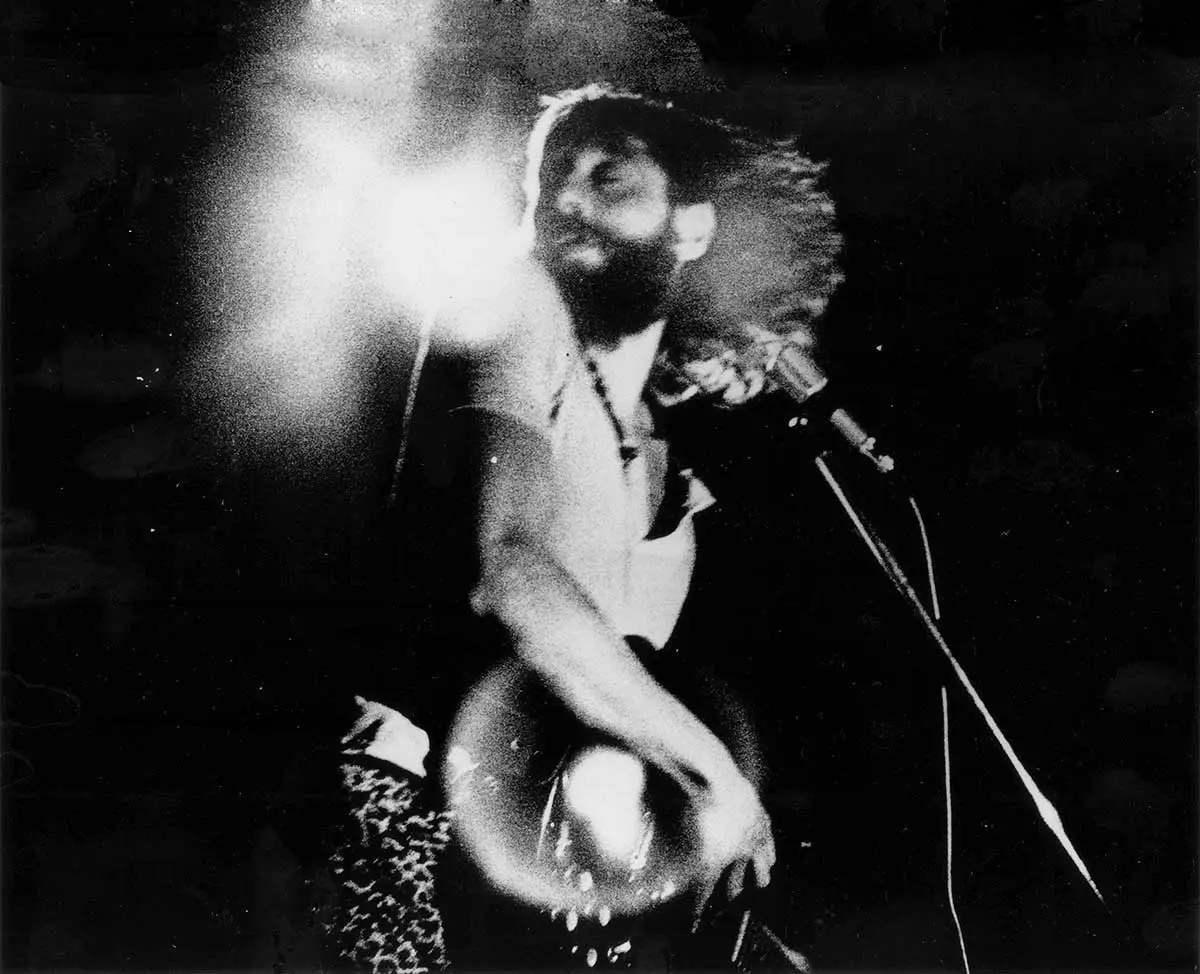
His critical and sagacious gaze drove him to make, in 1974, Rock Star (A character appropriation), a photo performance comprised of 8 photographs telling the story of a pop singer’s moment of ecstasy; it was Lamelas himself, appropriating a character almost as parody. Los videos violentos del año 75, photographs in the format of a fotonovela, told the story of a couple living in a city of the future, with the particularity that violence didn’t exist until the protagonists found a series of films with images filled with it. Informed of the situation, the government began to persecute them, finally killing the couple. In strict connection with the country’s sociopolitical situation, Lamelas used a mass-culture format and gave it new, ironic meaning: it no longer is the love story with a happy ending that the genre’s usual audience would expect, but a tragic version signaling for another viewer.
More recently, in 2012, Lamelas made Señalamientos in Buenos Aires. Just as Time as activity dealt with time, this new work dealt with space. As we have noted on a different occasion, Señalamientos focuses more on the function of the work of art than on its morphology, which can be interpreted as a legacy of Marcel Duchamp.
Entering the gallery, the viewer encountered abstract drawings reminiscent of the concrete avant-garde of the 1940s and drawings of palm trees, both created by the artist in his youth. Some had been made on pages of a notebook that Lamelas used when he lived in Belgium.
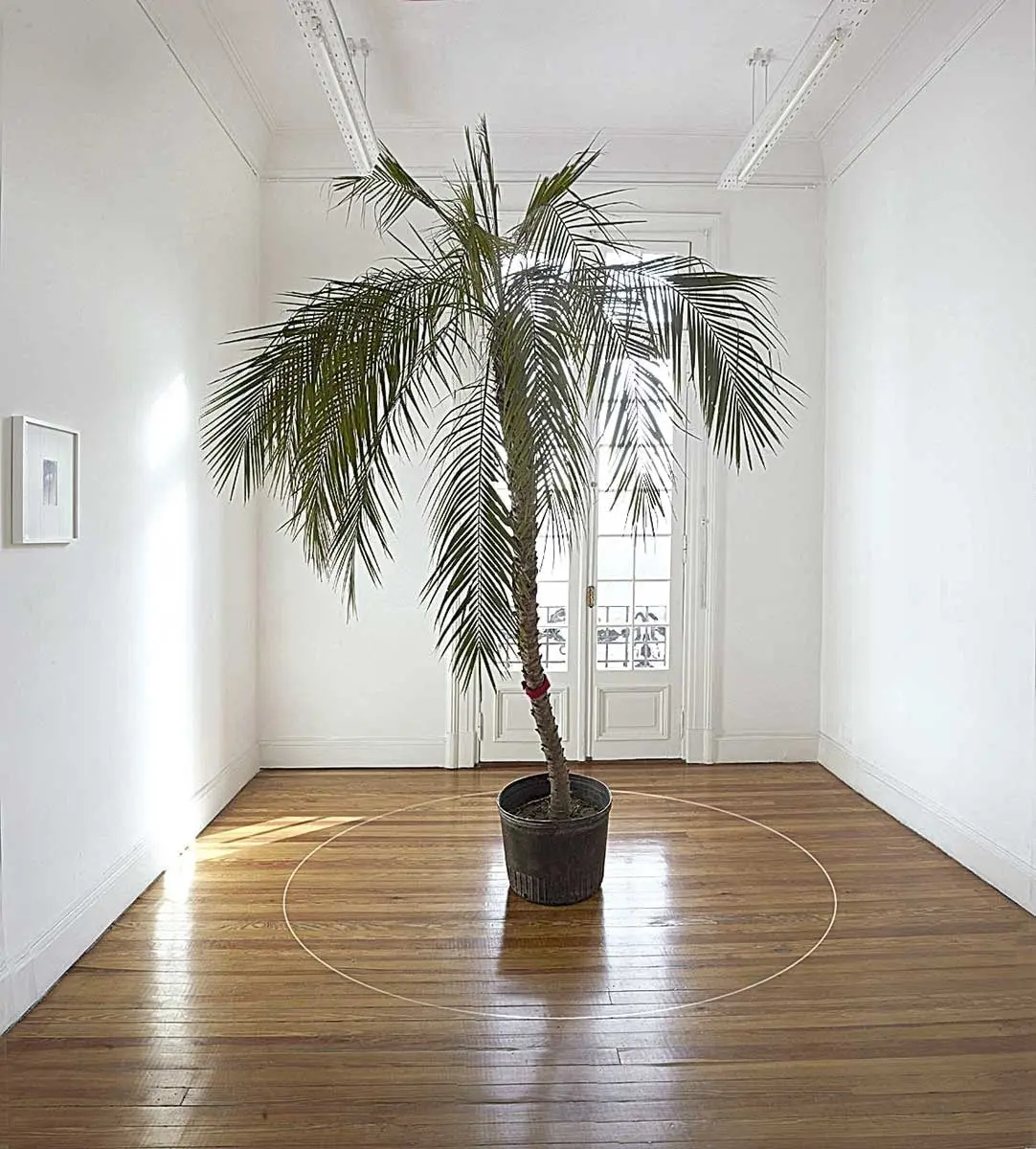
Also on exhibit was the record of older work, Señalamiento de tres objetos (1968), where the artist had marked the space of two trees and a chair in Hyde Park, London. In the version of Señalamiento created for Ignacio Liprandi, two palm trees were “situated” next to their pots in two contiguous rooms. The trunk of each tree was severely bent, and its circular space was outlined by a white line. Suddenly, two performers entered the gallery to interact with the tree, establishing a relationship between its geometry and their own sensuality; at a given moment, the dancers came together so that he could lift her. In this way, the sensation of gravity emanating from the leaning palm tree shifted to the performers’ dance, as they drew branches and trunks and with their bodies.
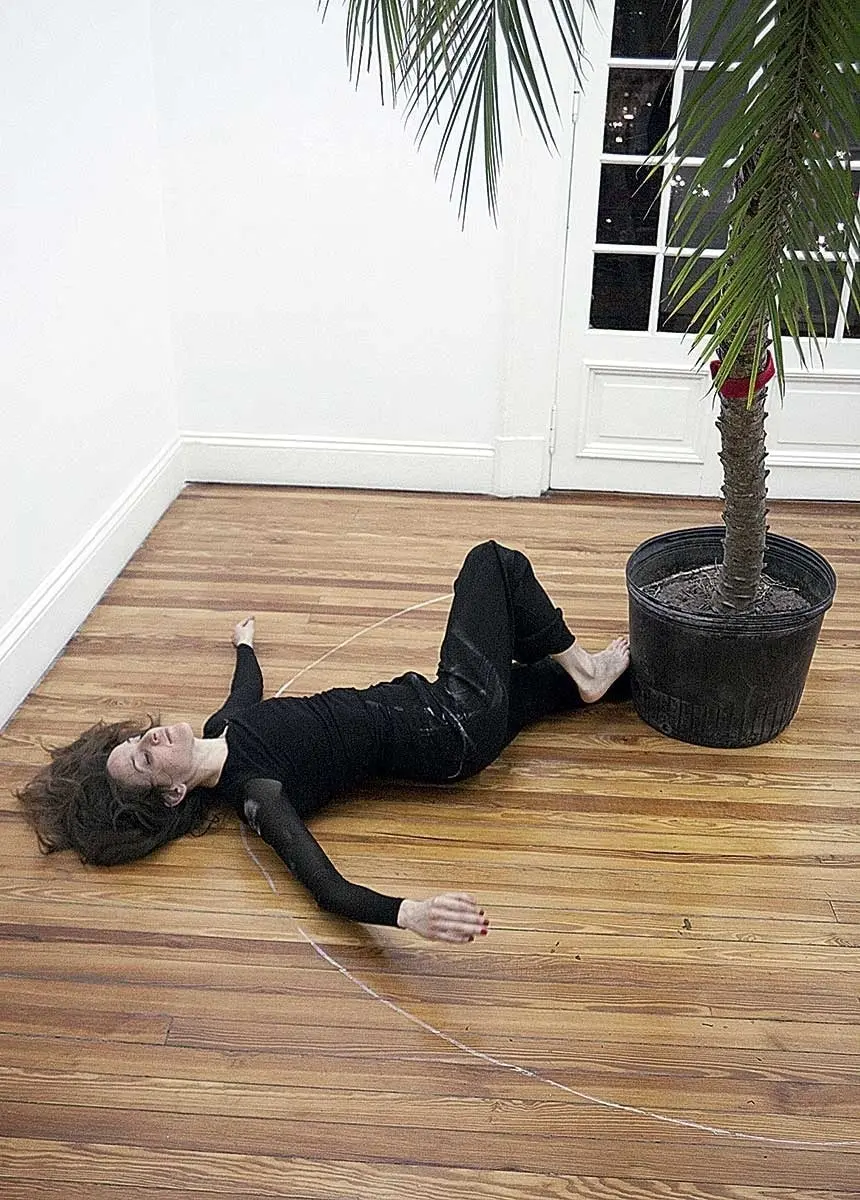
The relationship between the palm tree, the human body, and gravity was brought to the fore on the basis of a quotation from Jorge Luis Borges’ story “Averroes’ Search”: “You are, O palm!, also a stranger in this soil…” In that also, the writer formulated an analogy between the palm tree and the person; in both cases, being a stranger refers to their provenance from a place whose nature is not known in any depth. Thus, the feeling of being a stranger in something as concrete as the soil.
Real palm trees, dancers symbolizing a palm tree, and drawings of palm trees: three modes of expression that, after all, give an account of the concept “palm tree.” Señalamiento confronts us with the topic of perception, not only in art but also in ordinary experience. In times like the present, Lamelas has questioned the extreme mediatization of the real. Gianni Vattimo has dubbed the phenomenon of a global environment punctured by the mass information media, the “transparent society.” Perception is contaminated, and we lose acuity and depth in the act of discerning.
Also featured in this exhibition was Buenos Aires n’existe pas, which deals with Marcel Duchamp’s stay in Buenos Aires in 1919. At the time, the precursor of conceptual art wrote that Argentina’s capital did not exist, as a comment on the dearth of artistic activity in the city. Ninety years later, Lamelas replies: “Mon cher Marcel Duchamp, Buenos Aires exists.”
The definition of art that derives from Lamelas production responds, from the beginning to a new artistic paradigm, one that came into greater focus in the 1980s, when a variety of theoreticians (Danto, Vattimo, Belting) spoke of the death of art in the sense of the dying of a way of understanding it. With Lamelas, now art forms “detonated” to require new modes of perception for a viewer anesthetized by the impact of the mass media. The response developed in Lamelas’ work could very well be interpreted as that breaking with sensorial alienation by revealing the devices of art and traversing them.
NOTES
1 . Among the salient landmarks of Lamelas’ career are his participation in the Di Tella Institute’s Experiencias Visuales in 1967 and 1968; representing Argentina at the São Paulo Biennial in 1967, and winning there an award along with Jasper Johns, Michelangelo Pistoletto, and Tadeusz Kantor, among others; being selected for the Venice Biennale in 1968 and for the 5th Documenta in Kassel in 1972. In 1993, he won a Guggenheim Fellowship.
2 . In 1996, MALBA organized an anthology exhibition of Lamelas work, curated by Inés Katzenstein, and in 2011 and 2012 he exhibited at Ignacio Liprandi Arte Contemporáneo, in Buenos Aires.
An exhibition organized by the Torcuato Di Tella Institute.
* All images illustrating the text are courtesy of the artist and Jan Mot, Brussels.
MERCEDES CASANEGRA
Art historian, UBA. Independent curator.