
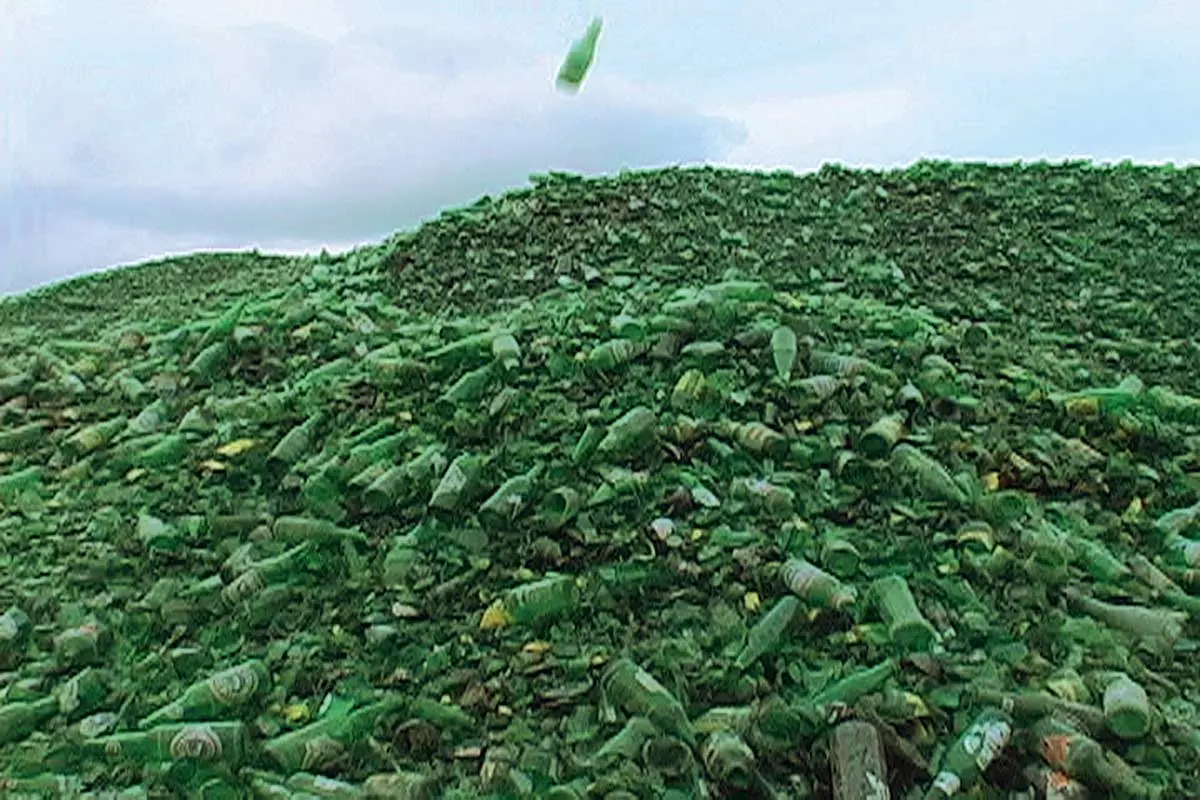
Their collaboration started casually in 2006 when Donna Conlon invited her fellow artist and friend Jonathan Harker to accompany her to a recycling plant on the outskirts of Panama City. They found mountains of green bottles —like landscapes of unusual beauty— which they photographed and also recorded on video when Harker began to play with the bottles, loudly crashing them against the mounds. The images produced during this outing provided the basis for the video entitled Dry Season (2006), the first joint work by this artistic duo whose oeuvre is now in the collections of museums like the Tate Modern in London and the Guggenheim in New York.
Over the years, the contemporary art scene has featured a considerable number of creative couples, as well as short and long-term collaborative artistic projects. Duos like Gilbert and George or Fischli and Weiss, as well as temporary collaborations such as that of Warhol and Basquiat, provide good examples. The history of art offers clear precedents in the group works of the Surrealists —such as the drawings called “exquisite corpses”— and the way the Dadaists valued the artistic process over the product. The growing importance and pervasiveness of conceptual art in global cultural production have also been influential. Above all, during the twentieth century, the romantic archetype of the artist as a solitary creative genius became outdated, as the notion of teamwork gained importance. The results prove how shared creation, with its implicit exchange of views and joined forces, leads to the making of works that are different from those that the artists would have produced on their own, as in the case of Donna Conlon and Jonathan Harker.
Unlike some famous collaborative duos such as Christo and Jeanne-Claude or Allora & Calzadilla, Conlon and Harker are artistic partners, but not a couple. Their joint work includes more than a dozen conceptual videos created during the last decade in Panama, where they both live and work. Also, unlike other artistic teams, prior to working together, each had made art on their own and had individual careers, which they continue developing, even as they collaborate.
The theme of ecological conservation and the ubiquitous presence of trash had already appeared earlier in the personal work of Conlon, who has used it as a vehicle for interpreting human idiosyncrasies. However, in Dry Season, that first video created together with Harker, waste products acquired a new dimension with the addition of sound, specifically the ruckus produced by the barrage of bottles that a group of assistants threw on the pile of green glass. As in a musical piece, the sound increases to a crescendo and then decreases towards the video’s end, marked by the stroke of one last bottle. In this collaborative video, the cathartic process of destroying the bottles contributed to building an unreal landscape, while proposing a new interpretation of recycling as a creative process. As cultural promoter Walo Araújo described it at the time, that first joint video “develops Donna’s usual concerns regarding the tensions and transactions between the artificial and the natural worlds, confronting ideas about welfare, consumerism, and social behavior.” However, as he concluded, in the joint work those features were enriched by coming together “with Harker’s natural penchant for absurdity, his sarcastic wit, and the knowledge of structure, rhythm, and composition that stems from his education as a filmmaker.”1
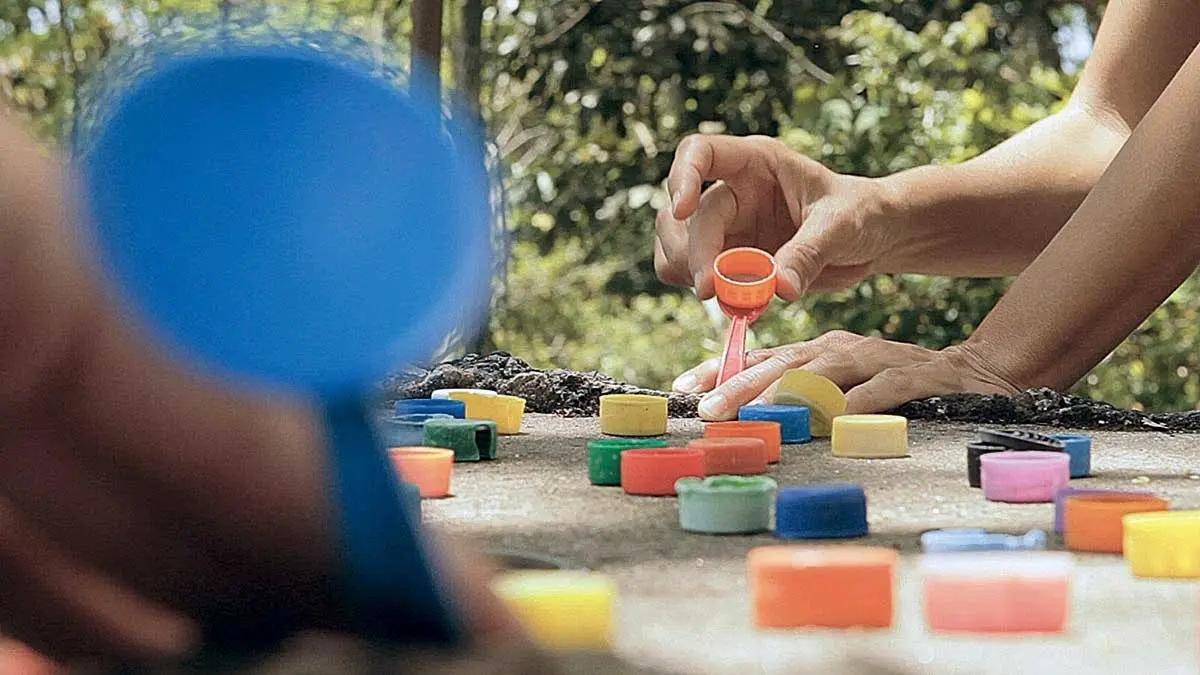
The paradoxical beauty of accumulated trash is also featured in Harker and Conlon’s videos Summer Breeze (2007) and Capapults (2012). In the first, a cyclone fence is gradually converted into a vibrant canvas as a strong wind carries and fills the metal structure with colorful bits of waste material such as plastic bags, ribbons, and paper cups. Despite their lightness, the objects click as they hit the fence, providing an experience that is both visual and auditory. The idea of an artificial landscape created by pollution also appears in Capapults, a video filmed in the rainforest of Panama City’s Metropolitan Natural Park. The interaction, reminiscent of the childhood game of catapults, takes place on a concrete platform (a remnant of a former US military installation, now used as a lookout) where the artists are playing with disposable spoons to launch thousands of small plastic bottle caps. Against a natural background of lush trees, we watch the caps fall through a drain in the platform, under which they progressively build a mountain of multicolored plastic on the forest floor. As in many of Conlon and Harker’s videos, high-quality sound effects are an essential feature: the lifeless caps produce a repetitive and artificial tapping that contrasts with the sounds of the birds and insects in the surrounding scenery.
Beyond commenting on consumerism and the need to protect the environment, Capapults suggests other interpretations. On the one hand, it establishes a relationship between the ruins of a military base and catapults as war machines; on the other, it sends a subliminal message about how Panamanians have created a park where Americans used to train soldiers. The occupation of the territory formerly known as the Canal Zone by a US civilian and military population until the end of the 20th century is a crucial topic in Panama’s history, one which Conlon and Harker have addressed in many of their works.
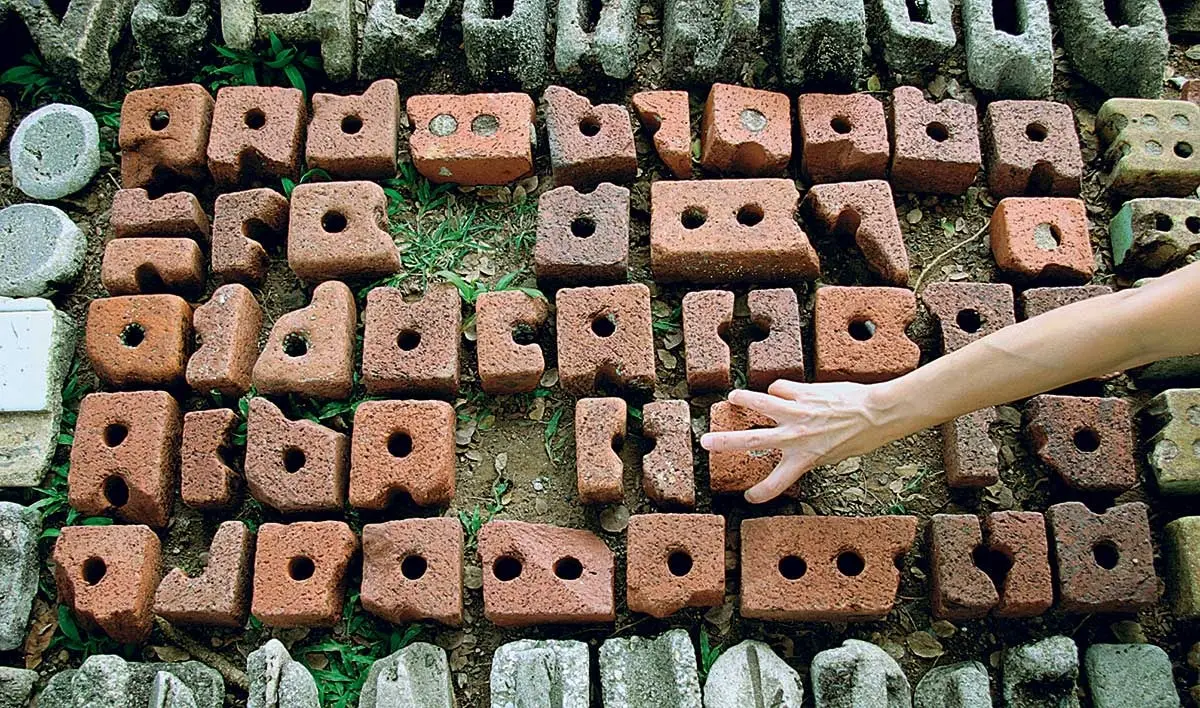
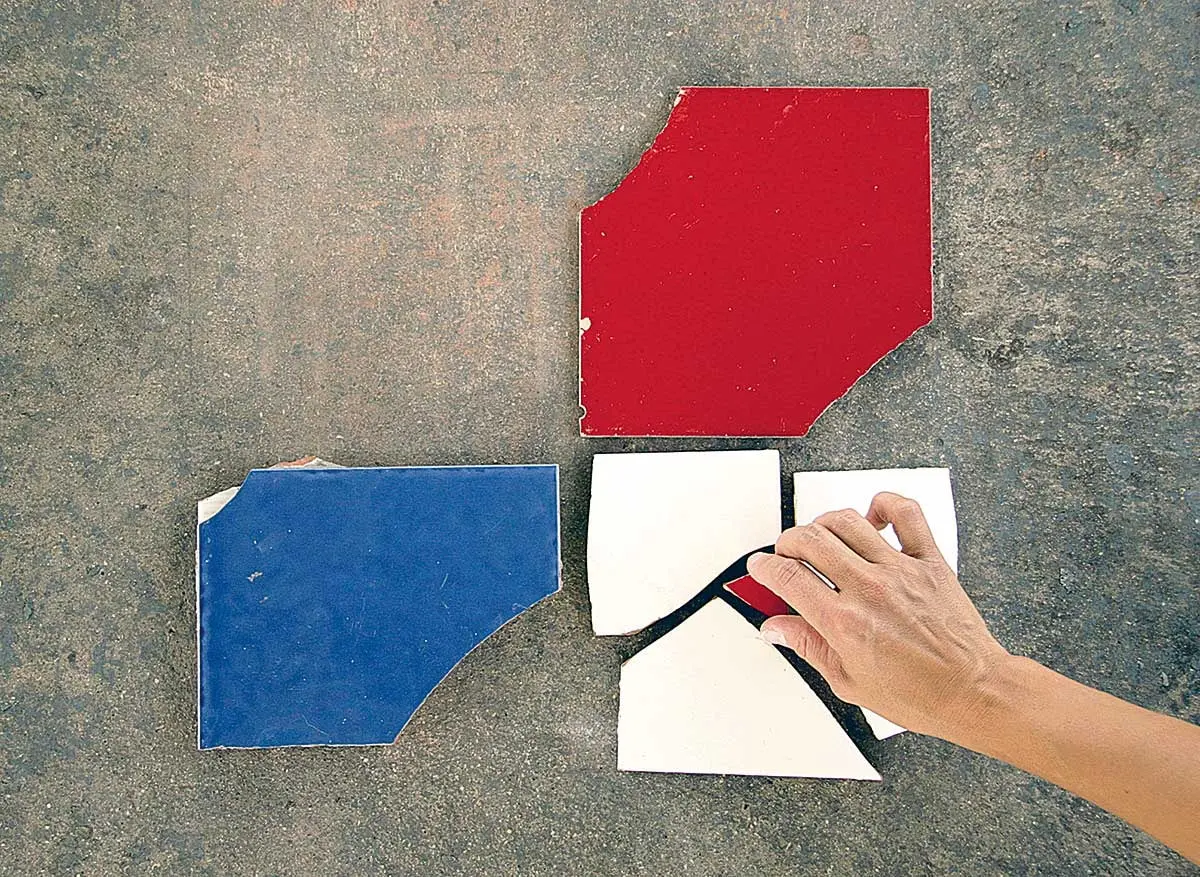
Reflections on the concept of national identity and political artifice abound in the series of seven (Video) Games Conlon and Harker created between 2008 and 2009, in which the artists have filmed playing games they invented, which on first view seem to resemble puzzles or chess. In each case, there are two contenders metonymically represented by their hands and arms who, according to a strange logic and rules of their own, appear playing on makeshift boards of soil, sand, concrete, or tiles. The games’ pawns or pieces range from fragments of bricks or concrete blocks to broken tiles and rusty iron bar objects the artists found in the rubble of torn-down houses in Panama City.
Although they are inanimate objects, in Conlon and Harker’s videos, the pieces in the different games become the protagonists of poetic narratives that slowly reveal geopolitical content and propose profound meanings for the apparently light-hearted interactions between the artists. For example, in (Video) Game No. 1, after multiple moves, the semi-abstract bricks (which were once part of a house in the US sector) spell the word Panama, as the camera rises to show a ship going through the Canal, “creating a metaphor about the contradictions between global flow and local circumstances.”2 In the fourth video game, we watch the artists’ hands place bits of cracked tiles to create a broken-up version of the Panamanian flag, albeit one in which the upper left quadrant displays a group of stars, with a nod to the flag of the United States.
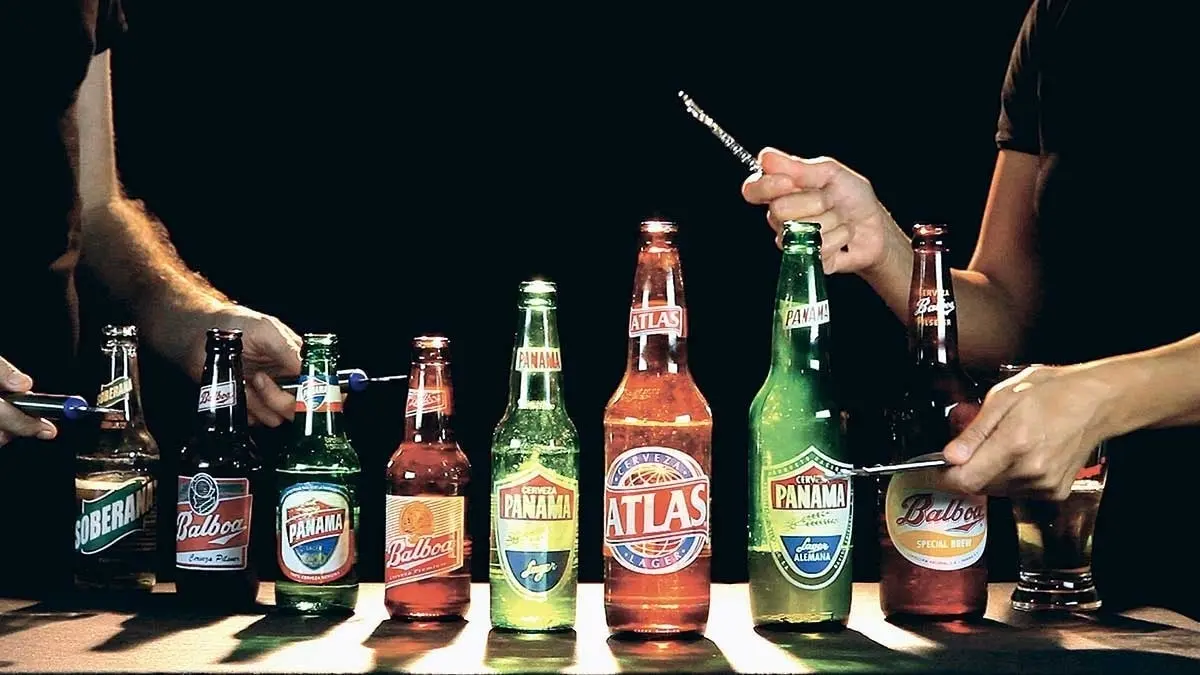
This type of game, which serves to analyze and question the role of patriotic symbols in the construction and mystification of national identity, provides the cornerstone for many of Conlon and Harker’s works. The process was particularly successful in the video titled Drinking Song they created in 2011 for the Mercosur Biennial, held under the theme of “geopoetic essays,” whose curators invited artists “to present, from their own imagination and experience, alternatives to the conventional idea of the nation in modern times.”3 In Drinking Song, Conlon, and Harker play the notes of the national anthem of the United States by hitting metal openers against Panamanian beer bottles arranged in a row like the keys on a xylophone. The brands of the beverages —Atlas, Balboa, Panama, and Soberana (Sovereign)— use nationalist ideals as marketing gimmicks that are strangely linked to concepts rooted in ambiguous historical truths. The video has the overall feeling and aesthetics of a high-quality advertisement, with dramatic lighting and a familiar “jingle”, which simultaneously make reference to Panama’s neo-colonial and postcolonial experiences as a country that endured the presence of an American enclave within its territory for almost a century. As curator Carmen Ferreyra concluded in her careful analysis of this video, Drinking Song echoes “the paradox of Panamanian identity: while we perceive that the bottles (Panama) are the ones in charge of the organization of the video, it is the tune (the United States) that links them together.”4
The title of Drinking Song offers another point of analysis as it refers to the ironic fact that the melody of the anthem of the United States was borrowed from an old English drinking song. The music together with the imagery of beers and commercial logos convey a message regarding the strange character and even commercial nature of the source for patriotic insignia. In Harker’s own words: “In this video, we use humor to talk about very serious things: the manufacturing and strategic use of national symbols to build and propagate the idea of the nation-state; and the turbulent and abusive relationship the United States has had with Panama over the years.”5
The conclusion of the reversion of the Canal and the former Canal Zone to Panama on the final day of the twentieth century ushered in a new era in the country’s history, a period of impressive economic growth due to the new Canal revenues and an increase in foreign investment. In turn, that new wealth brought about an uncontrolled real estate boom that transformed Panama City’s skyline through the addition of numerous commercial and residential towers, built at the cost of destroying a great number of historic structures. In (Video) Game No. 2, Conlon and Harker illustrate this failure in urban planning through an exchange between two opponents, one of whom aggressively replaces traditional tiles placed along a horizontal line with vertical pieces of glass or mirror that resemble small skyscrapers. According to the artists, “This schizophrenic metamorphosis, which many consider symptomatic of the ‘modernization’, is producing the obliteration of the city’s architectural history and collective memory. There’s an almost antiseptic compulsion to destroy old buildings and houses regardless of their aesthetic values, with the goal of erecting in their place a vertical and soulless ‘new’ city.”6
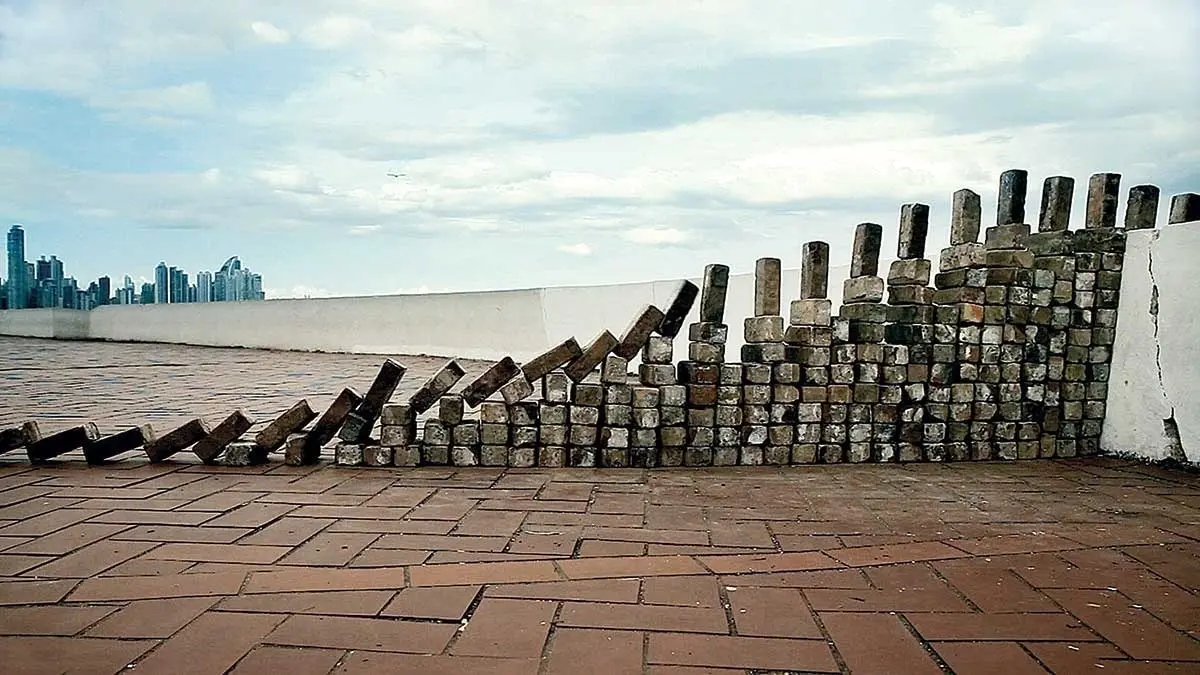
In the process of creating their videos, Conlon and Harker managed to turn architectural remains and the debris from a mass-production economy into parts of a meaningful dialogue regarding the eradication of historical heritage and the weakening of the nation’s collective memory. These shared concerns were the main focus of Domino Effect (2013), a video they filmed in Panama City’s Historic District (Casco Antiguo). Established during the colonial period, in recent years this neighborhood has experienced an intense process of gentrification and renewal (including the construction of a multi-millionaire marine viaduct around the peninsula), which has jeopardized its status as a World Heritage site granted by UNESCO. As part of its renovation process, the Panamanian government decided to tear up and repave the district’s old internal streets, acquiring new bricks to replace the original colonial bricks, historical objects that were then used for landfills elsewhere in the city.
To create this video, Conlon and Harker conspired with the workers in charge of “fixing” the streets, who helped them in the arduous process of collecting thousands of old bricks over a period of several months. In the video, the action begins with the touch of one finger that triggers the progressive and apparently continuous fall of an impressively long row of bricks that the artists had carefully set up in the form of a chain that ran through the squares and streets of the old sector. Sound plays a major role, conveying the volume of the pavers as they hit the following one and continue the progressive falling path. The work, described by its creators as “a metaphor for development as a chain reaction,” functions as a portrait of the city and an allegory for the progressive destruction of its history. Even more, than in previous videos by Conlon and Harker, the discarded objects take on an almost human quality, like characters that move around town and that tell a story, which in this case ends on a tragic note when the last brick falls the sea, with the modern skyline of Panama in the background.
In addition to having been filmed in high definition, Domino Effect reflects a qualitative technical leap that has characterized Conlon and Harker’s films after 2011, including Drinking Song. Unlike their previous videos, which were created with natural light and based on single long shots, the works of recent years are the product of an increasingly cinematic process, with the use of scripts, storyboards, and multiple shots in order to create more sophisticated sequences that produce the illusion of a continuous chain movement in the first case, and of an uninterrupted melody in the other.
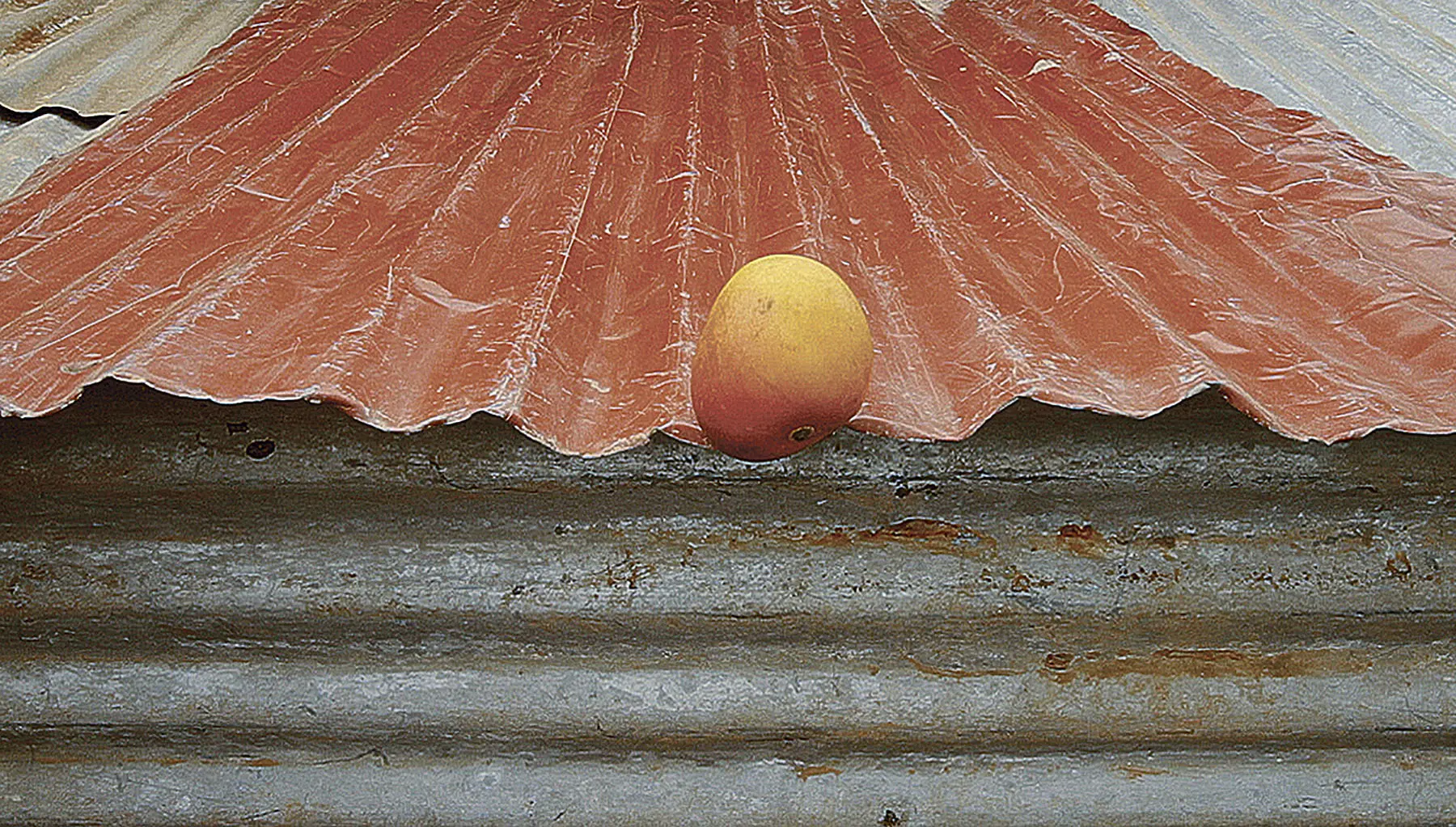
That sense of cinematic flow also stands out in Tropical Zincphony (2013), a video that displays the mischievous quality and sense of humor that is essential to Conlon and Harker’s joint work. The work shows a fortuitous choreography in which at first a single mango, and then many mangoes, noisily roll and fall on broadsheets of zinc roofing. While the multicolored, angular, and corroded roofs evoke the precarious houses in the poorest areas of Panama, they also work as artistic compositions that remind the viewer of Cézanne’s still-lifes or of a series of modern abstract landscapes. Again we see how Conlon and Harker manage to imbue the objects in their films with a sense of personality. By their own description: “At one point during its journey, the lonely mango is overtaken by a stampede of wild mangoes, evoking notions of community, individuality, and loneliness.” With its blushing, cheerful mangoes, Tropical Zincphony offers a synesthetic experience that tells a story about the tropics, the pleasure of improvisation, and those individuals who choose a different path from others.
In striking contrast and despite its magic tricks, theatrical effects, and an almost choreographic flow, Conlon and Harker’s latest video Invisible Hands (2014), does not seem to represent a game but rather grim political reality. Against a black background, we see the hands of a magician with white gloves and those of the two artists involved in multiple interactions with a large number of coins. More specifically, they are Panamanian balboa coins (equivalent to one US dollar) popularly known as “martinellis” in honor and mockery of the Panamanian ex-president who arbitrarily put forty million of them into circulation in 2011. In spite of its title, it is not the hands that are invisible in this video, but rather the people who are counting, stacking, redistributing, transferring, washing, and pocketing the money. As in a magic show, coins appear and disappear. The video reflects the concerns of Panamanians regarding the constant embezzlement that has characterized its most recent governments, particularly that of former President Martinelli, against whom the Panamanian Supreme Court recently ordered an investigation for corruption.
The works of Conlon and Harker use a local lens to consider global issues, which is why they arouse the interest of the Panamanian public as well as international museums. Although their formally and aesthetically remarkable videos focus our attention on serious ecological and sociopolitical problems, they always do so with a great sense of humor. As artistic partners, they generate special alchemy, using a tropical, geopolitical, and poetic language that beguiles us with its sense of humor but then engages us with its conceptual depth.
NOTES
1. Walo Araújo, “Donna Conlon y Jonathan Harker”, Estrecho Dudoso (San José: Teorética, 2006), p. 58.
2. José Manuel Noceda Fernández, “No van lejos los de adelante…” en XXXI Bienal de Pontevedra – Utrópicos. Santiago Olmo, ed. (Pontevedra, España: 2010), p. 134.
3. Alejandra Villasmil, “Una bienal integral, que no es apenas una gran exposición”, Artishock, revista de arte contemporáneo (Santiago de Chile: 13 de septiembre de 2011).
4. Carmen Ferreyra, “Imágenes y sonido en Drinking Song por Donna Conlon y Jonathan Harker”, Sauna, revista de arte (Buenos Aires: Vol. 3, Nº 25).
5. Jonathan Harker, “Donna Conlon y Jonathan Harker: Cervezas y arte”, Ellas, supplement of La Prensa (Panama: 14 July 2014).
6. D. Conlon and J. Harker, XXXI Bienal de Pontevedra – Utrópicos, p. 142.
MONICA E. KUPFER
Ph.D. in Art History, art critic, and curator.