
The topic of this exhibition, presented recently at BOD Cultural Center and sponsored by Telefónica Foundation, is the environment, urban or rural. With the title, Electro_estética ambiental.ve. Video-Art, Electronic Art and the Environment, curator Benjamín Villares Presas sought to establish a variety of objectives: the presentation of artworks by Venezuelan artists that have an electronic component, are beautiful, and deal with environmental issues. The title also redirects us to the webpage where the exhibition’s catalog is housed.
Villares begins by noting that electronic arts are a generic designation that does not express the actual diversity of media working with technological elements. He opts for differentiating, for example, between works with analog or digital technology; video art from web art; and productions that require motion sensors from those incorporating software that allows for interaction with the audience. Such diversity of resources and procedures is present in the exhibition.
We must point out, first of all, how difficult it is to organize an exhibition of art and technology in a country whose development potential has been cut short by a severe economic crisis, as is the case in Venezuela. To propose so large an exhibition in the current circumstances involves a great deal of risk. For starters, the slowness and low quality of Internet connections in the country, which have been fatal for web art explorations. Nevertheless, it was important to attempt it and to showcase artists whose work develops along these lines, some of whom have left Venezuela.
The exhibition features works by twelve artists. Of them, Jaime Castro, Magdalena Fernández, Gabriela Gamboa, Zoltan Kunckel, Lourdes Peñaranda, Antonieta Zerré, and Julia Zurrilla presented videos and video installations. Enrique Moreno’s work included motors, motion sensors, and improvised materials, while Carlos Javier Gómez de Llarena, Corina Lipavsky, Yucef Merhi and Tecné Collective (Rodrigo Arcaya and Gorka Cortázar) worked with web platforms or with software either adapted to or created for specific objectives.
Jaime Castro and Lourdes Peñaranda used two monitors each to display their respective videos. They both work with landscapes but from differing perspectives. Castro presented two entirely divergent scenarios, one in Chile and the other in Venezuela. Peñaranda captured images of a single location, the Maracaibo Botanical Garden, from two different points of view. In Castro’s case, one monitor offers images of the Tatio Geysers, in Chile’s Atacama Desert, and the other presents vistas of treetops at the Henri Pittier National Park, in the state of Aragua. The selection of these two sites may be due to their fragile ecological condition. The Tatio geysers have been surrounded by controversy, due to a project to extract geothermal energy from them. The richly biodiverse Henri Pittier National Park, in turn, is threatened by frequent fires, human encroachment, poaching, pollution, and scant resources, among other problems. And there is a significant contrast between these two videos: time. In the Tatio Geysers’ video, the scene is presented as almost still, stationary, while in the second case the images move quickly and the scene is shot from below.
Lourdes Peñaranda presents two perspectives on the Maracaibo Botanical Garden: one monitor, situated above our line of sight, shows the top part of a tree, and another one, much lower, displays views of the garden at ground level, with its plants and flowers. The midpoint on the wall between the two monitors is left empty, with the intention of inducing in the viewer an oblique, in-motion perspective. Thus the title of this work: Indagaciones sobre la visión oblícua en movimiento (Inquiries on Oblique Vision in Motion).
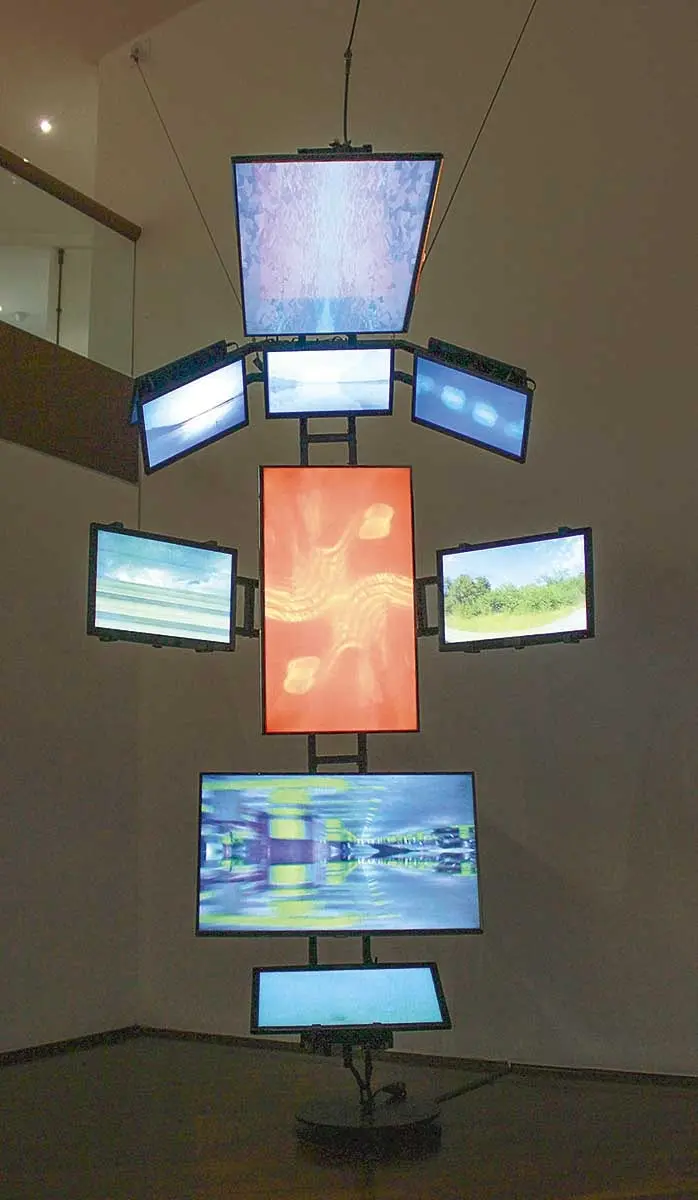
Meanwhile, Zoltan Kunckel’s video installation, titled Biótico-Abiótico (Biotic-Abiotic) is comprised of nine monitors of different sizes and in different positions. Here the artist alludes both to the natural landscape and to the environmental impact of pollution, and the transformation of the landscape by human hands. All living organisms are the biotic factor, living in a physical space whose components determine the a-biotic element. The latter can be water, light, temperature, air, nutrients, etc. The artist’s travels in Europe, Asia, and the Americas have allowed him to collect images that express, according to Villares, “the dysfunctionality that exists between nature and human beings” after industrialization. Viewers are confronted with nine simultaneous projections seen in varied columns and directions, which gives dynamism to the proposal. In this work, sound and the acceleration of the images create a high-impact situation that seems to prefigure the coming denaturalization and unbalancing of our environment.
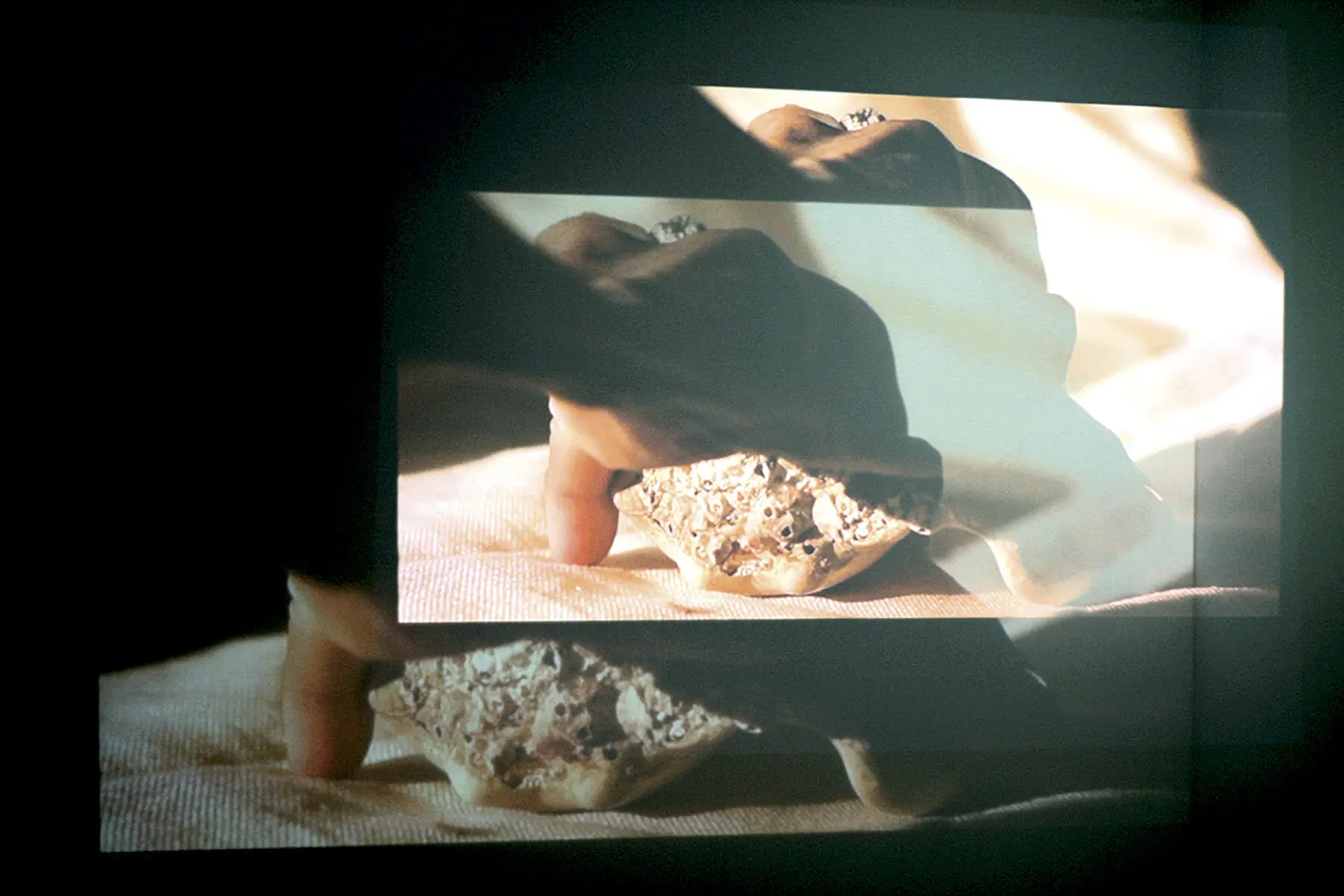
Ray Bradbury’s Martian Chronicles were the starting point for Gabriela Gamboa’s video installation, which reformulates the theme and focuses on our planet instead. The installation is divided into two parts. The first part is referred to the environment, by means of images of a beach in Paraguaná, state of Falcón, registered by the artist at different moments; the second part is a video showing, systematically and repetitively, how the artist—whose face we see in profile—picks up a seashell and takes it to her ear. Then, in an evocative way, almost in a whisper, we hear the repeated phrase “You will barely feel it is no longer dawn,” which alludes perhaps to our time-bound, ephemeral condition, and to the transformations that occur in nature. This is a subtle, transparent work of art in which images follow one another like echoes, in simultaneity with the voices of memory.
Julia Zurrilla seems to work her video like a collage. Using a concave screen, she involves the viewer in an imaginary, yet familiar scene. The image of Caracas—taken from a calendar—appears distorted, presented as a coastal city with the ocean in front and Mount Ávila in the background. The point of view is, thus, from a fictitious sea. In this way, the artist shifts not only reality, but geography as well.
Geography also plays an important role in Antonieta Zerré’s video installation. The artist appears in a video, opening bags of sand gathered by seven people at seven different geographical points in Venezuela. The video seems to reproduce “in three dimensions” the space she occupies—the same as the exhibition gallery—during this performance. We find out what the seven sites are by scanning codes placed on a bench in front of the installation, using a smartphone app. Progressively, the artist covers the gallery floor with sand, and each bag, linearly extended, seems to create a “path” of light and shadows that we see on the real sand on the floor of the gallery.
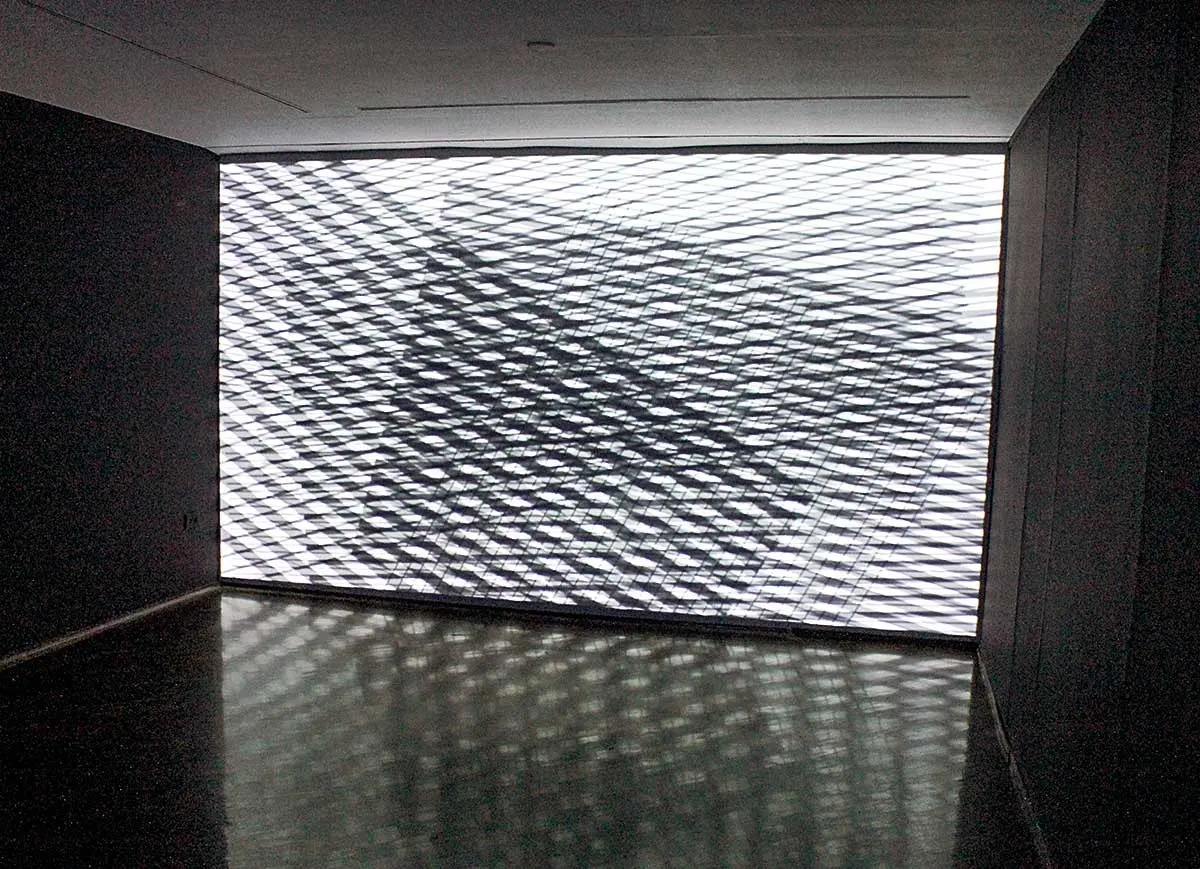
As is usual in her work, Magdalena Fernández couples an abstract reticule with the sounds and voices heard in the city. The image is transformed into a sustained transit from light to darkness, and in this transformation Fernández posits an exercise in perception, taking as her point of reference the work of Jesús Soto and real elements from nature and the city. Dawn in the city is perceived in this light grid and in the sounds we hear.
Plant-in-the-city was meant to be an interactive installation. Using an app downloaded from the Internet, viewers were supposed to distantly care for the plants that are part of the work. The proposal was presented by the Brooklyn-based Venezuelan architect Carlos J. Gómez de Llarena, Huy Bui, and Jon Schramm. It was a modular system with water and light sensors, connected to the web, that could be used to water the plants at will.
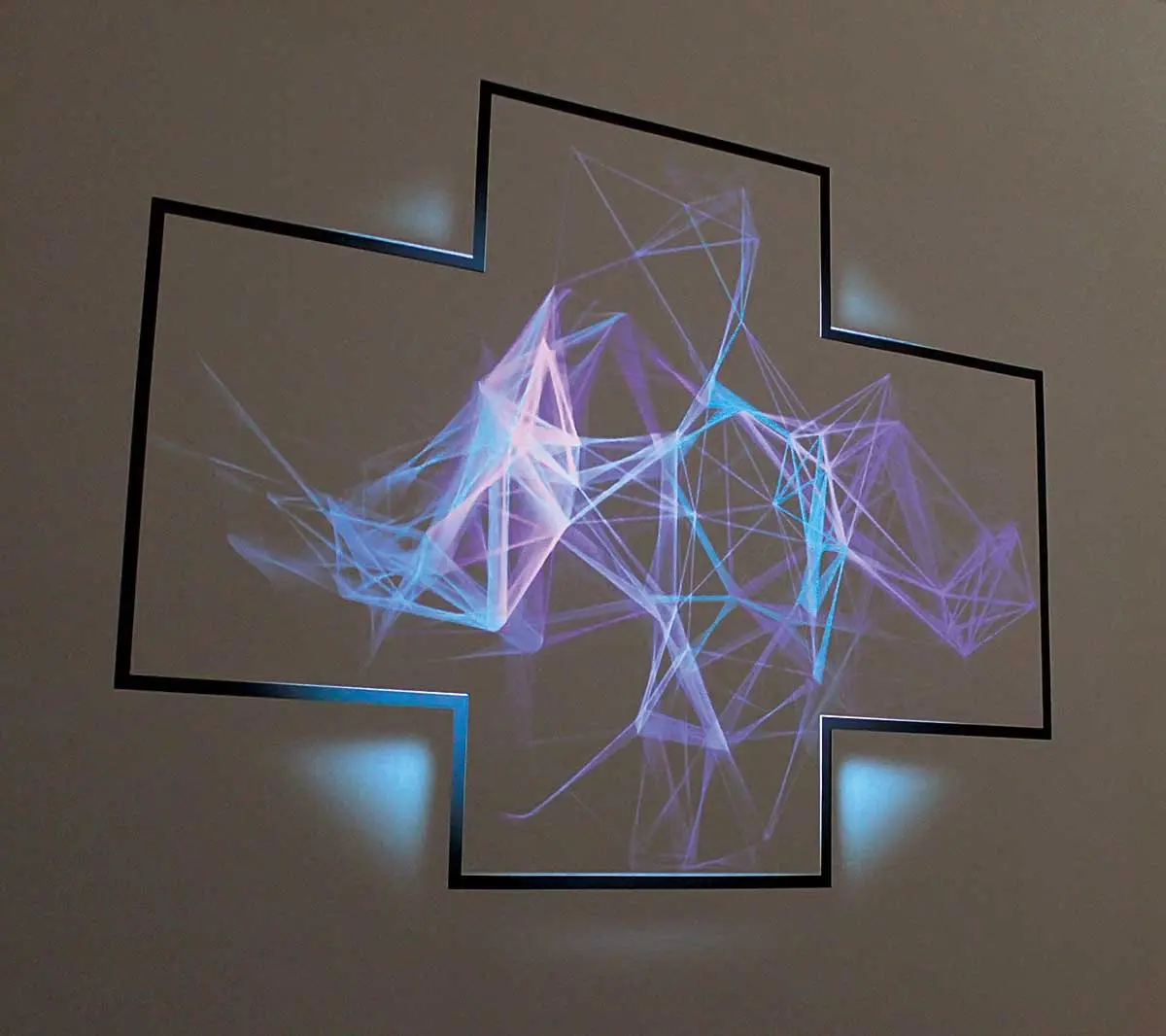
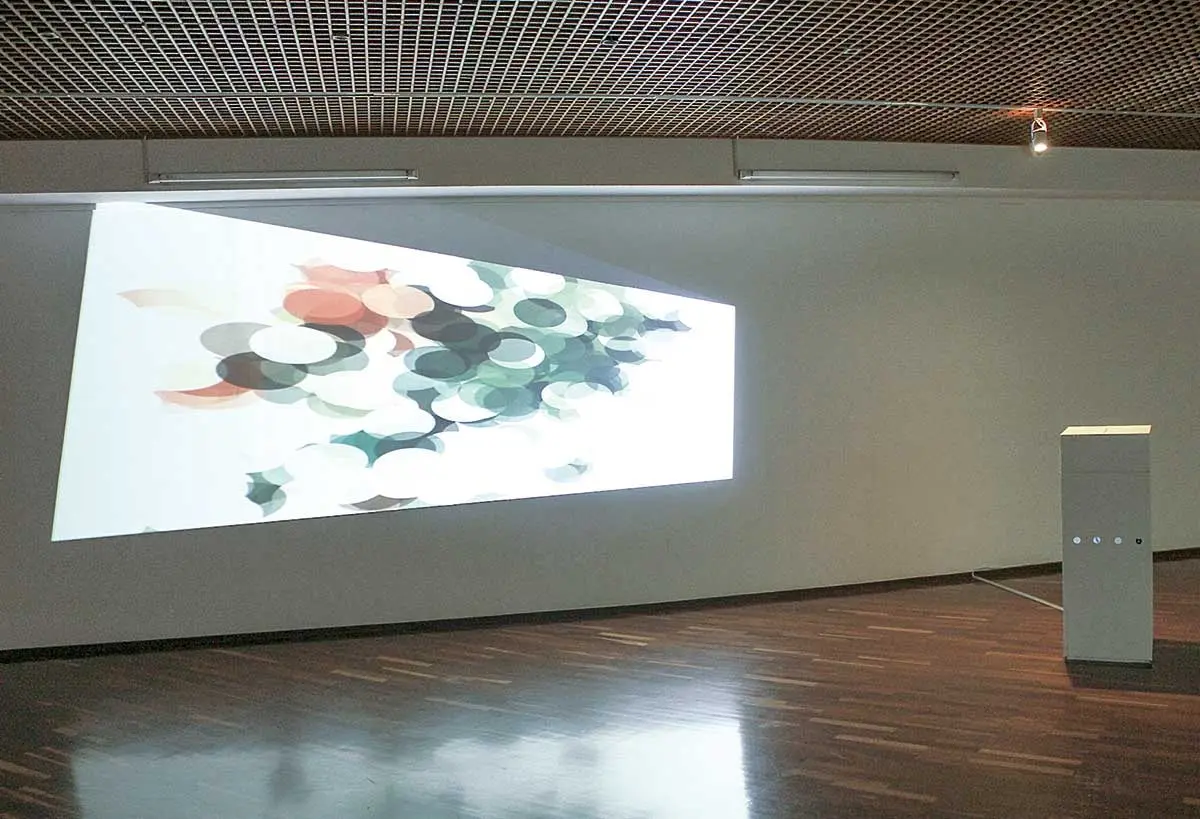
The artists in Tecné Collective (Rodrigo Arcaya and Gorka Cortázar), meanwhile, conceived complex systems that use mathematical algorithms to simulate the behavior of ant colonies and fish schools. The result is a series of images that reveal, via lines and color, the complexity of the interconnections that include both attraction and rejection. Also, meteorological changes in Miami, Madrid, and Caracas made the system’s behavior shift.
Corina Lipavsky found her inspiration in the botanical illustrations that resulted from Alexander Von Humboldt’s expeditions in Venezuela. The artist adapts certain applications and, in an interactive installation, has her images change color and size according to how a sensor is touched by the viewer. The sensor is located in a module situated obliquely to the projection.
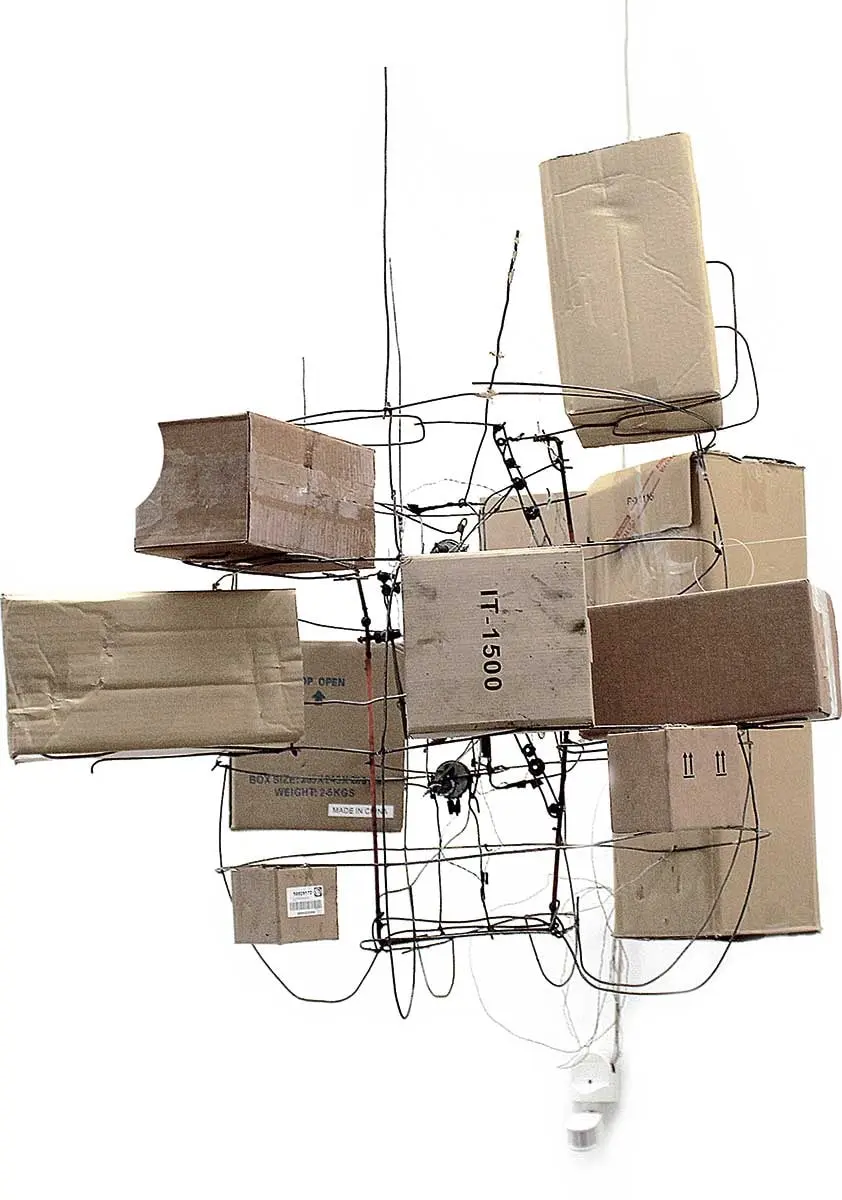
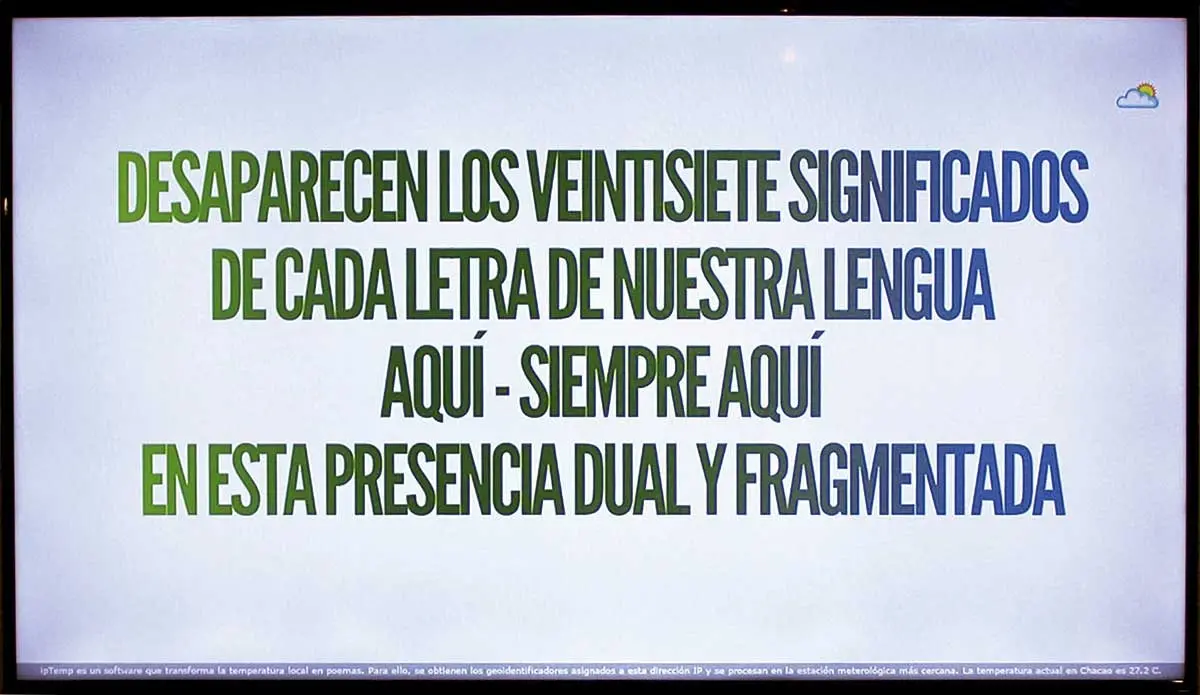
The works of Enrique Moreno and Yucef Merhi respond to two opposing treatments of technology. Moreno works with a precarious technology, using motors and motion sensors, wire, and recycled boxes. With these elements, Moreno builds a “machine” that moves as the viewer approaches. Merhi, for his part, presented a digital work in which the thoughts displayed on a monitor change color according to temperature changes in the gallery, including the viewer’s own body heat.
Electro_estética ambiental.ve. Videoarte, artes electrónicas y medio ambiente was an interesting exhibition experience, and can be a guide for similar editions in the near future.
*All photos in this text by Elisa Barrios. Courtesy: Fundación Telefónica.
SUSANA BENKO