
The exhibition titled “New International Commission on Boundaries” presents over twenty works by Emilio Chapela (Mexico City, 1978) produced between 2007 and 2015. The show owes its title to the body formed in 1899 by the United States and Mexico to implement international treaties on the border between the two countries. The exhibition proposes two lines of thought: on the one hand, the notion of limits and boundaries and, on the other, the ways in which contemporary information systems determine the current social dynamics.
Chapela’s work has long included the integration of computer systems in his creative process, a strategy that induces the questioning of languages and of the current communication systems. For Chapela gives priority to inquiries on everyday life and the way that it has been totally permeated by computer systems and the network communications available online, in all of its various manifestations. Based on a strategy of detachment and an apparent objective strategy, Chapela uses everyday digital tools in his artistic practice and successfully reveals the weaknesses of such a system, as he also evidences the customization and surveillance processes that are applied to all users.
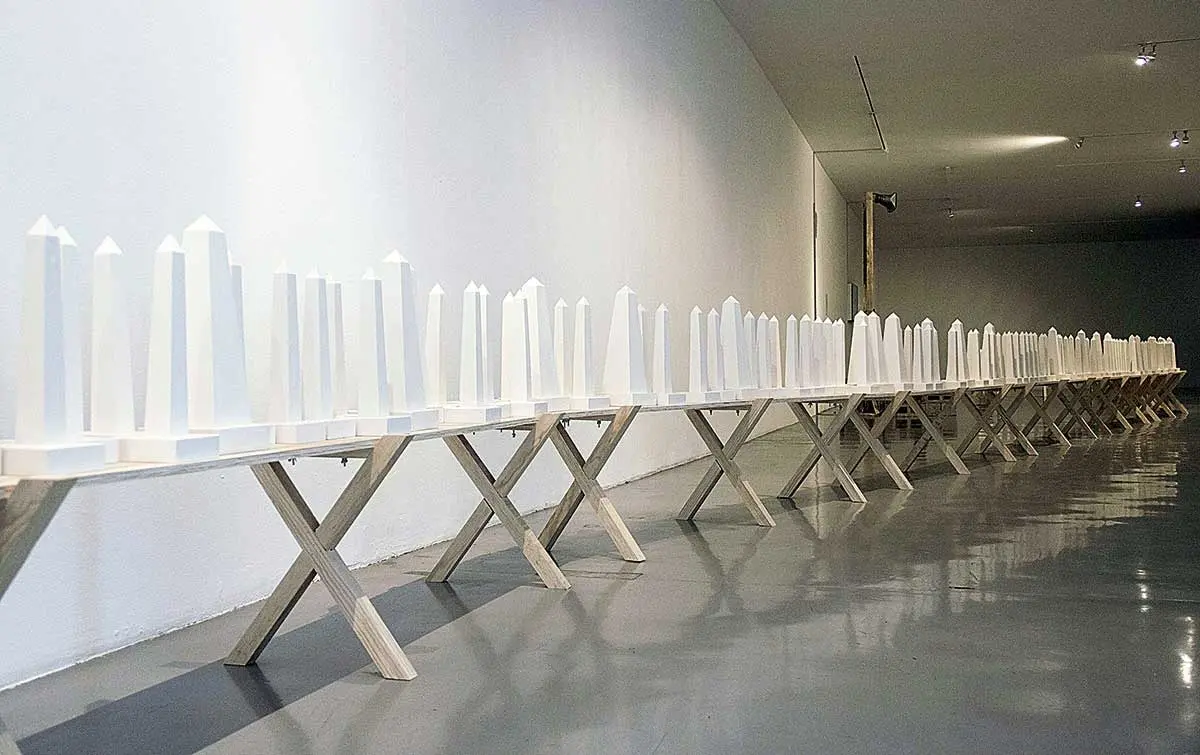
The exhibition approaches this issue in several works, like the pieces Data Centers and Domicilio Conocido (Known Address) that, based on satellite images, reflect on the simulation, monitoring, accumulation and saturation of information, as well as the multiple possibilities of interpretation contained in them.
Also included in the exhibition is the piece titled G8 (2015), in which Chapela creates the flags of eight powerful transnational companies based on the chromatic deconstruction of their logos. The emblems in question represent the brands of Starbucks, Wal-Mart, McDonald’s, UBS, Google, Amazon, Telcel and Coca Cola. While in the earlier series titled “Logo Paintings” Chapela had already raised an analogical relationship between commercial companies and countries, it is in this latest piece where the reflection on the power of the companies has been clearly crystallized by making flags that are exactly like the flags of certain countries. The title of the piece makes an obvious reference to the group of powerful countries also known as the G8.
A ceramic reproduction of the border between Tijuana and San Diego titled Línea Divisoria (Dividing Line) articulates the narrative of the entire exhibition. This piece is accompanied by an audiovisual work titled Radio Latina (Latin Radio) that reproduces a radio program dedicated to Mexican migrants in the United States. The decision to articulate the exhibition using this piece as its connecting thread reveals the narrative of the show in that it synthesizes the two axes around which the exhibition is conceived: rethinking of notions of boundaries, as well as the Internet and the overproduction of information. The work consists of the representation of the buildings that are actually located on the dividing line border and whose location information is accessible through mapping and information systems like Google Maps. According to Chapela, these works raise contemporary issues like virtuality, a phenomenon responsible for the renunciation of fundamental aspects of daily life, like the relationship with the environment and the connection in real time with remote situations.
As a source of knowledge, the Internet is another issue addressed by Chapela in “New International Commission on Boundaries” that proposes the structuring of encyclopedias, definitions, stories and narratives, articulated from the information contained in search engines like Google, which collect and manage common preferences and successfully enounce and specify collective imaginaries. Subjectivity and individualization are diluted to make way for common visions that reflect revealing and disturbing statistical data. Emilio Chapela translates this data into three-dimensional pieces, sculptures, installations and videos that can be materialized and transformed into artistic proposals. An example of this can be found on the works: Ask Google, Gun, Narcoconcreto, and Religión/Ciencia (Religion/Science), among others.
According to Guillermo Santamarina, curator of the exhibition, the show presents certain lines of thought that reflect on representation, the relationship between diverging views, the resistance to contemporary communication and the recovery of both situationist détournement and the art practice.
The exhibition “New International Commission on Boundaries” offers a relevant critical reflection that pertains to our everyday life and that is constituted as an intelligent review of the work by a young artist whose work is significant in the Mexican art scene.
JOSEFA ORTEGA