
Absent for several years from the solo-exhibition circuit, Gabriel Silva now presents in the basement of Espacio Odeón a new proposal with installational elements that combine sculpture, painting, and ceramics. The selection of works as a whole, and each considered individually, appear as responses to a sustained effort carried out by the artist in his studio, around issues of light, time, and space.
Silva intimates that his artistic production has a rhythm and that the issue of painting remains an important concern, driving him to his studio on a daily basis in order to carry on with an ancestral struggle that seems entirely personal here. The oneiric universe, the constellations that seem like a projection of life itself, and the permanent projection towards mythologies that are kept in a nightstand, are stronger over time. With this show, Gabriel Silva is telling us about his persistence in the pictorial exploration and the search for visual-art solutions to eminently human problems. He has been able to read his own oeuvre over the years and to understand that—even as he works on ceramics, collects small dead trees, or lets days and weeks pass in the elaboration of small gardens—the pictorial problem and the human problem always come up. And that painting, and especially the respect he feels for this artistic language, requires a maturity that can only be provided by labor and time.
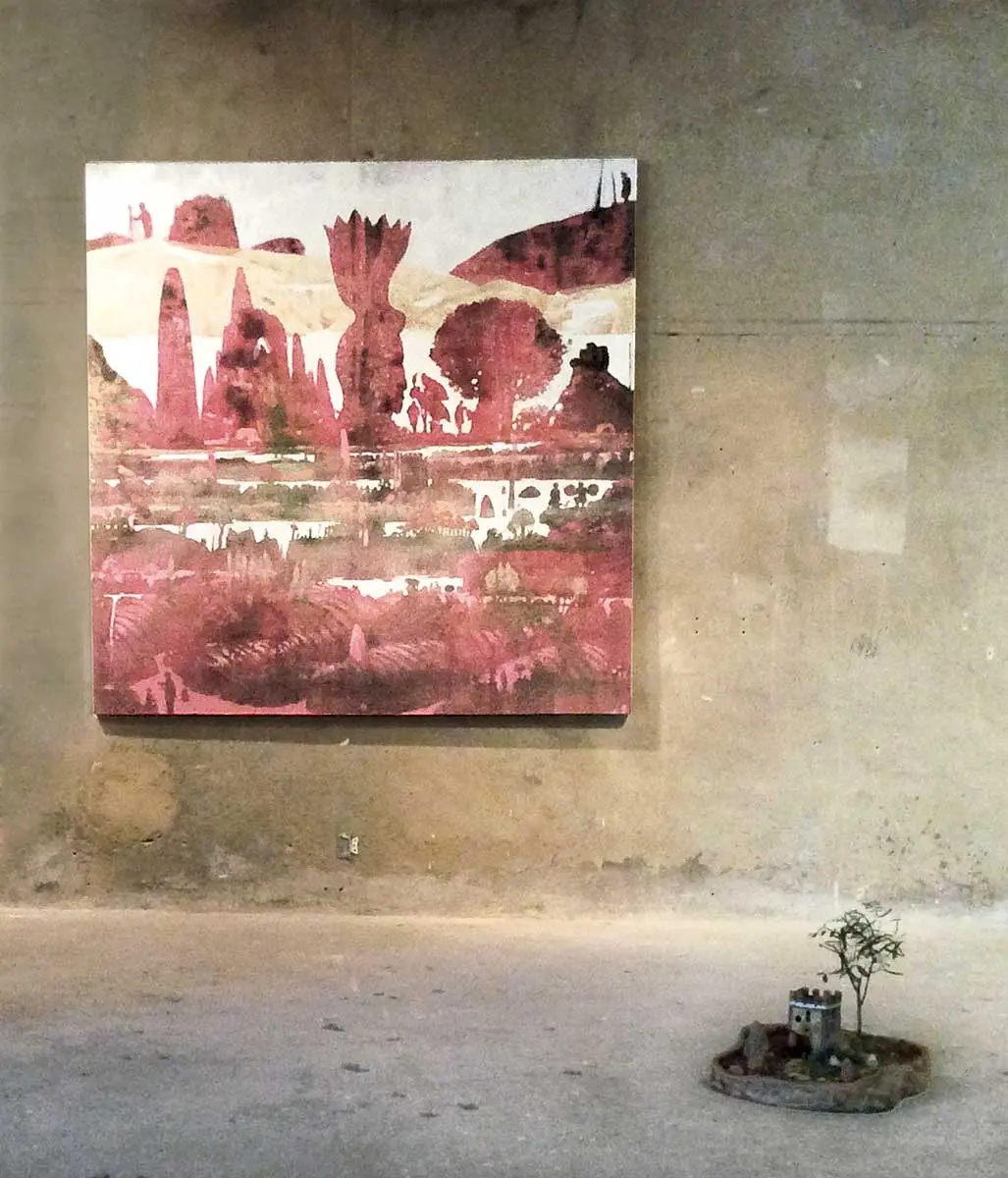
A lover of nature, Silva owns a small collection of trees, bonsai, and succulents. Each one of these works receives special care in his studio; he builds them their own ceramic habitats without even considering it an art project. Silva is not interested in a vision of the world as fragmented between art and non-art, but in the care and contemplation of everything he does. Some eight years ago, a small pine tree died in his studio and, he tells us, once it was dried he unearthed it and kept the skeleton of what was formerly a tree. After a few years of contemplation, he realized that its shape was much more forceful when turned upside down, with the roots up. In this way, it appears as a mythological being inhabiting the artist’s studio as if reflecting the whole of Bataille’s low materialism in a single yet conclusive operation. This is how Silva proceeds with his art: he builds, he unearths, he turns things upside down, he covers and veils, never abdicating to aesthetic taste but letting his work persist in the world where a volcano, an inverted perspective, a series of stars fuse into a single image beyond the casual viewer’s gaze.
Surely the issue of time is one of the most important components of Silva’s work. When Silva responds to the insistence of volcanoes in his paintings, the geological time comes up; when he is asked about the stars and planets, he talks about the time of the cosmos; when we approach the pictorial exercise, he speaks of waiting and the many layers required by those canvases he will always deem unfinished. His is not a linear time, but a time progressively unmoored as we cover the space of his exhibitions, a time that transversally points out how small we are in the midst of nature. In this way, his paintings, which seem immobile and playful, become destabilizing and vertiginous. We who live in a world where the immediacy of the day-to-day is more and more valued, are returned by Silva, in a poetic and anguishing way, to a question about human beings and the cosmos. Silva does with viewers of his art the same thing he did with that pine tree: he turns us around, placing our feet towards the heavens and in silence, because his paintings and objects are as eternal as they are silent; he tells us that time is as capricious, demanding, and unfinished as the laws of nature or as mythical constructions. This is why we are able to observe, in astonishment, how the seeds of giant prehistoric trees such as sequoias need the heat produced by the burning of their “parents” in order to be born. After hundreds of years of growth, the only possible survival is by their own burning, so that their seeds can germinate. Not all of us are aware of these hundreds of years or have the time to analyze them. For Silva, this is all part of the imperious need to continue going to his studio with myths, space, and nature as his permanent companions, which come through constantly in the layers of paint each canvas carries with it.
ANDRÉS GAITÁN TOBAR