
At the MADC, a space of more than two thousand square meters was devoted to the exhibition of works summarizing the career of Costa Rican artist Joaquín Rodríguez del Paso, which spans nearly twenty-five years. Before focusing on some of the works on exhibit there, I’d like to recall the artist’s own words concerning the central explorations in his oeuvre: “What does it mean to be born, to grow, to live in a peripheral economy? To live in an underdeveloped country, and ultimately in a country that is considered an ecological paradise? What does it mean to be an artist in such a society? Is there any validity to our production, being that ours is catalogued as a derivative culture?”
These questions are posited from different standpoints in the images created by Rodríguez del Paso. It is difficult to circumscribe them to a single technique, given the artist’s clear determination to experiment with media such as painting, sculpture, video, and photography. Nevertheless, after visiting the two levels of the museum, we notice three lines of force that proved a semantic field to his work: color, history, and humor.
A significant example of this tripartite relationship is the series of paintings titled Hotel América (America Hotel), dated between 1994 and 1995. Against a green background and mounted on a lilac-colored wall, the contrast between the work and the exhibition design invited the viewer to lean closer. Observing the details, we noticed the image of a man in European-Renaissance dress, conversing with two seated semi-nude human figures and situated in front of a landscape that opened up through a line of fugue. Below the narrative circle that presented this scene, the recoding of a grotesque painting where we read “America” and “circa 1505.”
This articulation of signs reveals the artist’s acid position concerning the creation of European images of the Americas during colonization. Joaquín Rodríguez del Paso revisits the mages that construed, in cultural terms, the territory of the Americas as a paradisiacal space and, as the title puts it, a space for hotels and tourism. Can we visualize the colonizers of Latin America as the first guests in that vast territory? Or, going back to the image and looking at it in a perverse way, wouldn’t it be more interesting to see them as the first entrepreneurs, responsible
for taking the land from the natives, sectioning it, and, little by little, transforming the population into guests?
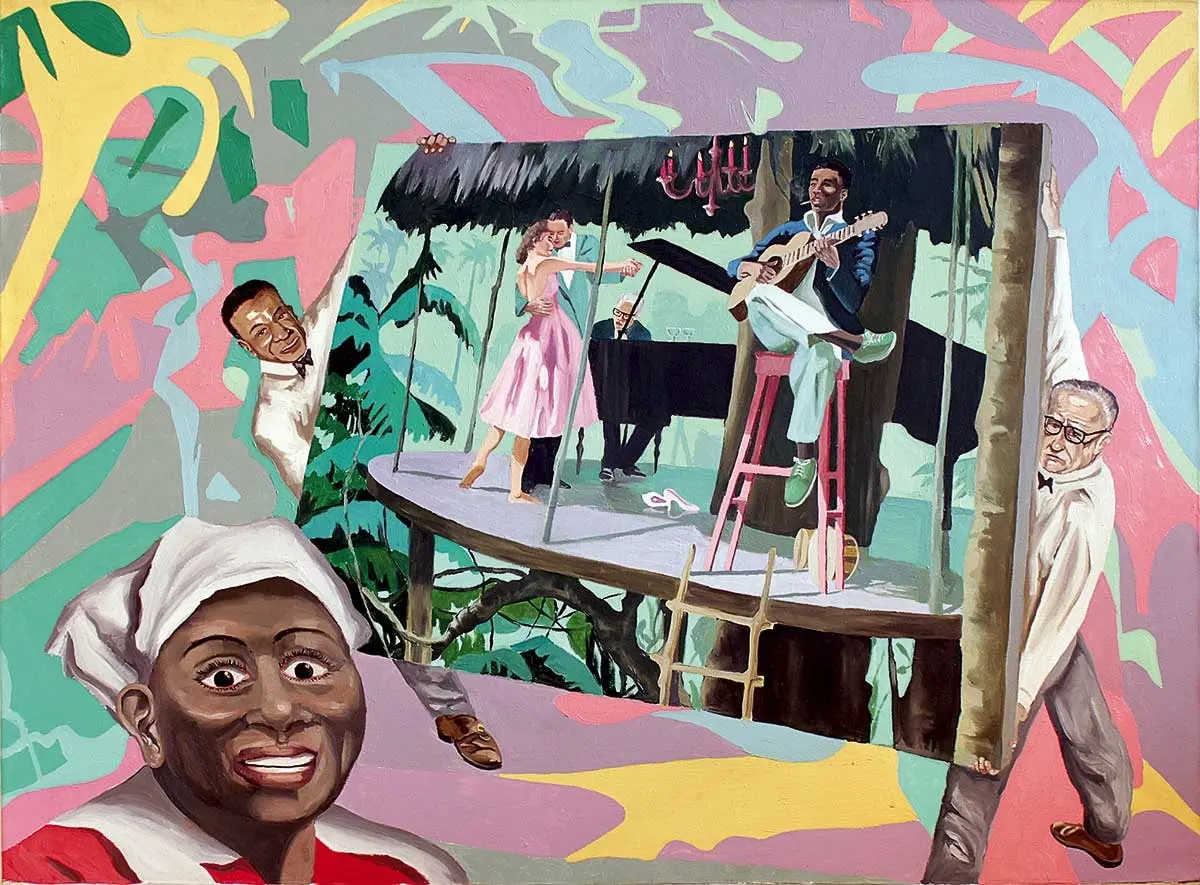
Another image by the artist puts it in a drier and more direct way: America was built many times in a “history in black and white,” where the whites were, literally, carried by the blacks on their backs, and the relationship between colonizer and colonized assigned well defined roles. Even if we are aware of this historical trajectory, what surprises us in this exhibition is how the artist’s gaze does not provide images derived from the articulation of literal images of the relationship between image, politics, and Latin America.
It was difficult not to laugh as we approached Leg godt (Leg Godt), from 1996. On the walls around the sculpture, which stood on the floor, were two sentences wavering between explanation and the confusion generated by the image: “Henry Moore found inspiration in pre-Columbian sculpture” and “Plastic was found in some Maya archaeological sites.” The work, made entirely with Lego pieces, referred to one of the most recognizable figures in the history of the arts found in the territories occupied by the Maya civilizations: the Chac Mool.
While, on the one hand, it is true that in his figures in a state of repose British sculptor Henry Moore dialogued with ancient non-European sculptural traditions, by suggesting the presence of plastic in archeological sites, on the other, Rodríguez del Paso is being ironic not only about “the paths of modern sculpture” (as Rosalind Krauss would put it), but also about the relationship between the West, the culture of consumerism, and Latin America. Art history and its generally Eurocentric point of view was able to identify a type of Maya sculpture, but it would not be capable, returning to the previous paintings, of reconfiguring the clearly colonizing relationship of some of its own historiographical approaches.
It is important to keep in mind the title of this work: Leg godt, which is the Danish term from which the name Lego originated, meaning “to play well.” The phrase is an important clarifying principle for the way in which the artist operates on different layers of images. Be it in a work like Mejen-Go (Mejen-Go), from 2004, where the map of Central America is the support for a game of foosball in which the audience is invited to participate, or in a work that considers the relationship between image and geometry via the design of cardboard boxes for pizza delivery, Rodríguez del Paso’s gaze is perspicacious in terms of its ability to play with materials, shapes, and words, in a game of signifier and signified that keeps the audience smiling, but also in dialogue with the historical and geographical memory of Costa Rica and Latin America.
Going back to the artist’s words, after positing the series of questions above, he comments: “Obviously, there are no answers: only paradigmatic proposals.” This questioning character, free nevertheless of the desire for definitive answers, is what gives potency to his work, reminding us that playing with the image and with history, while not necessarily serious, is always difficult.
RAPHAEL FONSECA