
This was the first North American gallery exhibit for the racially concerned artistry of the Brazilian Jonathas de Andrade who came to U.S. attention in the 2014 New York Guggenheim compendium of Latin American art, “Under the Same Sun.” This exhibition was a smaller version and simultaneous with a more expansive and informative form at Museu de Arte do Rio (MAR).
Brazil, more openly than the U.S., has long debated the importance of multi-ethnicity in the formation of a national identity, a project central to de Andrade’s thinking. He lives and works in Recife in the Northeast Brazil hometown to Gilberto Freyre (1900-1987), whose early (1930s) and multiple arguments for the acceptance of miscegenation as a positive element of Brazilian national identity set off continual explanations and debates that have lasted into today. At least one of de Andrade’s installations claims is direct, but I argue a problematic, relation to Freyre’s concerns for a “racial democracy.”
Indeed, the visitor enters the gallery exhibition under large hanging letters that spell the name of the museum established in Recife by Freyre in 1979, dedicated to a now unfashionable universalizing view of humanity (mostly male) and which de Andrade installed in the Guggenheim show, “Museu do Homen de Nordeste.” He recreates a version in the rear gallery with samples from his many posters featuring males he has photographed from the area with the museum title across them as a reported critique or updating of Freyre’s orientation.
He felt that Freyre’s models were somehow disconnected from contemporary conditions. But the specifics of his complaint and how his selections change things, aside from their date in time, remains very unclear. The most interesting part of the installation are the interviews he conducted with the men, several of which are photocopied on acetate so the viewer can select and project on the wall. Few visitors did so while I was there but it does provide a clue as to how the works and the installations both fail and succeed.
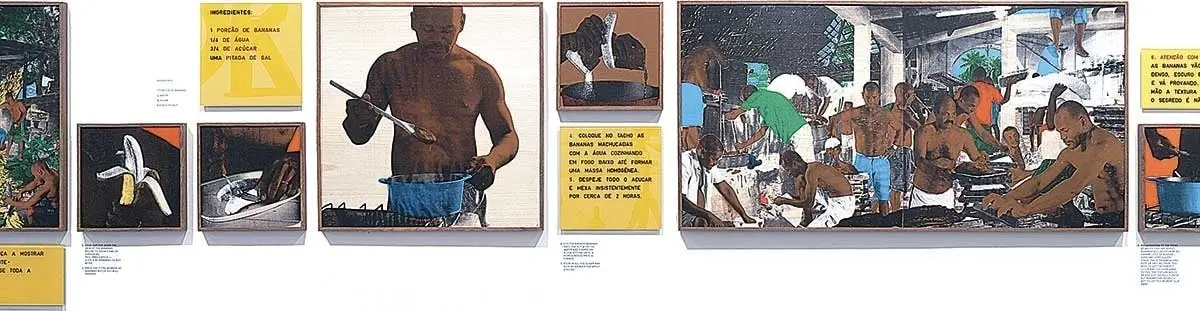
The two walls of the central gallery area are needed to display the various parts of his largest installation project, titled “40 nego bom e 1 real” and translated as “40 Black Candies for 1 Real.” The immediate referent is the name of a popular black candy in Northeast Brazil, made from bananas and sugar. “Nego bom” is literally “good black” with the obvious overtones of plantations and colonial history.
The left wall is a presentation of the process of making the candy through a combination of screen prints and wall texts in Portuguese with English translations. We assume the images are of the workers, in collage groupings and single images, in various degrees of work and relaxation. The general tone is of contented work, with none seen working very hard—one man lies in a hammock and eats the candy, others take breaks when they feel like it, none of which could be the case in factory production. The implication is that this is a critique of company propaganda on behalf of the “happy worker” syndrome and its hidden economic structures but there is little here that makes the case directly, with no information to the contrary.
The layout on the opposite wall is confusing but seems an attempt to sketch through images and text a diagram of the workers in the banana plantation village, using images of workers, text cards, and a collage with each of the 40 workers numbered. The viewer is to match numbers, figures, and what seem like interviews on the text cards that record random bits of biography along with comments on working conditions and now and then salaries at about an average of US $40 per week….if you can read Portuguese.
The overall tone is of a community that knows everyone’s business and exists on small payments and few possessions with no real provision for their welfare. But it is problematic in that the viewer has to assume the truth of the interviews—if they can find the Portuguese to English translations that are hidden in a small basket on an opposite wall—while interpreting information to form some narrative, which was an impossible task. The three other works in the exhibition suffer similar conditions.
There was far more context provided in the Rio exhibition, an element these works desperately need to function as intended. But there is also a fundamental “leap-of-faith” problem typical of imaginative documentary approaches that rely for their impact on information, then withholds it and uses the general disclaimer that at least some undefined conversation was initiated. The aesthetics of the white cube of the gallery has yet to catch up with the information age. Ironically what does emerge and is admirable is exactly what de Andrade seems to want to critique in Freyre, the nobility of people, labor with identity emerging as life is lived within the projected “racial democracy.”
RICHARD LESLIE