
In 2000, the Centre Régional d’art Contemporain (CRAC) presented a group exhibition of contemporary Argentine artists entitled “Buenos Aires In and Out.” Inaugurated in 1997 and directed by art historian Philippe Cyroulnik, the CRAC continues to have an interest in the art of our continent and particularly in South American art. Although located in a mid-eastern city in France, this public institution is strategically situated between two major artistic centers: Basel and Strasbourg. Its geo-cultural location is further enhanced by its proximity to Le Corbusier’s Chapel of Notre Dame du Haut in Ronchamp and Fernand Léger’s stained-glass windows in Audincourt.
Following the first exhibition by Jorge Macchi alongside French artist François Bouillon in 2001, the CRAC presents a major retrospective of the Argentine artist (Buenos Aires, 1963) that consists of twenty-four works including videos, paintings, installations and drawings, in a show that is the first of its kind in France. In this former industrial workshop, the apparent height of the metal structure multiplies the space and allows a clear view of the pieces displayed and the museology. Aside from the singularity of each piece and its autonomy, the group of works represents a conceptually coherent proposal that makes “the invisible visible” and emphasizes the complicit relationship between the pieces, despite their differences. With the first look we receive the impact of work whose subtle intelligence gently mucks the logic and reason for the objects, threatening or overcoming the imposition of reality and thoroughly transforming it, as it questions all levels of meaning. It is a work that divests visitors from their assumptions and invites them to build, with varying degrees of success and uncertainty, other stories for the object based on their deviation or fragmentation. Outside the building, visitors are greeted by a work especially created for the exhibition: the word Entrada (Entrance), written backwards with black letters over a white background (2015) shows, from the beginning the type of universe that they are about to enter.
Although it may not be appropriate to speak here of themes or evoke arguments, it does not mean, however, that they are less relevant, present, clear or evident: speed, time suspended, the fragility of borders, illusion, loneliness or melancholy; utopia or enchantment. The paradox of a potential fiction emerges, more or less consciously, from the installations to the individual works, but never truly reaches the status of a narrative. While the themes could be described as “abstract,” in certain instances however they are not free from a true ludic desire. There are mental or dreamt images within the challenges for which Macchi stretches the boundaries of meaning and searches for dialogue or equilibrium between opposites—such as permanence and its disappearance, the frugality of detail, the inappropriate object, memory and reality, among others. The artist confirms their presence in the origin of this work whose scope—whether poetic, intellectual, aesthetic or social—is based on the interaction between verbs and images that have the double specificity of questioning the imaginary boundaries of reality.
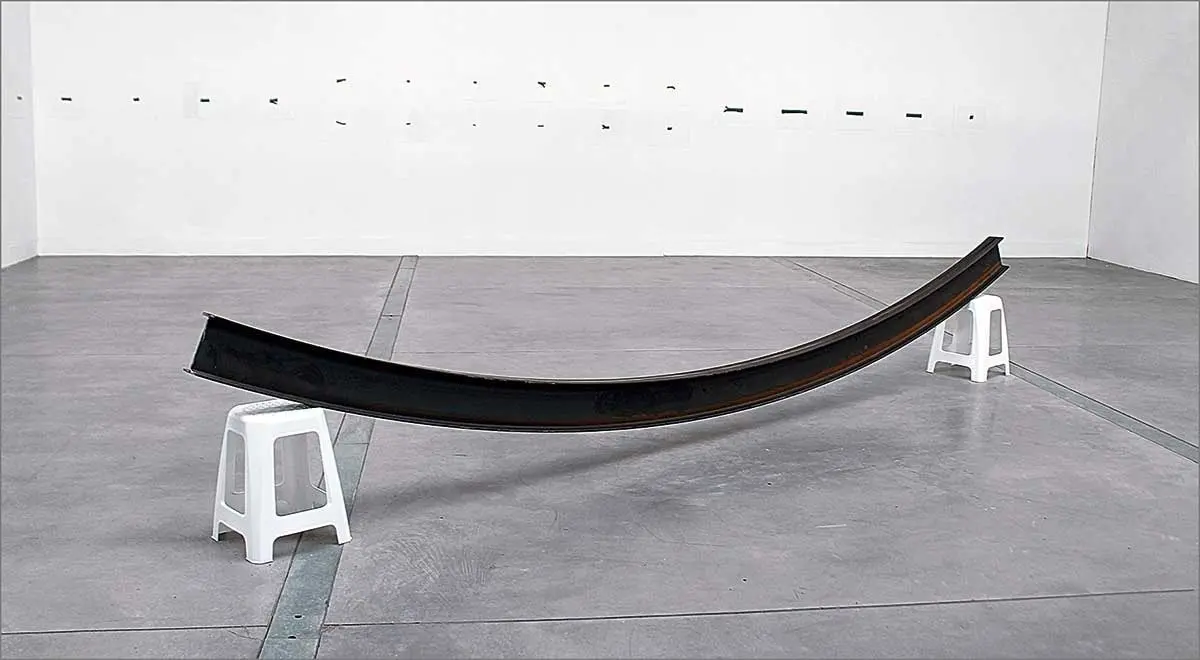
Two large paintings begin the walk through the exhibition and immediately establish the question of an outdated perception. The works Memoria Externa 05 (External Memory 05, 2013), which show the roof of a submerged car, and Memoria Externa 07 (External Memory 07), face the video Streamline (2006), which shows images of moving cars that are punctuated by the complicit soundtrack by musician E. Rudnitzki. The videos presented are brief. They include Víctima Serial (Serial Victim, 2000), Diario Íntimo (Intimate Diary, 2006), in which it is possible to observe words taken from newspapers or magazines such as “Super 8” (1997), “Segundo” (2013), among others. Their short duration makes them a sort of visual haiku to be captured in its almost invisible referential brevity. To Macchi, the poetic and temporal dimension also involves sound, carefully reworked and mixed, which is an integral part of the work. Several other pieces stand out: the sequence of 32 black gouache works on paper titled 32 Piezas de Agua (32 Pieces of Water, 1994), which the artist describes as pieces of the Seine. And at the center of the room, there is the sculpture, also minimalist in essence, titled Pendulum (2013) whose curvature, supported by two plastic chairs, defies any equilibrium and questions any contradictions (heavy /light). The installation titled Refracción (Refraction, 2012) occupies an entire room and “immerses” visitors in the illusion of the fractal and fragile immersion of 25 metal rods—1.70 m each—that rest on a wall painted gray at eye level.
With the collage titled Lilliput (2007), Macchi broke geographic maps and threw the pieces at random (right or backwards) on the paper support to create a new world “disorder;” with the installation titled Horizonte (Horizon, 2002), Macchi interrogates infinity and continues to “cover” and “discover” the senses and identities, cultivates mystery or enigma, and approaches “shadows as the spectrum of form, the sign of its dissolution.”
CHRISTINE FRÈROT