
From January 15 to February 21 the Cristin Tierney Gallery presented the “Wormhole: Lina López and François Bucher,” an exhibition that consisted of the video La nuit de l’homme (The Night of Man) and a group of works that emerged from the collaboration of both creators. The show inaugurated the Black Box program of the Cristin Tierney Gallery, an initiative centered on showcasing the proposals of artists working with new media and the moving image, which is part of the institution’s annual program.
Spatially speaking, the central piece of the exhibition was Bucher’s video La nuit de l’homme, which occupies the first and largest room of the gallery. This work dating from 2012 is part of the explorative and inquisitive spirit that ran throughout the exhibition and that revised the mechanisms by which knowledge is constructed and the way in which we understand, and are limited by, the notions of what is “real” or “true.” The film is a fragmented narrative in which events of a “mystical” nature turn out to be the common thread: a medium in Poland embarks on a mission to Egypt guided by a spirit—identified as the Sumerian god Enki or father of Earth—that manifests itself through her; contacting a man on a sacred mountain in Peru also becomes part of the story. To which end? To save humanity from an impending cycle of destruction. All told from the perspective of someone who has had a shamanic initiation ceremony in Colombia. And, as the story progresses, the narrative attends an experience in which the line between those things assumed as reality and those regarded as supernatural is inevitably blurred. This 80-minute film also combines the genres of fiction and documentary precisely to engage viewers in that logic that revisits those notions on which we base our own understanding of the world.
Earlier works by Boucher already offered a multidimensional understanding of the universe and of time and space. His reference to the idea of “the duration of the present interval” proposed by Mexican psychophysiologist Jacobo Grinberg-Zylberbaum already demonstrated that way of approaching his work. Grinberg-Zylberbaum developed his entire research in close connection with the esoteric experience, shamanism, meditation, yoga, and other spiritual traditions. His explorations point to the malleability of time, and thus, to the possibility of expanding the present moment—that space where the ephemeral and the eternal, the material and the immaterial coexist—notions that are present in the video and that address the quote from Borges that appears at the beginning of the film. Likewise, Grinberg-Zylberbaum also expresses the idea that energy and matter are interchangeable and, therefore, two minds could influence one another without the need for anything physical to mediate and regardless of the distance that exists between them.
In this manner, this video proposed the conceptual presuppositions that the other works in the gallery’s second, and smaller, exhibition room were also going to address. Therefore, viewers were already immersed in the logic of the proposal by the time the entered that second exhibition space. And it is there where we found the conceptual nucleus of the show: Wormhole, the work that gave the exhibition its name. It consisted of a group of works from 2014 and 2015 that were the result of the collaboration between López and Bucher.
The term “wormhole” refers to a concept in physics also known as “Einstein-Rosen Bridge.” It is a hypothetical topological feature of space-time that would essentially be a shortcut through those two dimensions. A wormhole has two exits that are connected to a single conduit through which matter could possibly move. Based on this idea, López and Bucher established a connection between an Egyptian tomb—located in the Valley of the Kings in Thebes—that belonged to Ramses V and Ramses VI, and the Svalbard Global Seed Vault in Norway, a seed bank also known as Noah’s Ark that was launched in 2008. A composite image showing two photographs—the entrance to each of the aforementioned buildings—was the central part of the installation. Each of the photographs in the image occupied one half of the plane and allowed viewers to appreciate the formal similarities of both spaces, which appeared to complement each other perfectly. These are two places with different characteristics and functions that belong to very different cultures and time periods and without any apparent connections between them. On the one hand, the Egyptian construction contains representations of the “Book of the Earth” centered on the creation, cycle of death and rebirth of the sun, as well as on the resurrection and the cycle of life. The seed vault, on the other hand, is an underground reservoir of millions of crop plant seeds from around the world, designed to safeguard biodiversity against any global catastrophe. It was built in a mountain of sandstone and the seeds are stored in airtight boxes and at low temperatures, which allows their conservation for centuries.
Somehow the artists established a dialogue between the two structures and connected them by using the idea of the wormhole. Both were then linked through a shared canal that ran through time and space to converge in a dimension that allowed us to see similarities in the way both structures related to the cycle of life and its understanding. Comprehending conservation and rebirth were the basis of these two structures that in the end functioned like time capsules. A body or a seed ultimately constitute the germ of a future life, a new life, an eternal cycle.
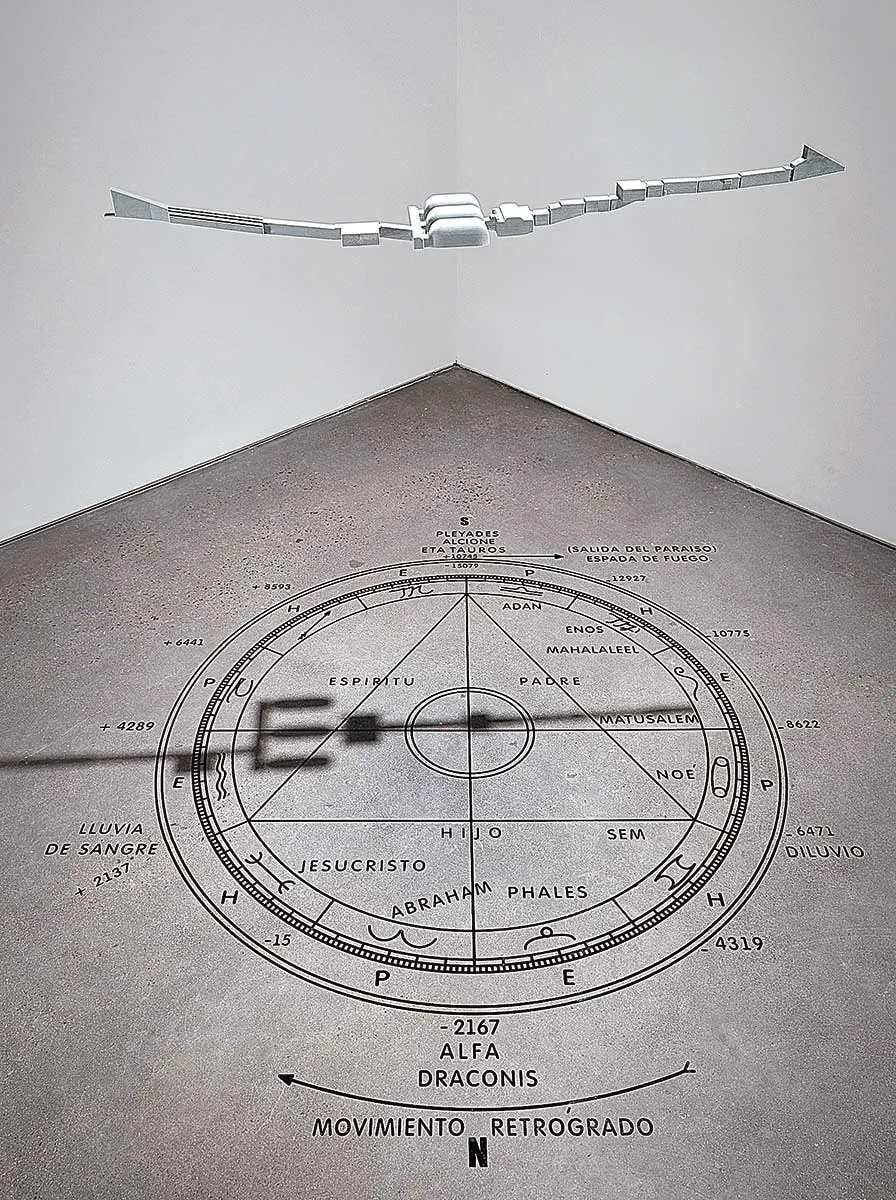
The installation also included a photographic print of a 3D model that described the likely type of communicating conduit between the grave and the depository. There was also a diagram on the floor that appeared to be related to the cycle of the Sun around Alcyone, a process that takes 24,000 years. The diagram also incorporated biblical references to the different generations of the Old Testament and the concept of the Trinity (Father-Son-Holy Spirit). This graphic designed by López and Bucher also made viewers rethink the way we develop our knowledge, the manner in which we think of time and space as linear dimensions or form our view of the universe, of history, as well our way of tackling that discriminatory exercise between the “real” and the “supernatural, spiritual, intangible ...” that we insist on defining—from a materialistic perspective—in the context of our relationship with the world.
Two other works completed the group: He Who Hides the Hours and Le Temps qui Reste (Time to Leave). In line with the dialogue established in the previous pieces, the first of these two works combined an hourglass and a photograph of an Egyptian motif. The second was a piece from 2014 exhibited by the two artists before that turned out to be the perfect finishing touch for the group. It showed a small and light element in constant motion inside a bell jar. It resembled a butterfly, but the information label about the work defined it as a flying seed. Further information established that the piece referenced a myth about the sacred tree of the Kogi indigenous group in Colombia. According to this myth, the tree leaves are transformed into butterflies the moment they are touched by the wind, or into fragments that permanently float in the air if touched by light.
Generally speaking, the exhibition proposed revisiting knowledge construction mechanisms established by a materialistic perspective of knowledge that bases our idea of truth on exercising distinctions between notions like “myth” or “reality” that are regarded as antagonistic. The return to the ancient sciences and the assumption of a multidimensional understanding of the world point to the legitimacy of a cognitive revision intended to rearrange the order of disciplines and types of knowledge.
The arrangement of the installation components, the use of dim light directed at the various parts, as well as the use of the bell jar, evoked the feeling of being in a museum of archeology or natural history looking at objects that appeared to be magically charged. It would have been interesting to organize the exhibition space in such way that the installation Wormhole could have also become the spatial protagonist of the show, given that it was the conceptual nucleus of the show. But instead, it was located on the second smaller gallery room while the video occupied the largest space. And although the idea was to give prominence to the visual aspect so as to take into account the Black Box program, this work was not mentioned in the press release or in the artists’ statement, which could be read as part of the materials offered by the gallery along with the clues to approach the exhibition.
However, the exhibition is a valuable and immersive experience, and perhaps its merit could also be its greatest risk: it demands considerable time from viewers and the willingness to engage in order to unravel the multiple layers of references and condensed knowledge contained in these works. It is not about instant visual interaction with the viewer, so common in exhibitions today. It is a story in another time that gives us the option of either entering the tunnel to explore history or staying completely out of it. I definitely recommend the former.
MEYKEN BARRETO