
“The Mediocrity of Beauty” is an exhibition that offers works and theories by Luis Camnitzer. While this solo show will certainly be valuable to followers of conceptual art, those less interested in this artistic current or those who do not know much about it, will nonetheless benefit from reading the essay by Camnitzer included in the catalog1 of the exhibition and relevant beyond the works presented at the gallery. The conceptual works by Camnitzer are not arid. They address tragic aspects and sometimes rely on irony. The practice of this artist hopes to encourage viewers to become part of social consciousness planes that lead them through various stages until imagining a ludic exchange of roles. While “The Mediocrity of Beauty” is not regarded as a retrospective exhibition, the works presented cover the period from 1968 to this day. The broad spectrum of media that the author works with includes engravings, installation, object, painting, mixed media, photography and video. As for title and content, the exhibition could be summarized as the limitations imposed by beauty—wrapping, symmetry and perfection—which can make one be trapped solely by what the wrapping offers. In other words, “The Mediocrity of Beauty” can offer immediate and futile satisfaction to the detriment of the search for content (when there is any).
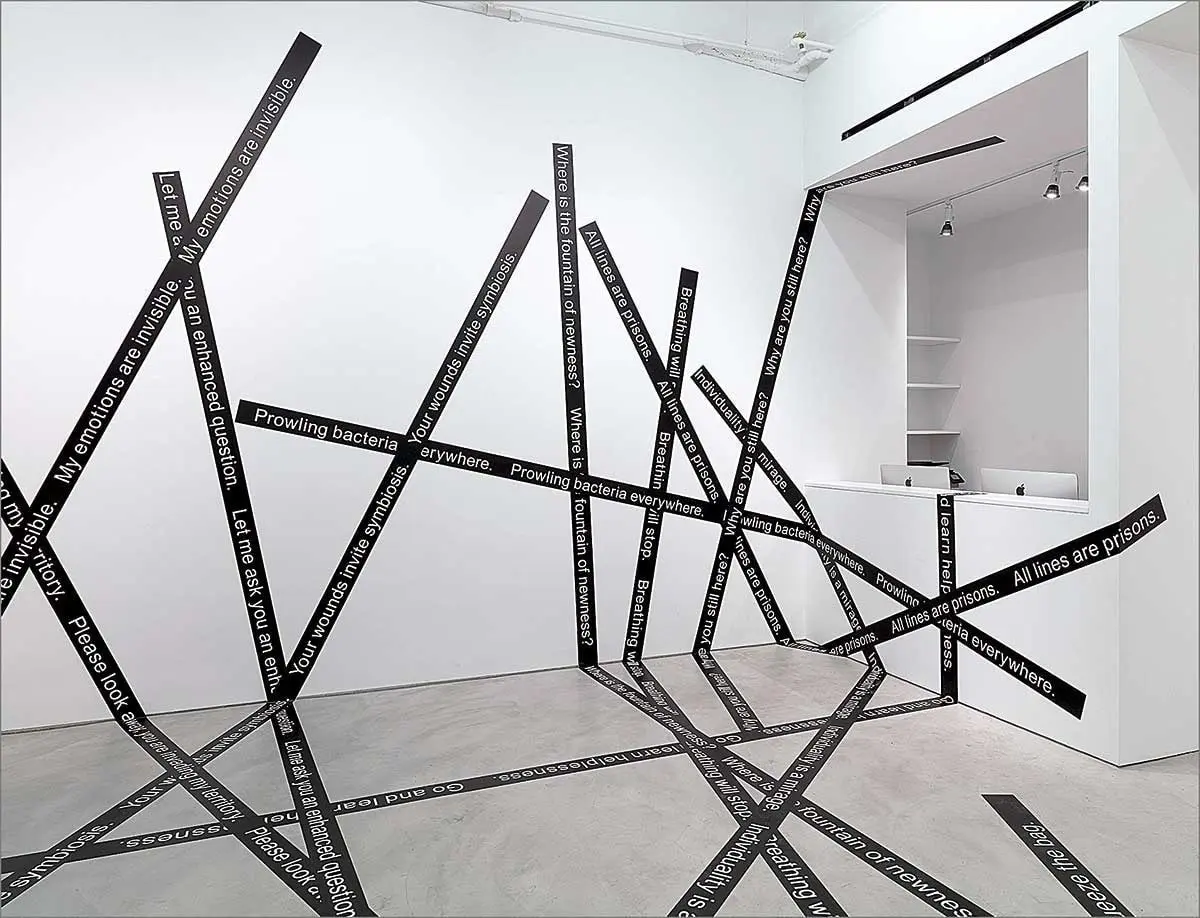
Born in Germany in 1937, Camnitzer grew up in a Jewish community in Uruguay. The artist exudes a culture that fostered the reading, studying and perceptual acuity that was incorporated into the exile, persecution, dictatorships and torture of a group of people. Migration did not isolate him from the tragic experiences that those who loved him wanted to spare him from experiencing. The anguishing Nazi period had its counterparts in the Latin American dictatorships of his adopted geography. In Camnitzer’s work, inhuman humiliations give rise to the construction of meaning through expressions that are closer to notes than to visual aestheticism. There are no verifiable references in his artistic vocabulary to the conquest that began in 1492, as his production centers on the twentieth century and is autobiographically structured. Luis Camnitzer is a political artist within the context of denunciation, synthetic accusation and skepticism. He has published numerous articles and books. While his written language belongs to the Latin American left, his place of residence and work has been nested in the full-fledged capitalist society of New York City since the 1960s, when he founded with Liliana Porter and José Guillermo Castillo the New York Graphic Workshop. The exhibition includes the installation titled Please Look Away (2015), with texts on adhesive tape, a very popular material in the last two decades. This type of installation offers viewers a dualistic experience that can range from stepping on art to being trapped by it. Another of the works presented is Jane Doe, one of the Camnitzer’s inquiries in which he addresses proportions, prototypes, percentages and distortions in a search for criminal abnormalities as compared to the futility and emptiness of beauty, its relationship with symmetry and with a lack of creativity. In addition to being one of the few paintings produced by Camnitzer, the work Painting with Titles is relevant as an example of the irony of values. The author places the possible titles on the painting for everyone to see, before the discerning gaze of viewers, to whom Camnitzer assigns the power of using their experience to approach the work. It is an expressionist abstraction that has on its upper right side six neatly displayed information cards with typed possible titles/suggestions/interpretations: Pajonal Revuelto por el Viento del Otoño (Scrubland Stirred by the Autumn Wind) Orquesta Tribal (Tribal Orchestra), Pintura Recordando un Día 24 de Febrero (Painting to Remember the Day of February 24) El Conflicto entre el Pincel y el Instinto (The Conflict Between Brush and Instinct), Conflicto (Conflict), Casa Ruinosa (Posiblemente de mis Abuelos) (Dilapidated House [Possibly my Grandparents]).
Symmetrical Jails is a recent group of seven engravings that incorporate the word symmetry in the six official languages of the United Nations, in addition to German which Camnitzer adds. He relies on graphic design formats to support his theory that “Words are never able to fully convey what one truly thinks: thoughts and feelings are pressed into an alien format, like when poetry tries to imprison poetics in stiltedness. Symmetry worsens this by curtailing the freedom of information.” As Camnitzer stresses the mediocrity of “beauty” and explains the reductionism of “symmetry,” he also elaborates on “elegance,” the “sublime” and—not forgetting Wikipedia—cites some characters—among them, Henry Moore, with a kind reference (which, didactically speaking, merits further explanation from Camnitzer directed to the uninformed reader, and that can be understood as a motivational suspension of the judgment against the experts).
In his works of art and in his essays, Camnitzer relies on metaphors—or rather, on a sequence of metaphors grounded in everyday life. It is indisputable that Luis Camnitzer expresses himself with clarity, almost always combining theory with the personal. In that manner, he declares his reasons for being an artist. According to him art “is a category in which I can speculate about all things and propose alternative orders to conventional and authoritarian ones”; and adds that he chose art to encourage creativity in others. In his transgressions the author goes through several tunnels—even through a Beuysian one—in which he dialectically poses a meaningful ending that is synthetically enounced as a parallel between art and politics. Luis Camnitzer is an emblematic proponent of conceptualism within this time of transmodernity.
NOTE
1. Version revised and corrected by the artist, based on ¿Quién le Teme a la Belleza? (Who’s Afraid of Beauty?), ed. Javier Domínguez et al, Medellin. La Carreta Editores, Universidad de Antioquia, 2010.
GRACIELA KARTOFEL