
Monika Bravo is a multidisciplinary artist who takes viewers into a world of non-traditional aesthetic situations and proposes new approaches to the appreciation of the work of art, through perceptive experiences that establish a different relationship with the exhibition space. One may refer to her works as visual integrations. In the sculptural installation titled Paisaje de Creencia (Landscape of Belief) Bravo calls into question the manner in which people build their lives according to their belief systems. Born in Bogota in 1964, Monika Bravo lives in New York since 1994. From that personal exhibition in 2000 to her most recent solo show at the Y Gallery and her current participation in the Venice Biennale, her work offers an experience through which she conveys her intentions: to go beyond… To immerse viewers into aquatic worlds, into urban perceptions and sound and sensorial approaches that reach beyond words.
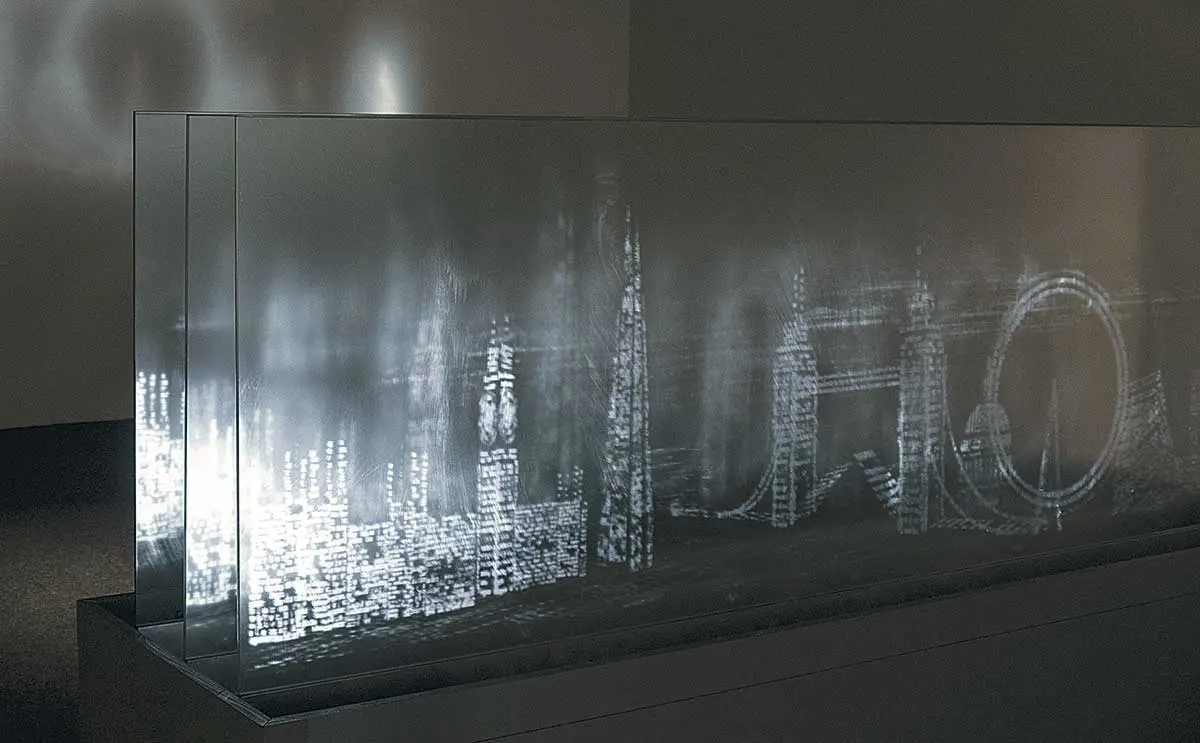
By drawing consecutive parallels between light and translucent planes, literature and architecture, abstraction and figuration, and word and sound, Monika Bravo stabilizes the presence of nothingness over the objects. As viewers walk through the exhibition, its parts gradually merge into a unified whole. Referring to them as illusory spaces partially serves to describe the dematerialized nature of Bravo’s installations. No matter how much the different areas can be individually perceived and despite the undisguised presence of materials—whether these are glass, drawings, film, aluminum, mirrors, computers, projectors, prints on canvas, or any other type—her work offers an illusory experience. But if any part of any of her installations were to be touched with the tip of a plastic object, the ensuing sound would confirm that they are not apparitions.
The artist has mentioned Italo Calvino and his novel Invisible Cities as referents in her work—something that probably comes to mind to those reading these lines. Likewise, Monika Bravo also uses words etched in glass and prints whose evocative nature positions her installations closer to literature than to painting. And since Italo Calvino has been mentioned, the exhibition “Landscape of Belief” is more in line with reading than with observing works by Rene Magritte, whose images appear in several of Calvino’s book covers. Landscape of Belief is not an exclusively digital show since it also proposes another perspective on multimedia. In the same manner, it could be argued that this exhibition corroborates original aspects of virtuality. It is not an installation in the surreal sense, it does not ignore the increasing relevance of intervened documents, and does not delve into science fiction, but some of its aspects fuel the oneiric. Bravo generates ethereal “states” through digital means but she does not specifically define the components. She decided that each of her installations should be executed in editions of 3 plus 2 A.P. (artist’s proofs), with the exception of the properly entitled Paisaje de Creencia (Landscape of Belief), which is a single work plus 1 A.P.
Everything happens simultaneously with individual rhythms. The various Estudios para Paisaje de Creencia (Studies for Landscape of Belief), are approached as prints, as newspaper contacts with typographic skyscrapers, as past architectural studies. The installation in glass with successive layers of the same image, the projection of words and the velvety darkness, converge both towards a conceptually approached romanticism and to the scene of a film. Monika Bravo is one among several artists whose metamodernism is partly generational and partly expected. These artists that have crossed the bridge between the pre- and post-digital periods have emerged with a different sensibility; they bear a smaller share of cynicism than the previous generation and mind the value of honesty. They are not free from the conventions of the art market but their conceptualizations are developed in parallel to it. Monika Bravo’s works attend to a motivational subtlety. Hers are not the phrases used by orthodox conceptualists, but are dematerialized reflections instead, ideas that are left suspended while they are being considered.
For those who have not seen the exhibition, there is, on the one hand, the experience that comes from viewing the installations frontally, and, on the other, the experience in which the dislocated planes, resulting from approaching the same images from a three-quarter view, are transformed, reordered and become aligned as the viewer moves to view the piece frontally. The time that it takes to transition from perception to another is important for an artist like Bravo who usually creates time-based installations. This does not indicate the dominance of the ideas or words that appear in the work. An allusion appears, contributes something, establishes doubt and vanishes in the space so we move to the next idea/word, without definitely stopping in any.
GRACIELA KARTOFEL