
For a period of two months, the Centro Municipal de Arte Hélio Oiticica in downtown Rio de Janeiro presented a group of works by Brazilian artist Osmar Dillon. Born in the northern Brazilian city of Belém in 1930, the artist died in Rio de Janeiro in 2013. He participated in the second and third editions of the Neo-Concrete Art Exhibition held in Rio de Janeiro and São Paulo. So there is no question that, on the one hand, this revision of Dillon’s work is relevant for an institution named after another artist central to Neo-Concrete art, and, on the other, that parallels can be drawn between the narratives of both creators, given that in addition to participating in the three exhibitions of Neo-Concrete art, Dillon was also one of the authors of the Neo-Concrete Manifesto in 1959.
Almost sixty years after the first ideas about Neo-Concretism were outlined, it is about time to shed light on other artists who played an important role in that artistic movement but that are not included in the almost sacred triad formed by Hélio Oiticica, Lygia Clark and Lygia Pape, or have not yet been incorporated into the group of those other relevant artists like Amilcar de Castro, Ferreira Gullar and Franz Weissmann, among others, whose trajectories have already been institutionalized. Inaugurated a few months after the retrospective of Amelia Toledo—another artist who constantly produced work during that same historic period—at the Paço Imperial, Dillon’s exhibition invited the public to read a newspaper from the 1970s in which Toledo’s name and his were accompanied by other figures also deserving of revisions. What sensory experience can the works referenced there—by artists like Yutaka Toyota, Paulo Roberto Leal, Raimundo Collares and Ubi Bava, among others—inspire in the contemporary viewer? This is a question that only future research in art history and curatorship can answer.
It is possible to approach Dillon’s exhibition from three different moments placed in three different exhibition rooms. At the entrance the public was received by a series of three-dimensional geometric shapes that almost completely occupied the floor area. The contrast between the separate groups of red and white forms already established one of the essential elements in Dillon’s work and, consequently, in the work of those artists closely associated with Neo-Concretism: color. Through the body of the viewer, the red shapes together formed the word “peace,” while the white ones formed the word “yes.” The relationship between image and word—so dear to the artist—in addition to the question of sculpture as an object to be activated by the public, is already present.
Larger than the first space, the second exhibition room contained cubes, tables and other furniture that served as a support for the various objects created by the artist. A panoramic view of the space allowed the collection of words that marked the semantic field that interested Dillon: “sun”, “rain”, “sky”, “wind”, “moon” and “cloud.” Although there was not an actual landscape to speak of, it is interesting to think that these words that revolved around a repertoire relative to nature are the ones that most frequently appear in this selection of works. Noting the representative role played by color in all these objects, where, for instance, the “sun” is a yellow object and the “sky” a blue structure, it becomes possible to regard them as a re-coding of landscape painting, an important tradition in the visual culture of Rio de Janeiro.
Other objects needed and allowed manipulation by the public. The words “act” and “moon” were deconstructed through the movement of industrial materials such as glass; in the same manner that sheets of paper unfolded within the trio “root/stem/leaf.” We sensed that “moon/sun” and finally “flower” were also contained there. Also in paper, “wind” could be transformed into separate letters and, in acrylic work, the letter “o” in the word “sound” could take the form of a ping-pong ball that, as it moved inside a box, provided an experience connected to the meaning of the word. It is this play between signifier and significance, between the geometric shapes that make up the letters of a word and their relationship with specific semantic and chromatic fields, the narrative that appears to be moving the central production of this exhibition, namely, that of the 1960s.
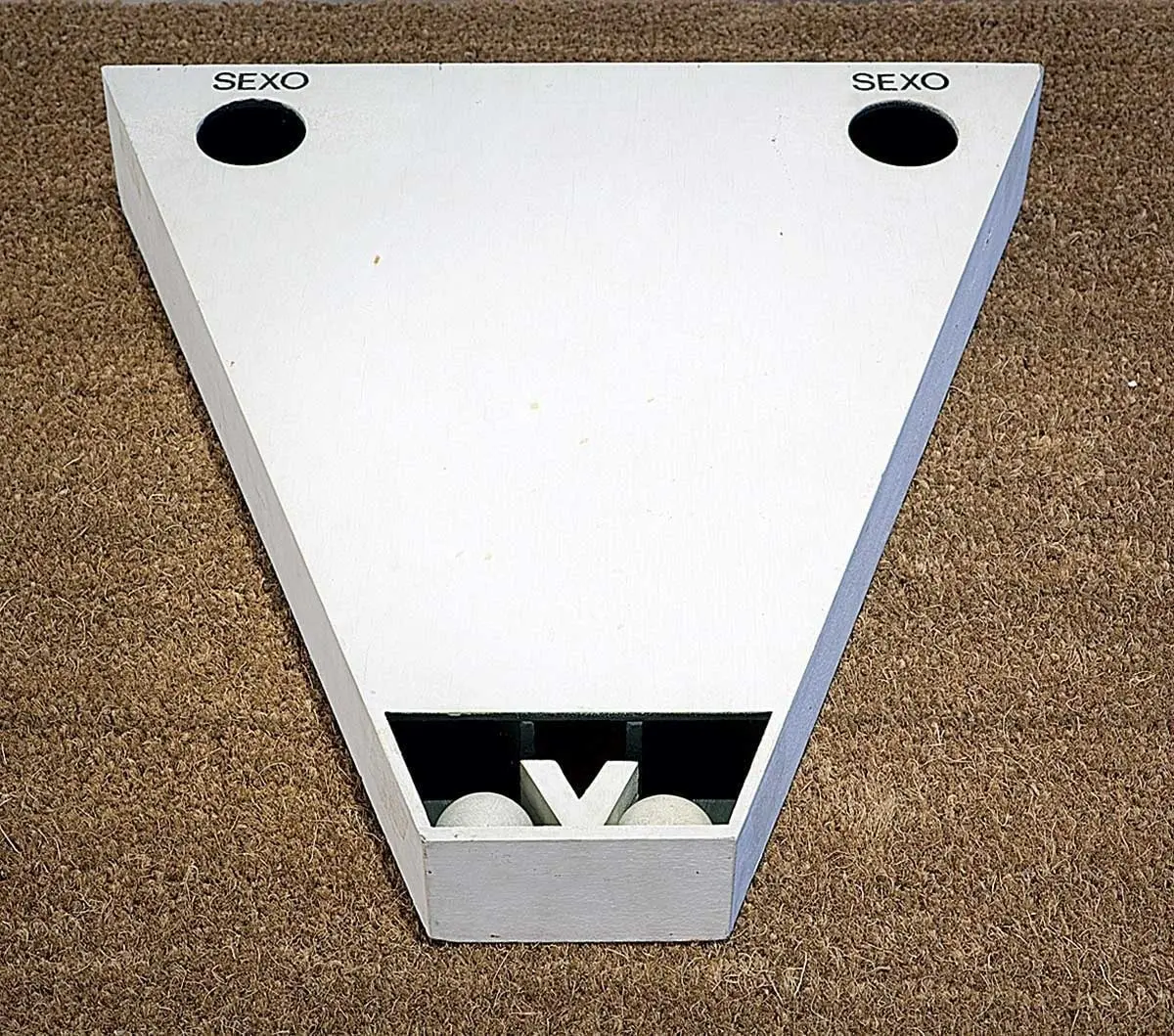
The third and final exhibition room presented and surprised viewers with other explorations by Dillon centered on form. If, on the one hand, it was possible to associate them with the artist’s interest in organic and instinctive words like “sex” and “egg”, the visual manifestation appeared to be dissenting nonetheless. While in the second exhibition room those same two words were interconnected, in the third space once again sex and the human body were present in the geometry and movement of a small ball, which served both as the letter “o,” contained in the Spanish words sexo (sex) and huevo (egg), expressed through drawings that established a compelling dialog with what was agreed to be called “surrealism.”
Breast, forms reminiscent of the buttocks, testicles, human mouths and predatory fish were combined to set the tone of some drawings from the end of the 1940s, along with some paintings created during the latter part of the 1960s and the beginning of the following decade. There was also a drawing series titled “Studies for an Existential Monument” that appeared to rest on tables, but lifted from the ceiling, in which the artist created fictitious buildings and proposed ways of experiencing them through the body. Finally, the third exhibition room also included some poems typed by Dillon that centered on the things that interested him and that were already mentioned here. With the word as the leading element, these works represented another point of connection with the previously observed pieces.
By the end of the exhibition one was left wondering about the work that Dillon created in the later periods of his career, namely, from the 1970s to 2013, which were not part of the exhibition. However, far from attempting a “complete retrospective” of his work (a recurrent claim that always falls short in any exhibition), the curatorship chose to focus on a precisely framed period of artistic production aimed at introducing the public to the complexity of Dillon’s artistic inquiries. One can only hope that this exhibition will encourage other fresh approaches to the work of the lesser-known creators of Brazilian Neo-Concretism, and that other curatorships—and the history of art—are able, not only to avoid creating new dogmas, but to also address differences, summoned images and trajectories.