
One imagines 1980s Chile in black and white. A country where transsexuals and prostitutes did their clandestine work with dignity, with the support of their families, making themselves up and dressing like princesses in the intimacy of a bordello. They laughed, displaying their joie de vivre without any fear. One evokes a Chile where old people caressed each other’s faces and fell in love as they danced. Where a sport as marginalized as it is marginal, boxing, had as its protagonists courageous youngsters who, after leaving their skins on the ring, felt themselves becalmed, at ease. Or one perceives Chile in the 1990s—still in black and white—where the patients of a psychiatric hospital show their affection and their estrangement, their strangeness, with something like pride. Where women belonging to forgotten tribes in even more forgotten lands exhibit their dedication to the sea, their everyday joy, their affection for and communion with the landscape.
And one believes that this is the way things were. And one is right, Because Chile in the 1980s and 1990s was in black and white, and Chileans were not afraid to display their nobility for the benefit of the photographic camera, no matter how discriminated against, set apart, segregated, or distant they were. This is what Paz Errázuriz portrayed.
Although Paz Errázuriz studied education at the Institute of Education at Cambridge and Universidad de Chile, and photography at the International Center for Photography; although she was a Guggenheim (1986), Andes Foundation (1990), and Fulbright (1992) fellow, what is important is what she did with her confidant and collaborator: her Nikon 35mm camera. What she photographed and continues to photograph, because she remains as active as she always was.
Adam’s Apple
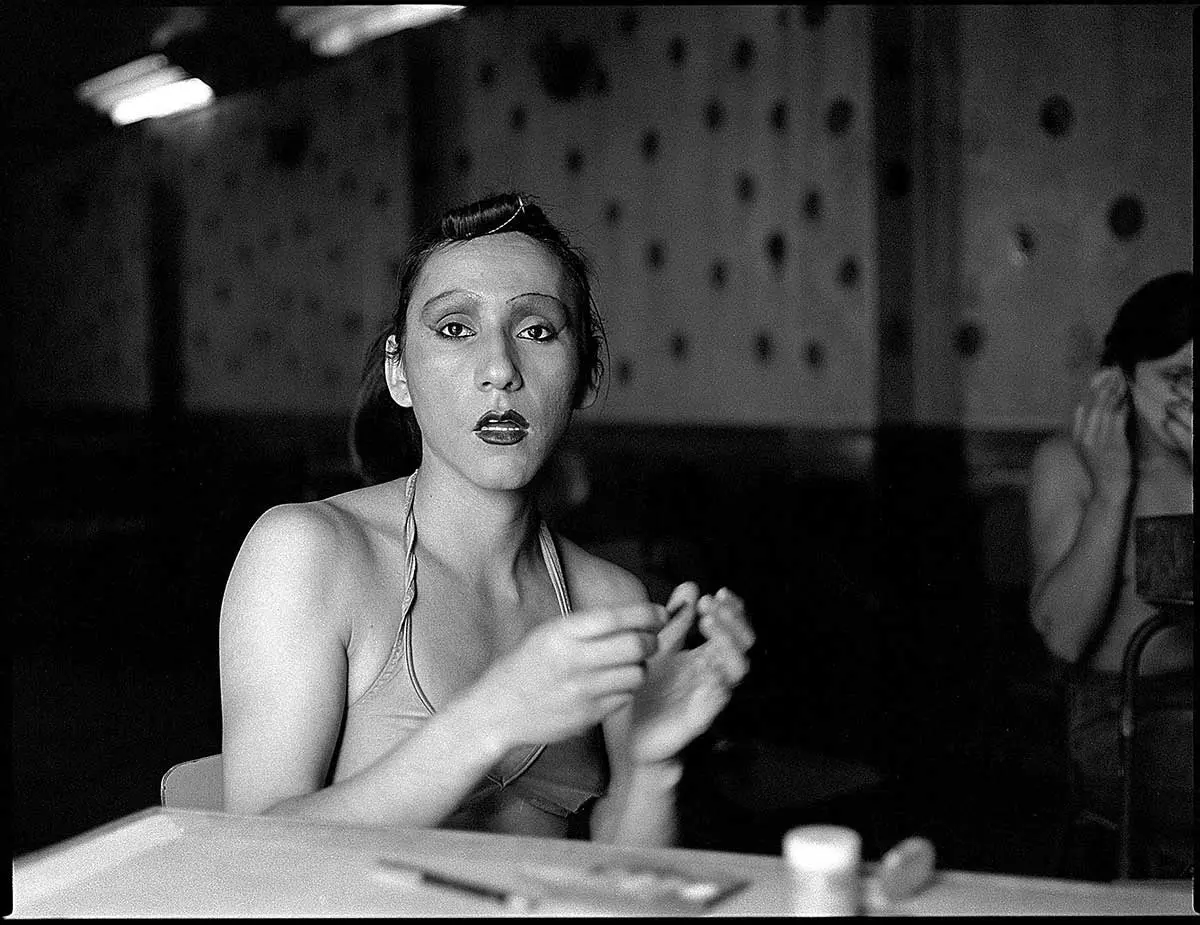
There is no better place to begin then with Adam. The first man. Paz Errázuriz has mostly portrayed women. In this series, one of her first, she captures the private life of transvestites. Evelyn, Pilar, Coral, Nirka, Leyla, Deborah, Andrea Polpaico, Maribel, Chichi, Susuki, and Macarena. Men by day and women by night. Between 1982 and 1987, Paz Errázuriz communed with the inhabitants (and visitors) to bordellos in the Vivaceta neighborhood of Santiago, and in Talca. She got to know their jobs, their families, and their secrets. And revealed them.
Aware that she could never capture their voices, Paz Errázuriz asked Cuban journalist Claudia Donoso to document the conversations. Out of this collaboration came La manzana de Adán (“Adam’s Apple”), a book published in 1990. In this way we met Mercedes, the woman to whom Errázuriz had become closest, the mother of two transvestites:
Mercedes Sierra had six children. The two youngest were Pilar and Evelyn, whom she calls Keko and Leo. “Keko insists to me that he is a woman and thinks he is going to fool me. He has a small wiener. Keko, however, is very much a man: his goes from side to side. When I took them to the hospital to have them checked out, I was told it was because a human error of their father’s. When Keko dressed up as a woman, I hit him so hard I almost killed him. But I am not unhappy now. If God gave them to me this way, so it is. I believe in God and am fearful of him. It wasn’t up to me to protest; I accepted it, because I had no other choice.
Since then, the collaboration between literature and photography became a constant in Paz Errázuriz’s career, working with such figures as Pedro Lemebel, Diamela Eltit, Enrique Lihn, and in casual encounters, for example with Susan Sontag, whom Errázuriz asked for support for the publication of La Manzana de Adán in the 1990s. The book was published with photographs and texts, albeit with little resonance in Chile, which was only awakening to democracy at the time. Recognition would not come until two decades later, when Ama Foundation launched a second edition, with the same title.
This is a story of transformation. Men who become women, mothers who come to accept their sons as daughters, the marginalized individuals who decided to put their ravaged faces on display for the whole of Chile; Chile itself, a country moving from dictatorship to democracy. In this and in all of her series, Paz Errázuriz portrays a transformation, but she is also the protagonist of a shift. An artist who sold a single copy of La Manzana de Adán in 1990, and decades later saw Tate Modern acquire work featured in that book. Chilean artists of the 1970s and 1980s got no recognition from their coevals, who always preferred to look abroad. When they finally looked from the outside in, their eyes crossed. But in many cases, it was too late.
In Combat with the Angel
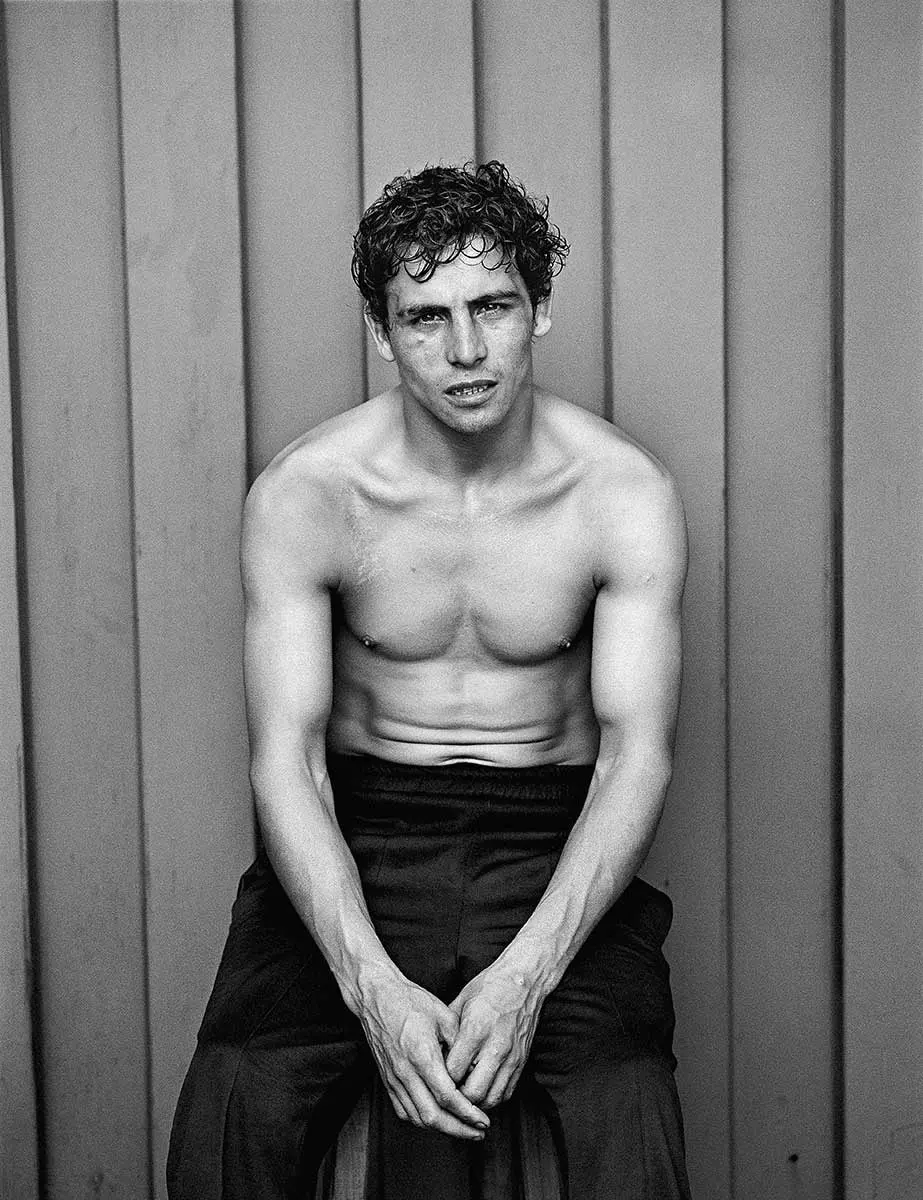
“The Fury,” David Ellis Venegas steps into the ring at the Coyhaique municipal gym. He is to defend his national title in twelve rounds. It is four days before Christmas, which this year will be special: David will celebrate the holydays without boxing. This fight was to be his last; afterwards, he would retire, as he promised his family. But before that he must do away with Abdenago Joffré. They reach round 11. The cards from two judges are tied; the third judge favors Joffré. At that point, however, “The Fury” Venegas is done. He raises his arms to abandon the fight, but “Danny” Joffré doesn’t seem to care. He hits Venegas, brutally, four more times before the referee gets to separate the fighters and declare a TKO. “The Fury” has been beaten. He chats with journalists and walks to the dressing rooms. He takes a shower and dresses for a barbeque he had programmed at home. After dinner, he feels dizzy. He vomits in the street. His head hurts, bad. He is taken to a hospital, where an acute left-side subdural hematoma is diagnosed. Ten days later, already past Christmas, David Ellis Venegas, age 29, dies. A later investigation determines that the fight should not have taken place. An electroencephalogram made a month before the fighters stepped into the ring had detected the effects of a severe concussion.
Four years before, in 1987, a novice David Ellis Venegas, barely a year into his boxing career, faced a benign but implacable rival. Sitting down, his jump rope on the floor, arms akimbo, relaxed. His gaze is direct and confident, but his mind seems to have wandered off. Perhaps he is anxious to stand up and return to his training. His T-shirt shows the logo of a discotheque. Discoelectro “Shock”. His rival jabs from the right. Paz Errázuriz is shooting. She will call this series El combate contra el ángel (“In Combat with the Angel”).
Tango
Errázuriz doesn’t call what she does series, but essays. This is, she believes, a more appropriate designation, because it implies greater freedom. Besides, her photographic projects are never complete; she revisits them often. The preparatory research for her essays can take years. Her work is not circumscribed to the millisecond captured by the camera. In the same way, observing and appreciating the entirety of what her images tell us takes more than one beat.
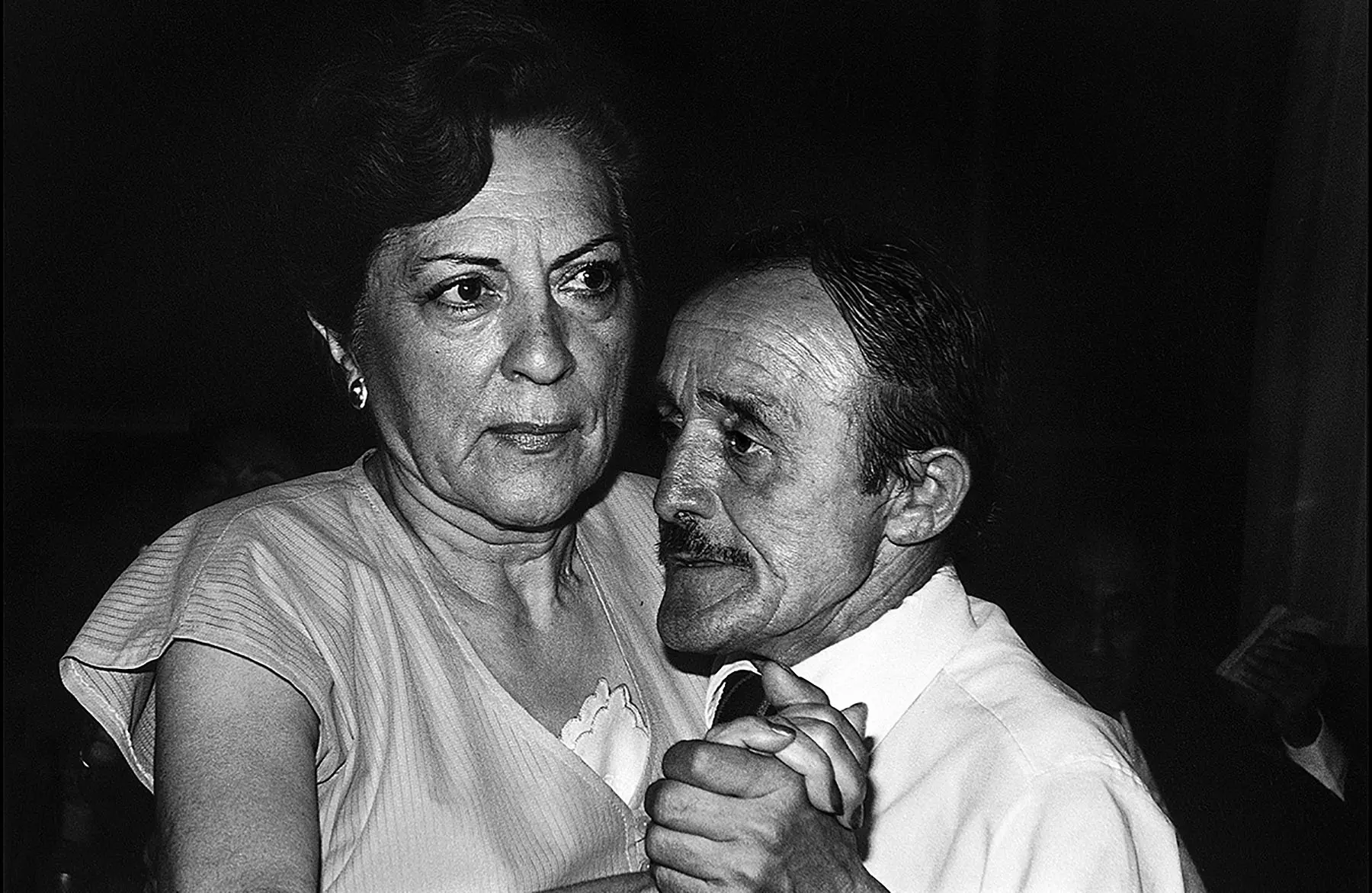
In 1988, she essayed in nightclubs where older couples danced tango. The intimacy of the couples (established or newly formed), the emotions hidden behind their focused dance steps, the hands directing the motion of the bodies: the camera invades the ritual without calling attention to itself, like just another dancer, sneaky, elegant, and sensuous. This is how poet Enrique Lihn described this work: “Photographer Paz Errázuriz has again achieved her goal: to neither distance herself ironically from her subject, nor to sentimentally fuse with it.” In order to not distance ourselves ironically from Errázuriz’ work, or fuse sentimentally with it, I decided to pose the artist a few questions that would, perhaps, shed some light on shadowy corners.
What attracted you initially to these subjects, photographing transsexuals, boxers, marginal individuals?
I think that my work is always about the same thing, and that there is “a continuum” there. I could also define it as variations on a theme. Chapters that point to the same thing. These are closed, marginal, minority spaces. They are outside the system, outside power. They are eccentric. This dimension fits me because from there I am freer to pose the questions that always haunt me, and to interrogate issues of power, conformity, lack of memory, exclusions, abandonments. I think that I move in a space of misunderstandings, where I seek and build my own history. My works always talks about it: I move through sites of invisibility and exclusion, situations that are yet to heal. As it happens, photography had been the master key to enter all these sites.
Do you think that your work was not recognized in the 1980s and 1990s? Why was that, in your opinion?
The country was not receptive to my work. If by “the country” we mean the elites at the center of cultural, political, and economic life, it is really irrelevant to take their gaze into account. The eccentric subjects are also the country, and their “margin” is the center for many. Marginal spaces are not those concerning, as it is often meant, to socio-economic conditions. There are margins where we can all seek refuge when dominant ideas, biopolitical control, and disciplinary devices over bodies and thoughts become too oppressive. In that sense, at least contemporary art in our country lives in relation to eccentric spaces, because they are creative and not bound like the spaces at the center.
I once heard you say that, at bottom, your portraits of other people are also self-portraits.
I think that my photographs are a permanent self-portrait, a private portrait that captures what I recognize over time, which, like a mirror, gazes back at me. Photography has been the master key to enter all the spaces I want to explore.
Often your work has been connected to literature. Nicanor Parra, Pedro Lemebel, Enrique Lihn, Diamela Eltit, Susan Sontag… Where does this relationship between your images and the world of letters come from? Which author or which text remains with you?
My connection with literature has had to do with friendships, with the absence of a specifically photographic criticism, and with the attractive possibility of creating interdisciplinary works. With Diamela Eltit we worked on a collaborative book, El Infarto del Alma (“The Soul’s Infarction”). With Enrique Lihn I worked the visual side of Paseo Ahumada (“Ahumada Avenue”), with Malú Urriola we did the project La luz que me ciega (“The Light That Blinds Me”), which will be exhibited at the Venice Biennale. Working interactively is very stimulating.
A Certain Time
Paz Errázuriz photographed her son Tomás every month over the course of four years. She closed that essay in 1991, before the current fashion for selfies, blogs with pictures of friends that photograph themselves in the same locale and with the same clothes, the movie Boyhood, or The Great Beauty, whose protagonist, Jep Gambardella, was ecstatic in contemplation of the thousands of photographs a father took of his son every day since birth. Un cierto tiempo (“A Certain Time”) came before all that, although this is just an anecdote. What is valuable in this work is not its visionary character, or the curiosity aroused by our observing a child’s growth. Its force resides in its mystery. Capturing the son’s childhood, bearing witness to a transformation, and speaking, above all, of the passage of time. Of a certain time.
The Infarction of the Soul
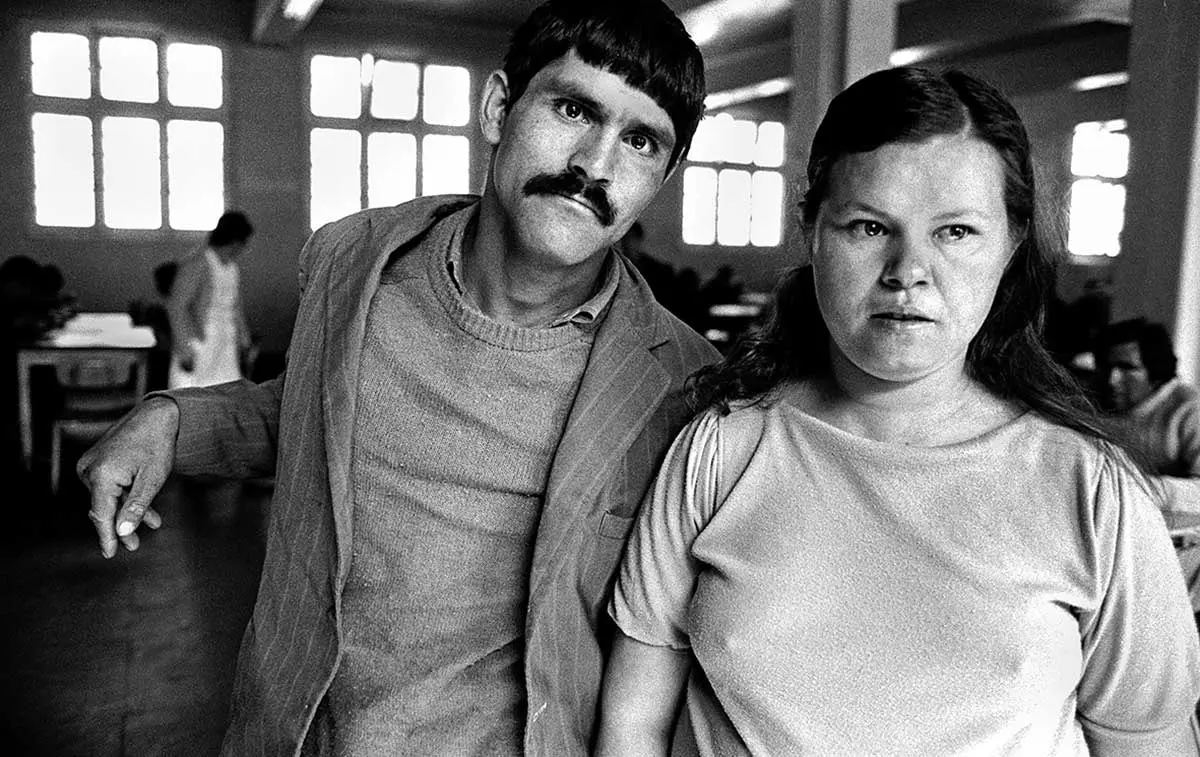
Paz Errázuriz takes her eye and turns it into a gift for the isolated. In her photographic gaze, she gifts them the certainty of her images. Capturing her poses, she confirms the relevance of their figure; smiling at them, she recognizes the divinity of their bodily behaviors. When she leans forward looking for an angle, she is dedicating to them her entire professionalism. (Diamela Eltit, El infarto del alma, 1994)
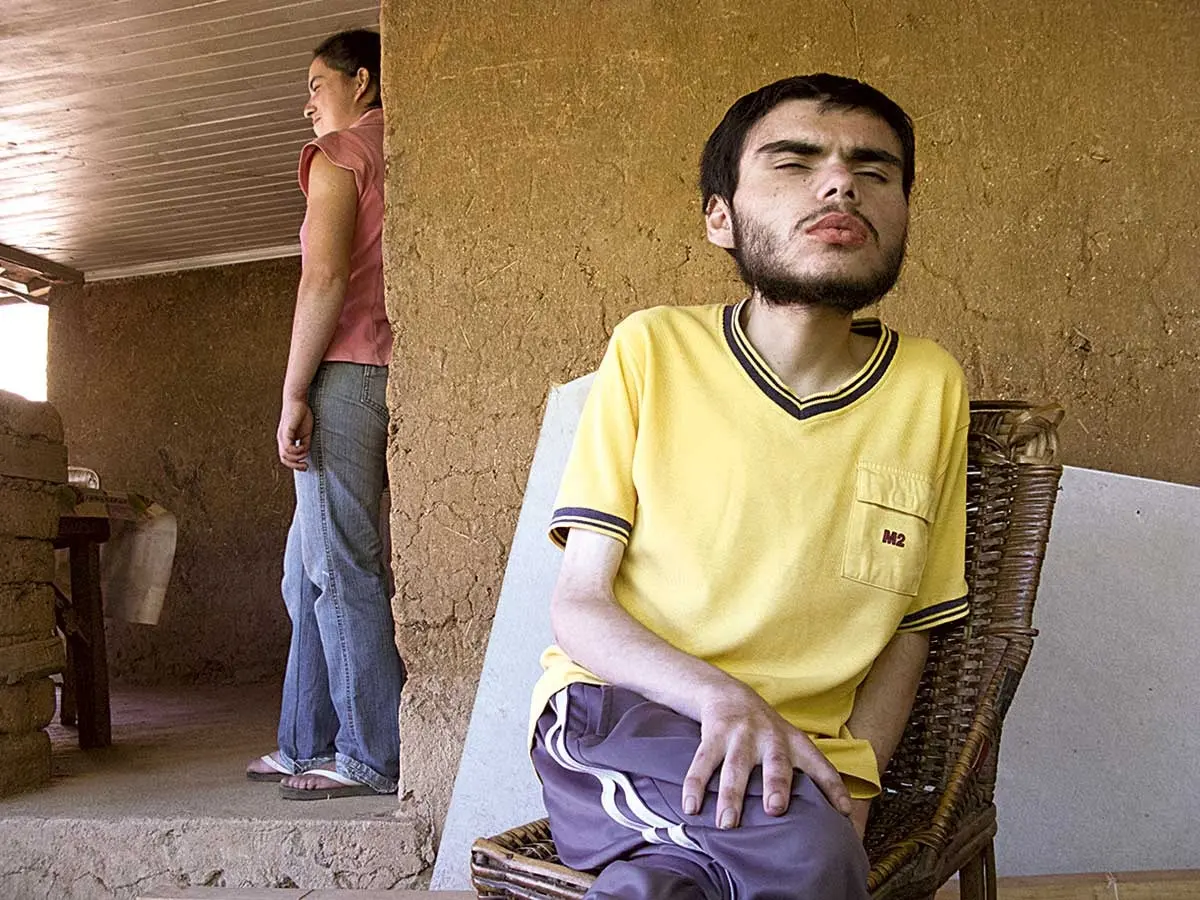
Paz Errázuriz and Diamela Eltit collaborated in El infarto del alma (“The Infarction of the Soul”) at the Philippe Pinel Psychiatric Hospital in Putaendo, in 1994. They portrayed—one with her Nikon, the other with her pen—pairs of hospital patients. “A solid bridge rises between tuberculosis and craziness. The ceremony of love (…) survives today as a debilitated archive of the most forgotten subjects, those most confined by culture” (Op. Cit.) This is a story of passionate furor. As in Tango, emotions are in doubt here. Mental illness seems to affect feelings, or so we believe. On a second look, we discover affection and complicity in the gestures, the smiles, the eyes. And we discover health there as well, plenty of it.
Nomads of the Sea
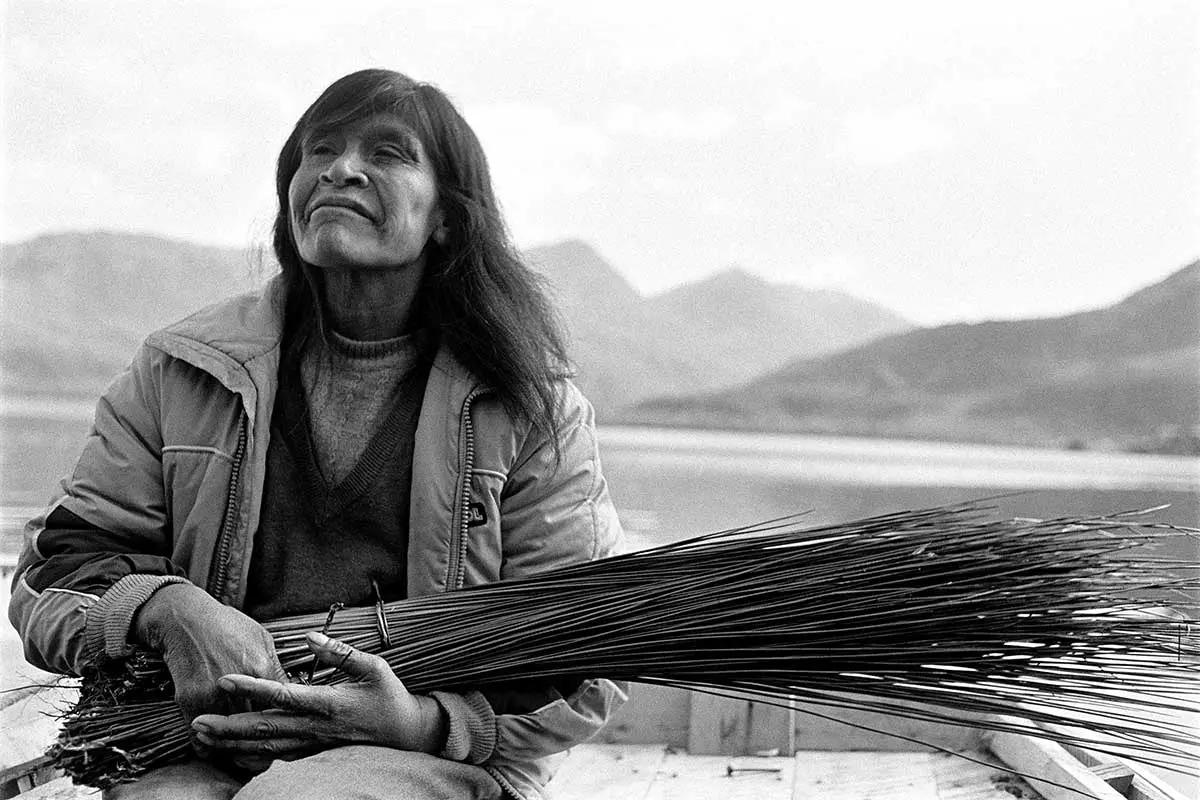
She said, “no pictures.” Errázuriz had traveled thousands of miles to the southernmost end of Chile, to meet the last of the alacalufes, Fresia Alessandri. But the woman rejected the threatening eye of the camera. The ethnic groups of the country’s southern region, onas, yaganes, and alacalufes, were threatened with extinction (this was 1996), and with the vanishing of these “nomads of the sea” a whole world of legends, skills, rituals, and traditions would be lost. In truth, there remained twenty-eight alacalufes, but Paz Errázuriz was especially interested in Fresia. And she is persistent. She returned several times over the following years until finally, with the complicity of a cigarette, of salt and wind, Fresia said yes. Because the eye was not threatening, but friendly. Paz got what she was after, again. She had her photo.
JUAN JOSÉ SANTOS MATEO
Art critic and curator.