
The recent solo exhibition titled “Metal Lines” by Ricardo Cárdenas at IdeoBox consists of a group of small and medium size sculptures produced over the past two years. Like many artists over the centuries, Cárdenas has been inspired by the perfection of the natural world and relies on abstract forms to capture it. He reveals his sources of inspiration in titles that use words like nests, clouds or forests. Thematically the artist produces his works in series, in some way recreating the cadence of nature.
Formally speaking, the works are impeccable assemblages created from many elements that are combined to attain the final form. They often rely on color to continue a series, although many pieces respect the natural color of steel.
Notable among the wall works are the clouds, which are structured from elongated elements made of stainless steel in tight sequence. The delicacy of each element is more reminiscent of drawing than sculpture. This statement is corroborated when observing a group of drawings in which the creative process of Cárdenas becomes evident, allowing us to graphically view his work method in stages. Seeing them in sequence establishes a similar dynamic than the one found in a comic, where each image serves to complete a story. As the title of the exhibition suggests, the line becomes the most important element in Cárdenas’s work because it serves to “construct” each of the pieces. The material has been reduced to lines that, in the case of the nests, are placed one on top of another, while in the clouds and forests are “organized” one beside the other. According to Cárdenas, “The development of the parts is nothing more than the three-dimensional execution of the drawing.” This idea of exchange between the graphite of the pencil and the steel is successfully achieved in works like Dibujo en Acero (Drawing in Iron, 2014), in which the sculpture is formed with long steel elements. By giving it that title, Cárdenas directly refers us to his drawings as the embryonic stage of his creations.
The Forests, another of his series, offers a formal solution quite similar to the one used in the clouds, but here Cárdenas thickens a little bit the volume of the elements that form the works to render the shrubs and trees that exist in the natural world.
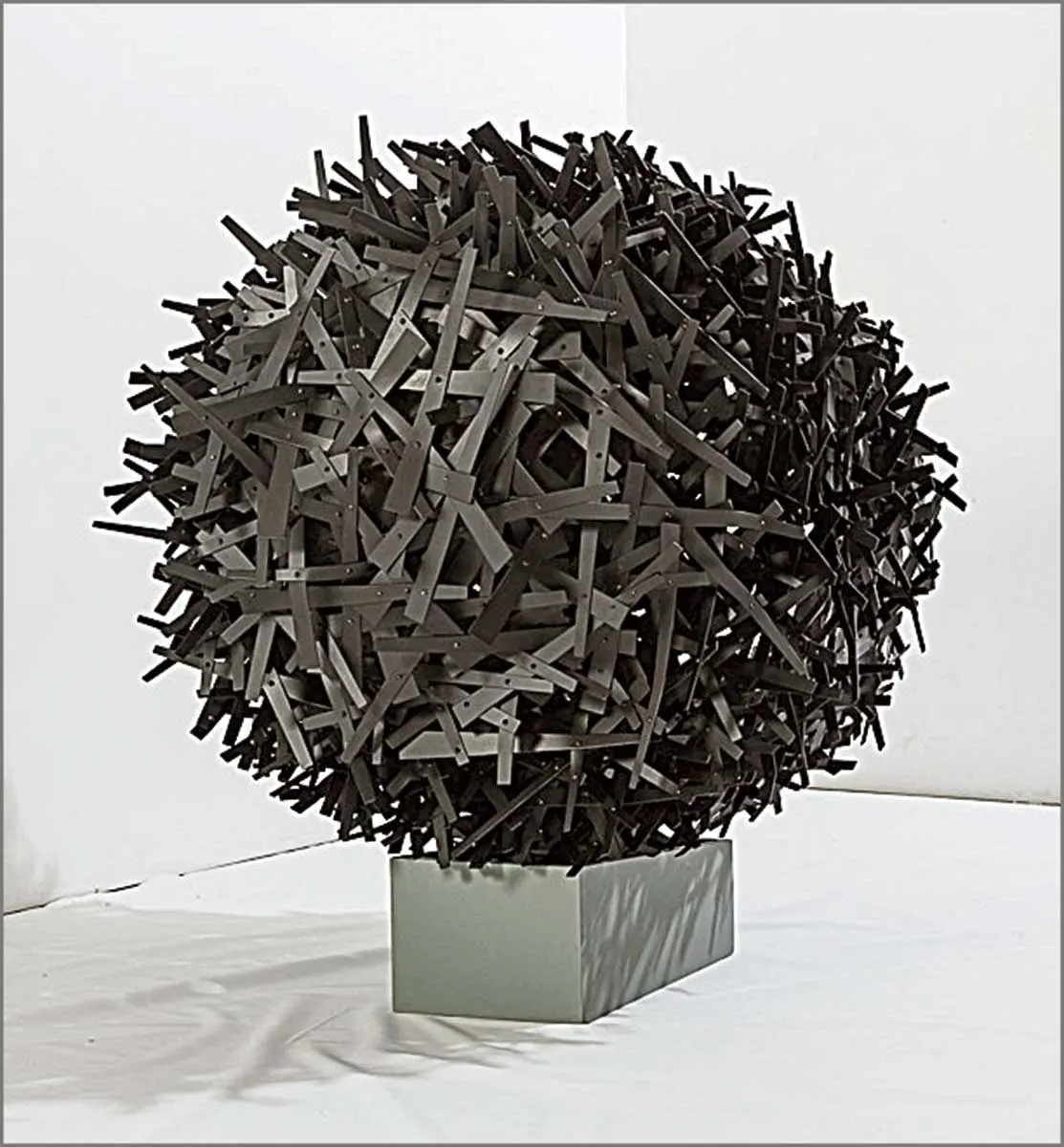
The “nests” follow a process of construction that is similar to the actual nests fashioned by birds. Cárdenas manages to recreate the original natural material (such as grass, leaves and branches) in metal and, although clearly different, the referent is nonetheless explicitly illustrated. The formal solutions used in his clouds and forests come together in this series. He fashions nests with very fine, needle-like, elements in combination with thicker ones, as he mimics those found in different species of birds that indistinctly use straws and branches. One of these works, Nido Negro (Black Nest, 2015), impresses for successfully conveying the care with which each element is linked and for the inner and outer perfection that results from it. Although the “lines” in this piece are thicker than in other nests, the assemblage work is equally meticulous. By looking inside we can observe the manner in which each aluminum piece has been proportionately and harmoniously placed in relation to the others. Nido Negro contrasts with Nido Blanco (White Nest, 2014) and Nido Grafito (Graphite Nest, 2015) insofar the metal elements are thinner, similar to the natural straws robins uses to build their nest.
Another piece that draws attention is Manglar (Mangrove, 2015), a proposal that is more a sculpture than an installation. Made with stainless steel, and using a similar solution than with his Dibujo en Acero, the elements are placed on the floor.
There are other more abstract pieces like, for instance, the work Columna Amarilla (Yellow Column, 2015), which as the title suggests is a column made of polychrome aluminum elements in yellow and blue. Punto Amarillo (Yellow Point, 2014) follows the same idea in the rendition of a sphere. Although it is made of metal, is visually reminiscent of a ball made of strips of paper. Another piece that follows this same idea is Ensamble de Pared Colores (Assemblage of Wall Colors, 2014), which consists of almost triangular elements in gray, yellow and blue colors.
Cardenas’s work is part of a current in contemporary art that focuses on abstraction. Despite being eminently abstract, his work successfully establishes a link between abstraction and figuration by drawing from the natural world and trying to reproduce it in his sculptures.
IRINA LEYVA