
Two exhibitions by Saúl Kaminer are simultaneously presented in two venues in Mexico City that are geographically distant from each other and each dedicated to activities that could not be more different from the other: the Mexican Stock Exchange (BMV) and a university hall. The term “light” is a component and vector in the titles of both shows. Labyrinths of Light at the Centro Bursátil of Grupo BMV—located on Paseo de la Reforma Avenue—and Migrations of Light at the gallery of the Casa Abierta al Tiempo of the Universidad Autónoma Metropolitana-Cuajimalpa (UAM-Cuajimalpa). Those who know Kaminer’s solid artistic career have witnessed stability and change in his process. A tireless explorer of materials and their applications, trained as an architect with postgraduate studies in Paris, he is immersed in aesthetic pursuits in the fields of pictorial design, drawing and mixed media, ceramic sculpture, painting on paper cutouts and cardboard, engraving; stone, marble, and metal three-dimensional works, outdoor constructions, a personal take on mural painting, installations, metal and light drawings—like those in a synagogue in downtown Mexico City— ephemeral textures and objects of various kinds, including a trilogy on glass, wood, and metal.
Magical Realism was the field of action that he chose to pursue during the two decades he resided in Paris. Coincidentally, also in geographical terms, Kaminer inhabits a pair of opposites: he never leaves his country of origin or the one he chose to reside in. Although after more than twenty years in Europe, he spends proportional amounts of time in both Mexico City and Paris and always stays connected to both. His early sculptures were appropriately telluric, in bare clay and without engobe or tin-glaze. Although Kaminer continues to use clay in his work, he has also incorporated metal--steel and bronze cut-outs—and various types of marble that introduce areas of light and convey the coexistence of different elements in nature. Light has increasingly become an important element of his artistic explorations, which today can be called magic-metarealists and, to some extent, metamodernists. Unlike the 1990s, this century has been experiencing a renewed energy in the reexamination of ideas. This pursuit is one of the distinguishing characteristics of Saúl Kaminer’s artistic production of the last eight to ten years.
The use of the space is another of the revisions undertaken by Kaminer, in terms of the way he conceives each work as well as the museology. In his exhibitions, he has been incorporating “hints” of small and medium sculptures placed in unusual places. It is possible to discover in his shows traces of humor and intimacy in the unusual angles and heights in which his oil paintings, mixed media works, sculptures, and other objects and installations coexist. Through the creation of organic-abstract forms, Kaminer’s works offer vitalist visions that indicate the presence of Eros—the life and love-giving primordial god—in his work. Full and empty, light and dark, line and plane, two-dimensional and three-dimensional, recessions and reliefs, are just some of the components manifested in this artist’s work. In the series Weave—wall installations—and Prophesy—created with intertwined tree branches or rendered in bronze—and paintings like Líneas de Transmisión (Transmission Lines), Kaminer takes synthesis to its most extreme conclusion. Thus, the organic coexists with the geometric as tribal forms also occasionally appear in works like La Casa del Lago (The Lake House), which dates back to its early work (1973).
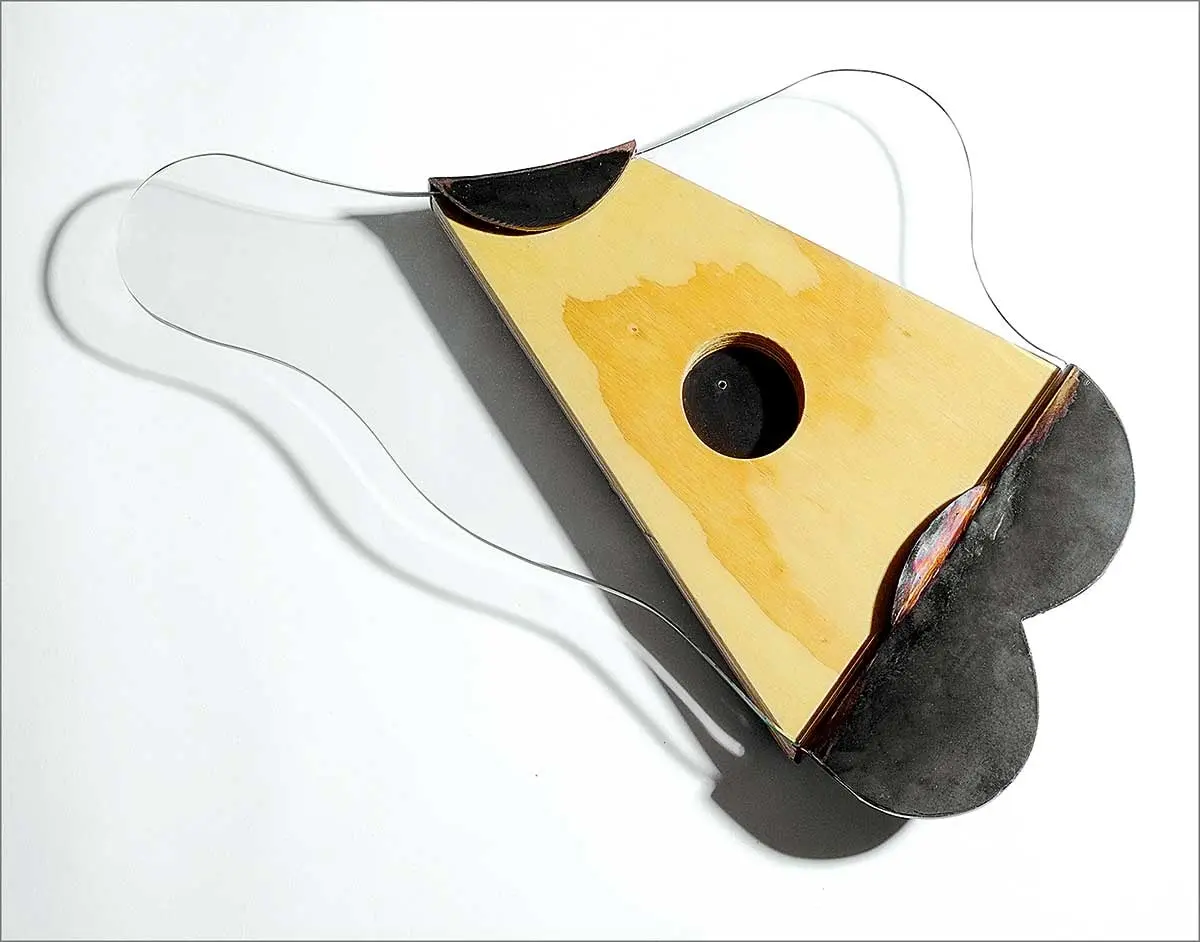
Spirituality inhabits much of Kaminer’s oeuvre. It can be perceived in the pictorial translucencies, the warm combination of tones and colors, the rhythm of the lines, and the recessions and reliefs of his carvings. This spirituality has a characteristic gesture in his creations: the curve. He uses it to develop the structure and poetry of each work. El Corazón de la Montaña (The Heart of the Mountain), La Montaña y la Semilla (The Mountain and the Seed) and Halom, are three reliefs from 2013 that share an unusual combination of solid and liquid, opaque and transparent, and rigorous and subtle components. Even though the titles refer to specific elements—mountains, seeds, and the heart—this trilogy is actually a creation of new forms that could very well be ritual instruments or musical invocation. His masks, tunnels, and bridges, as well as his Astrolabes—bronze or steel cut-outs—elicit similar interpretations. Saúl Kaminer is an artist who explores several directions at once with his own language. His works are baroque and elegant in essence. Over the years the artist has created serious syntheses in the pursuit of deconstructions across several disciplines while maintaining a ritualistic and harmonious spirit.
GRACIELA KARTOFEL