
Sebastián Romo presents a monumental installation that, according to the exhibit information, proposes “nonlinear narratives about flying, levitation and gravity.” These narratives are intended to explore (I use italics because it is the word, or verb, used in the exhibit information) and directly and tangentially allude to nineteenth-century colonialism—along with its signs, referents and imaginary—which has fed the visual culture of the twentieth century and helped it build an iconography that narrates, and encompasses, the mythology of modernity. Romo relies on various vessels in which this narrative is poured. A case in point is the timeline used as the basis for the activation of several contents and representations between the nineteenth-century adventure novel Heart of Darkness by Joseph Conrad and its updated version, set during the Vietnam War, the film Apocalypse Now. This generates an illustrated catalog of themes, motifs and figures that the viewer’s eyes see as a montage—halfway mural and halfway synoptic painting—in which a multiplicity of meaningful lines emulate the simultaneous transit of events that have served—based on several platforms—to represent the convulsive and at times exhausted and other times regenerated speed of the world.
Whether maliciously or candidly—I do not know—Romo appeals to the affections: namely, to the intimate relationship established by viewers—which creates a particular imaginary full of tropes and generalities—from which they generate a variety of visual and ideological content that Romo recognizes, appropriates and channels. This is precisely why the viewer becomes the first agent that—as part and as extension of the piece—taps into the monumental possibilities of an installation that the exhibit information describes as a movie set. A leather chair next to a tropical plant in a tin bucket—used as a pot—rests on an animal skin rug. A bench tells viewers to sit so they can appreciate the three levels of the installation. As each visitor sits when instructed, he/she becomes part of the work. The reproduction of a pre-Columbian eagle knight sculpture has been placed behind it. The setting is an invitation to travel, a commentary that updates the sites commonly visited during a journey to exotic places; It is also the gap opened by the instinct of adventure that has been reduced to a guided tour.
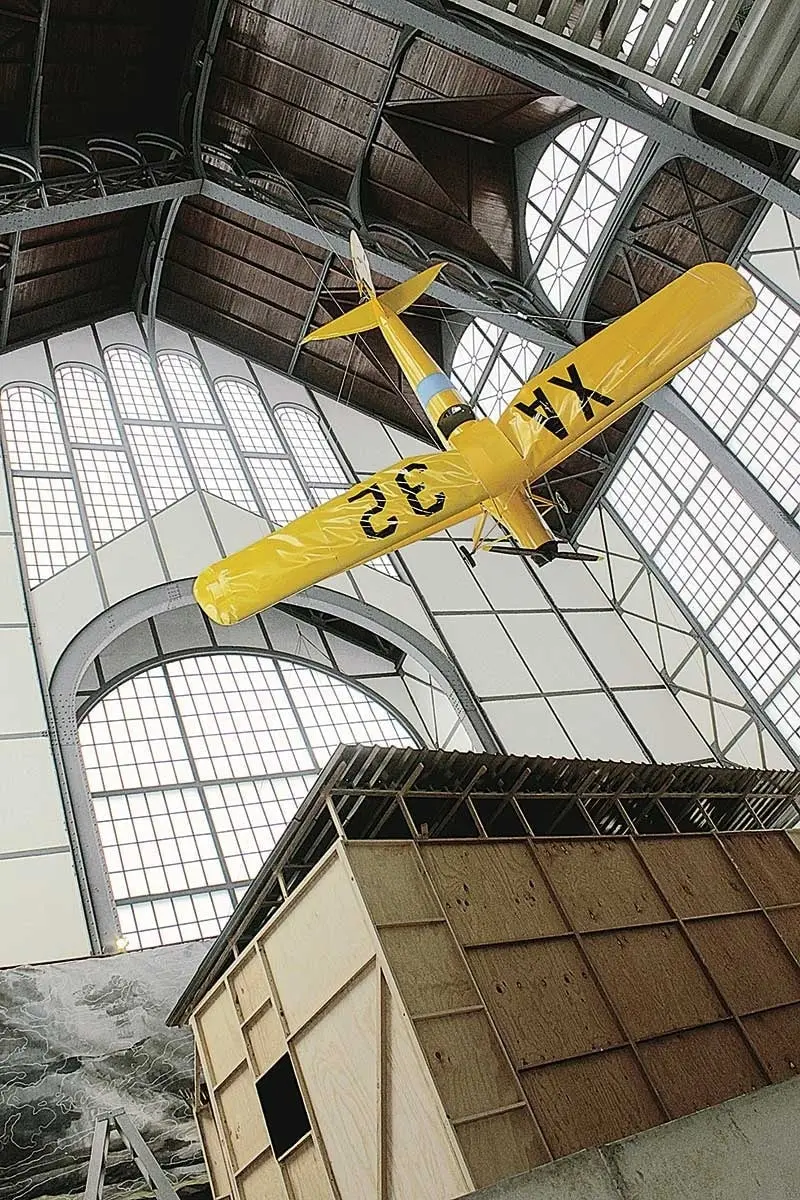
The three-level installation was titled Tótem because it conceptually resembles the three sections of the totems carved by some Native Americans tribes from the Pacific North Coast. The first level is the structural base of a set or cabin that in turn represents the second level. The third level consists of a plummeting plane that references—like a paradoxical allusion—the winged beings that adorn traditional totems.
Several stuffed birds (swans, hawks, etc.) have been placed between the crossbeams in the first level along with dressers, terrestrial globes, magnifying glasses and other objects that Romo rescued from the storage area of the Museo del Chopo—formerly a museum of natural history, between 1913 and 1964—as well as the leather chair for the viewer who, as I mentioned earlier, is the invisible agent that makes possible the monument to the impending disaster that hangs over the installation as a leitmotif of the modern spirit.
This impending disaster is a moment suspended in time comparable to the photogram (or still) of a film that is devoid (or stripped) of the continuity that would eventually turn it into a disaster. The absence of a conclusion opens the door to countless narratives that can lead to such destruction. Viewers climb a set of stairs to enter the cabin and begin a walk through a mise-en-scène that intentionally resembles the theme museums in Southern California. Between the tables and corners viewers can observe a display of maps, cabinets, boxes, cases, drawings, paintings reproductions, cards, atomic models, measuring and calibration instruments; news clippings, photographs, plane models, movie projections (Metropolis by Fritz Lang), beetles and stuffed birds that build an evacuated (abandoned) space which is refilled through the interaction with each new visitor. Placed on a table surrounded by scientific paraphernalia—as well as a bottle of wine with DADA in large letters printed on its label—a typewriter holds a page with written instructions on how to assemble the installation:
Take any narrative or story, a film for instance.
Cut that linearity into several sequences.
Make a star with intertwined v’ertices (sic).
These instructions offer clues about the piece and are also its synecdoche. By themselves, they are the object (with or without the support of the page) around which the expansion of modernism gravitates, as a universe of that which is possible: its mechanisms. Like a colophon—and projection of the cinematic imprint—inside the set, and after passing by a bust of Alexander von Humboldt, an inverted image of La Gioconda and a Newtonian telescope are a colophon, visitors enter another room—and a separate reality—where with chromatic variations and halves of white mannequins, Romo mimics the Korova Milk Bar that appears in Kubrick’s film A Clockwork Orange. With this element, the installation highlights the separations that, paradoxically, serve as communicating vessels in a theme park like Disneyland. It is cinema taken to physical space. To recognize space is to inhabit it. The exhibition was curated by Esteban King.
RICARDO POHLENZ