
The exhibition titled Fiction in Things by Waltercio Caldas (Rio de Janeiro, 1946) presents 16 recent works never before shown. They are eight sculptures created with stainless steel, twine and other types of thread, acrylic and wood, as well as eight drawings/objects—drawings on paper with small three-dimensional pieces attached to the support. Presented at the Galeria Raquel Arnaud in São Paulo, the exhibition was inaugurated on April 7 and will remain open to the public until the end of May.
Waltercio Caldas is one of the most important names in the contemporary art of Brazil. His work belongs to a constructive tradition that developed in Brazil during the second half of the twentieth century. The guiding principle of Caldas’s aesthetic strategy is of a minimalist order. His work is connected to the experimentation developed within Brazilian neo-concrete art.
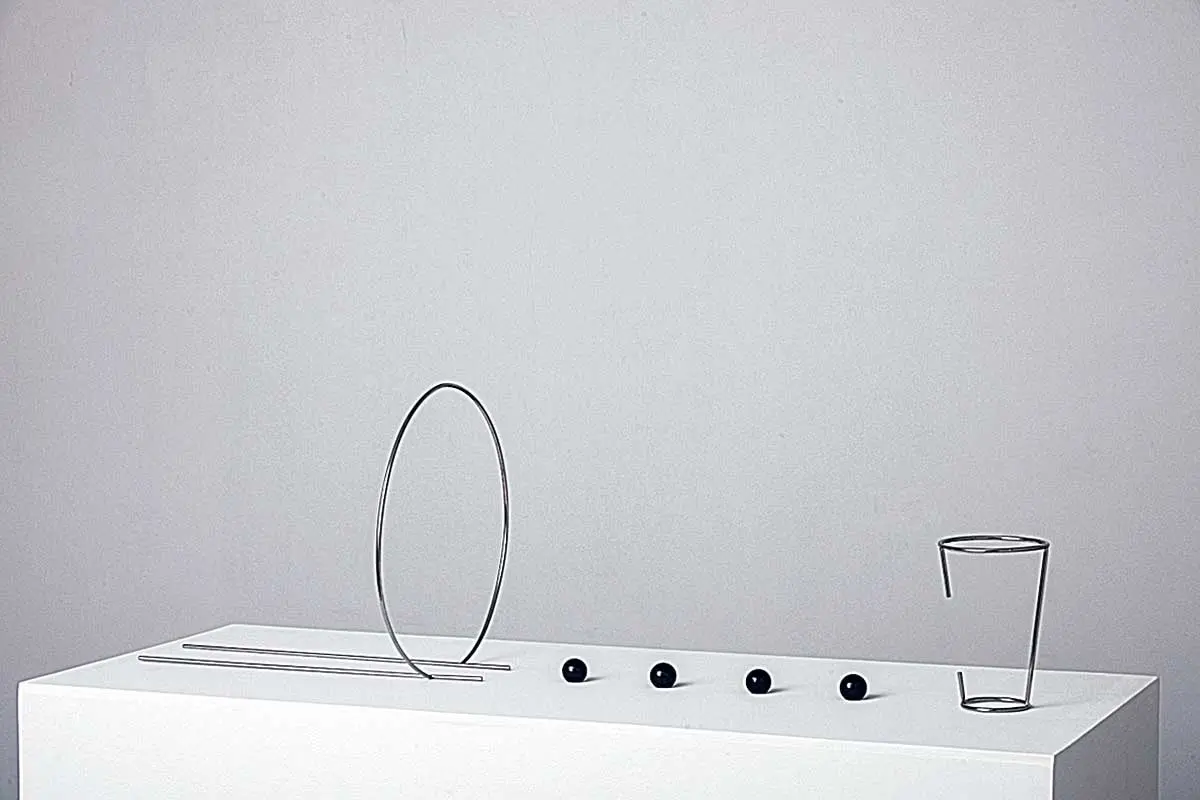
The exhibition at the Galeria Raquel Arnaud showcased the peculiar nature and continuous search for innovation of Caldas’s inquiries into three-dimensionality. He explores the expansion of the line across the space and traps viewers through perceptual commitment. The linear element serves to give movement to the work, suggests sound, vibrations and rhythm—as if dancing—or creates geometries, minimalist virtual volumes. The works are actual spaces/places activated through the interaction with viewers and there are many possible paths for those interactions. From the place where they are placed, his works are open to perception and flow freely in the space, defying the gaze with the voids that they generate. Caldas performs phenomenological oriented research as he involves viewers sensorially.
Paulo Sérgio Duarte, a critic who has studied Caldas’s production at length, believes that the artist reinvents the space through the structures that he creates. According to the critic, Caldas’s work contains “a purely optical intelligence.” His “sculptures bring a subtle dose of humor that viewers enjoy through interaction.” Thus the experiential dimension is always at stake.
Waltercio Caldas began his career in the 1960s. He studied at the Museu de Arte Moderna do Rio de Janeiro under Ivan Serpa, one of the pioneers of concrete art in Brazil. He began exhibiting his work in 1967, participating in several groups. He was granted an award for his drawing at the Galeria Gead in Rio de Janeiro.
In 1973 he presented his first solo exhibition at the Museu de Arte Moderna in Rio de Janeiro. On that occasion he presented thirteen objects and twenty drawings. Several of those works were acquired by the Colección Gilberto Chateaubriand.
The first critical text about his work was written by Ronaldo Brito and was published in the Opinião periodical, an important alternative newspaper in the Brazilian cultural scene at the time of the military dictatorship. In the mainstream press his work was reviewed by Federico Morais and Walmyr Ayala, both very active art critics at the time. His work has consistently been exhibited in the Brazilian art scene and abroad. In 1974, he participated in the exhibition titled “Brazilian Graphic Art,” which was promoted by the Itamaraty* and presented in Barcelona and Paris. In 1977 he was nominated for the Venice Biennale but he refused to participate for political reasons. At the same time he was co-editor of the Malasartes periodical, an important art and culture magazine in the cultural context of the country during that period.
Waltercio Caldas also creates public art. His first public sculpture, titled O Formato Cego (The Blind Form), was completed in 1982 on Paseo de las Americas in Punta del Este, Uruguay. He has created many other public works throughout his career. Standing out among these are the site specific sculpture titled Escultura Para o Rio (Sculpture for Rio, 1996) on Avenida Beira-Mar, Rio de Janeiro; and Jardim Instantáneo (Instant Garden, 1989) installed in Parque do Carmo, in São Paulo.
Some of the recognitions that he has received during his artistic trajectory include: the Grand Prix in 2004 for his installation O Ar mais Próximo (The Nearest Air) at the South Korea Biennale; the special hall featuring his work at the Fifth Mercosul Biennial (2005) in the city of Porto Alegre, Brazil. On that occasion he installed the sculpture Espelho Rápido (Fast Mirror) on the shore of the Guaiba River—a work that received great response from the public. In 2007, he participated in the 52nd Venice Biennale with Half Mirror Sharp, in the Italian Pavilion.
Lately, the artist has exhibited in several countries, such as Portugal, Austria, Ecuador, Belgium, The Netherlands, France and the United States, among others.
His works are part of the collections of institutions, such as the Centre Pompidou (Paris), the Museum of Modern Art, MoMA (NY), the Museu de Arte Moderna in São Paulo (MAMSP), the Museu de Arte Moderna in Rio de Janeiro (MAM), and the art collection of the Instituto Inhotim, and other institutions and private art collections worldwide.
The exhibition Fiction in Things offers the public an intense experience with the poetics of Caldas. The show was conceived to establish an open dialogue with visitors. The objects were there to be revealed before each viewer. There is never pre-designed content in his works. The sensory experience of each viewer is the fundamental way to build that revelation.
* Itamaraty (or Foreign) is the executive body responsible for foreign policy and international relations in Brazil.