
The Sharjah Biennial is now more than 25 years old. Its first edition took place in 1993, and since then it has been formulated as an active project for cultural collaboration and exchange. The most important change in the history of the event was, without a doubt, the establishment of the Sharjah Art Foundation in 2009. The foundation was created with the intention of generating a program of exhibitions, debates, and permanent residences—beyond the biennial central event—a gambit in favor of building a local audience that could participate actively in different cultural projects. The foundation was able to enhance communication between the region and the global context, fostering a fluid dialog between diverse geographic settings, among which Latin America stands out with a growing presence in the history of the Biennial.
This 12th Sharjah Biennial, curated by Eungie Joo and Ryan Innouye, proposes a poetic engagement with the world. The exhibition, featuring 51 artists and groups, explores the possibilities of utopia from the standpoint of experimentation in the dialog of forms. For the curators, the event is “a meditative pause to reassert the need for astonishment, attention, and interrogation,” at a particularly decadent time in human history. Under this premise, it does not come as a surprise that a large portion of the works on exhibit opted to address the private, existential, or contemplative spheres.
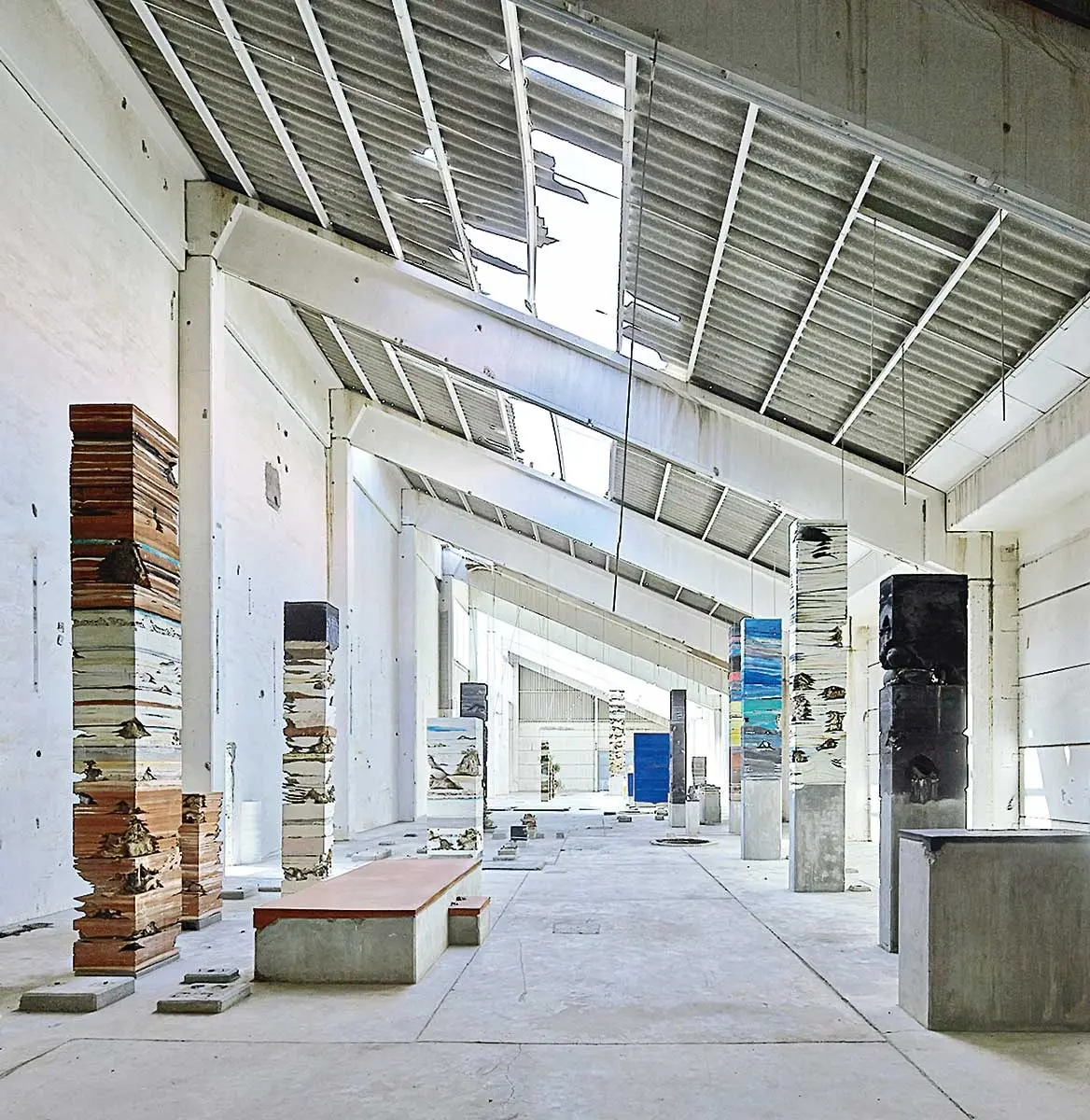
One of the Biennial’s wisest moves is its scale. The exhibition achieves great balance between the use of its spaces and the kind of works on display, and unfolds over Sharjah’s entire historic downtown and port area, inviting viewers to move around the city, traverse its popular markets, and navigate its river. The work situated the farthest from the city was a monumental installation by Argentine artist Adrián Villar Rojas, on exhibit inside an abandoned ice-making factory in the city of Kalba, near the gulf of Oman. There, Villar Rojas set up a series of columns made from natural elements and recycled objects, in allusion to the process of decomposition and regeneration of the landscape.
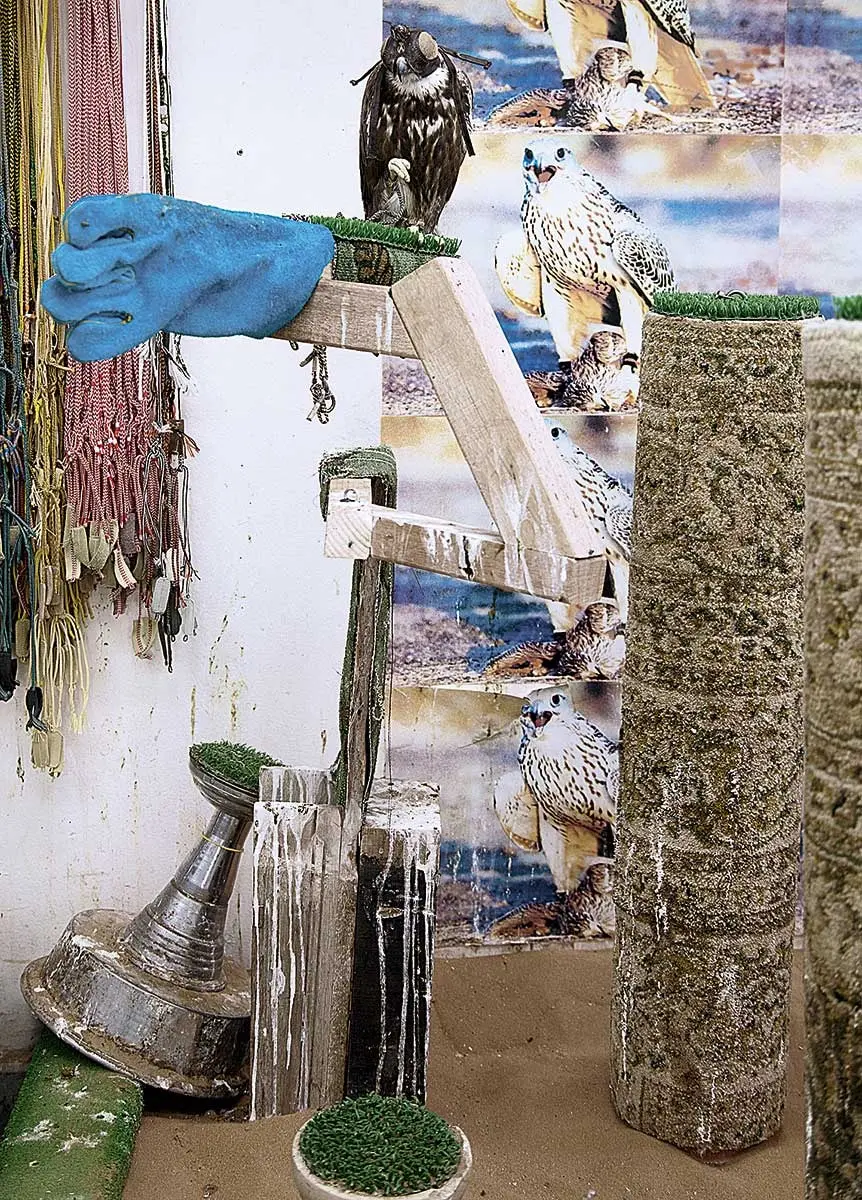
The title of the 12th Biennial, “The Past, the Present, the Possible,” also carries geographical allusions. One of the event’s premises is to think the site where it takes place in connection to others, conceptualizing its present on the basis of a series of urban transformations that have altered its structure in recent decades. In that sense, many works have emerged from research projects carried out in the city itself and its environs, exploring social configurations based on exchange and reciprocity, but also the local architecture, landscape, and economy. For example, Mexican artist Abraham Cruzvillegas presented a silent, almost invisible intervention in the city’s Animal Market. This market is characterized by the sale and purchase of falcons, which remain with their eyes covered, standing on wooden planks, for most of the day. The artist manufactured a structure using recycled elements, and placed inside one of the stalls, generating a radically different habitat for the animals at rest.
One of the exhibition’s most notable works was also focused on an active site of exchange in the city. Communications from the field of contact (Each hair is a tongue), a 2013 sculpture by Lebanese artist Rheim Alkhadi, consists of a small ribbon on which a number of eyelashes, collected from dockworkers at the port of Sharjah, are placed. The fragile work builds a new object that allegorizes, forcefully, a type of collaboration between strangers—most of them, immigrants—and a very special kind of intimacy.
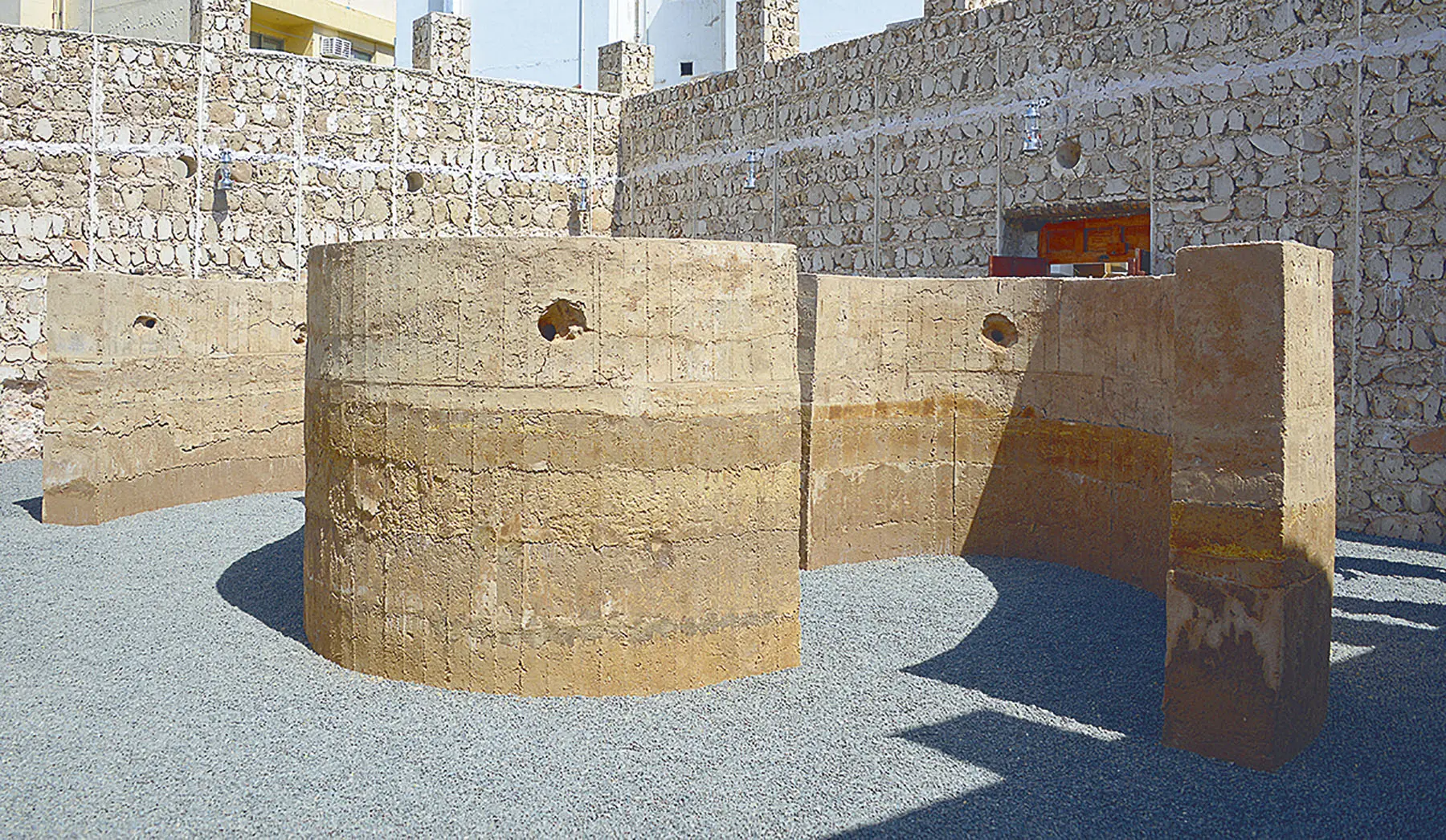
Another effective choice by the curatorial team is to privilege mainly installations and sculptures along the exhibition, opting for only a small number of videos. This turned the Biennial into a deeply corporeal experience. It is also important to note that many of the sculptures on exhibit dialogued brilliantly with the city’s architecture. For example, Talking Wall (2015), an installation by Mexico’s Damián Ortega, carried forward the artist’s investigation of architecture and communication systems. Ortega observes the characteristics of local architecture, especially in the area of patrimony, where many walls have been built using coral fossils, which gives them a porous texture. Ortega’s installation echoes this: the artist builds various thick walls and fills them with internal ducts and canals, which stimulate the unexpected circulation of sounds and voices through the small labyrinths formed, thus creating a haphazard mode of communication.
The same degree of subtlety is repeated in Karensansui (2015), a site-specific installation by Taro Shinoda. It is based on the principles of the Japanese dry garden, only the garden here is built using local materials. The garden is a large white sand rectangle on which we can observe, like inverted cones, some small swirls, the traces of two holes located in the lower part of the structure. In this way, the holes grow gradually with the slow passage of time, generating a beautiful configuration of waves formed by weight and gravity on the sand. The work can only be seen from atop a small podium built in one of the extremes, which brings viewers towards an inevitably meditative perspective.
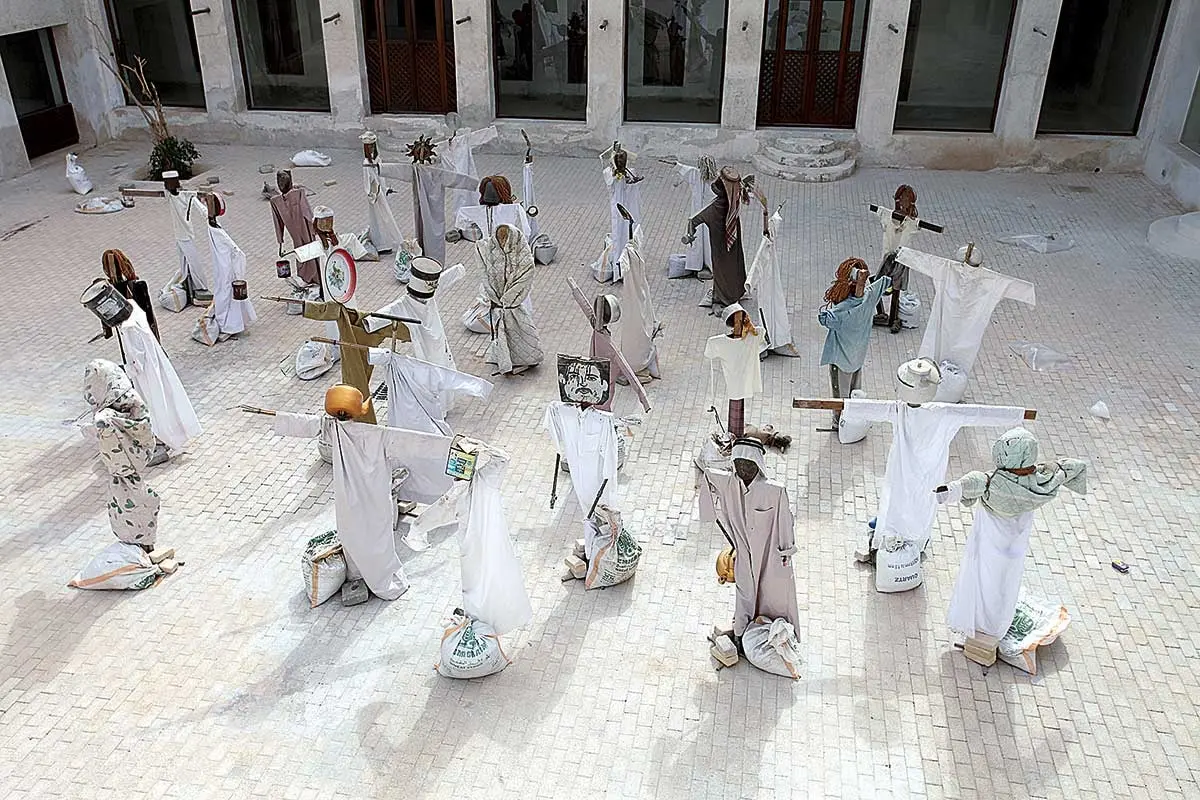
Another imposing installation at the Biennial was Scarecrows (2013), by Abdullah Al Saadi, from the United Arab Emirates. This work is inspired on the landscapes of Brazil, which the artist encountered while on a research journey to several South American cities. Via the assemblage of everyday objects (buckets, frying pans, pieces of fabric…), Al Saadi creates a series of characters that escape the traditional modes of racial or gender identification, evoking a kind of multitude of the absurd.
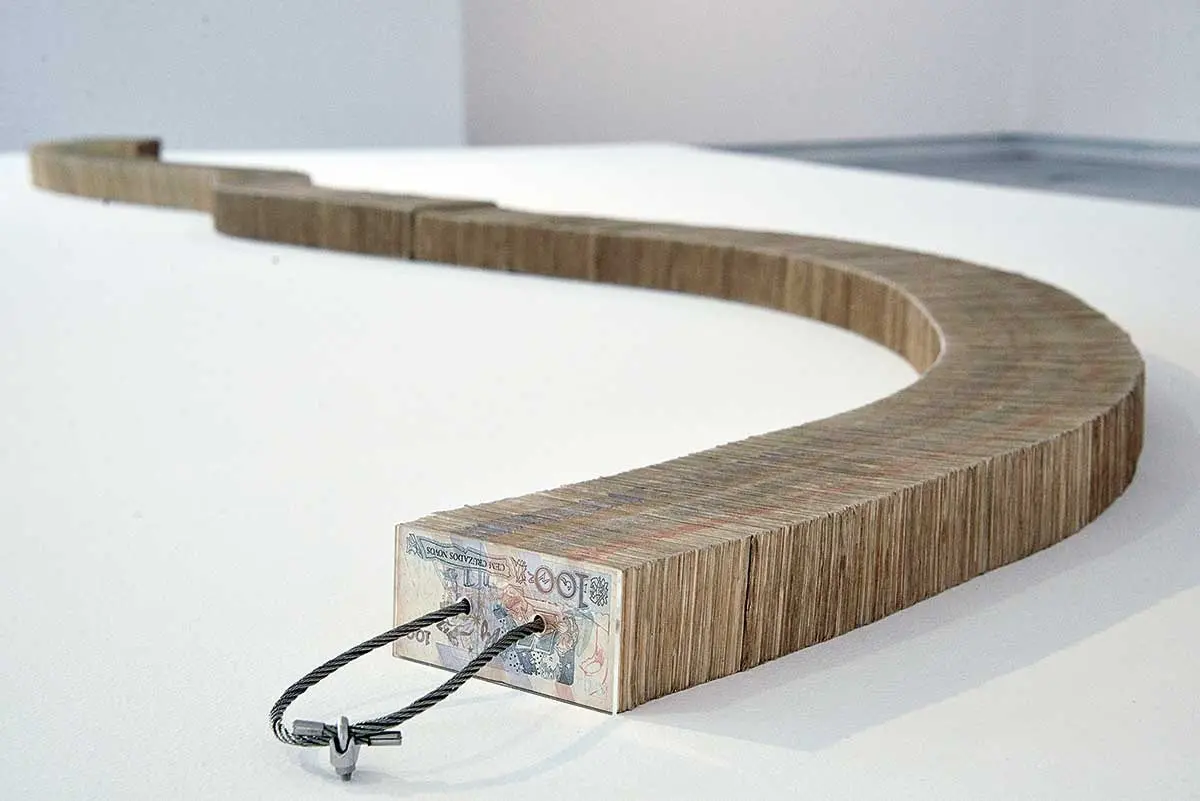
Other works featured in the Biennial utilize everyday elements in order to allude to certain contrasts or shifts in the social landscape. Jac Leirner’s sculptures Os cem (ronda) (“The Hundreds (wheel),” 1998) present an iron circle that holds hundreds of 1-cruzeiro banknotes from the 1980s and 1990s. Brazilian currency went through several processes of accelerated devaluation, which also meant sudden changes in their value and use. Another work dealing with changes in specific cultural meanings is the installation WAM (World Agriculture Museum), 2010/2015, by Spanish artist Asunción Molinos Gordo. It is a fictional museum devoted to telling the story of food production using objects, diagrams, and photographs that reveal shifts in agricultural labor since the spread of genetic manipulation, the struggle around the copyrighting of seeds, and global food-security policies.
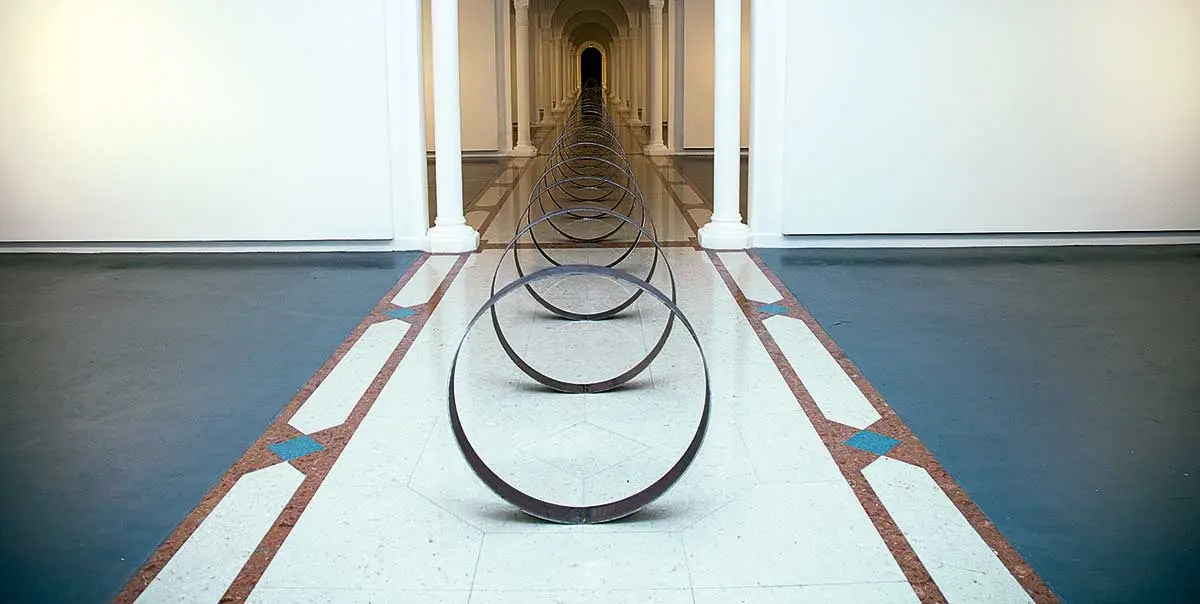
A surprising aspect is the general absence of works that allude directly to conflicts in the Arab world, and in particular to the dramatic political situation in countries at the heart of the region, such as Libya, Syria, Iraq, or Egypt. While there is no mandate for art to engage any specific theme or debate, one cannot avoid wondering about the curatorial decision not to deal with some of the globe’s most complex conflicts. There are, nevertheless, small moments in the exhibition that address those ideological and geopolitical tensions. For example, Steel Rings (2013), by Lebanese artist Rayanne Tabet, which presents an elegant and powerful reflection about political disputes of the past and the present in the Arab world. This sculpture is a succession of metal rings organized in a monumental way along an entire wing of the Sharjah Art Museum’s second level. It alludes to the construction of pipelines on the desert surface to transport oil from Saudi Arabia to Lebanon, traversing along the way Jordanian and Syrian territories, in the 1940s and 50s, as part of a trans-Arabian cooperation project. As a result of social and political changes in the region, the project was abandoned in 1983. Tabet emulates those abandoned circular structures as the traces of an entire genealogy of territorial disputes that reach into our own era.
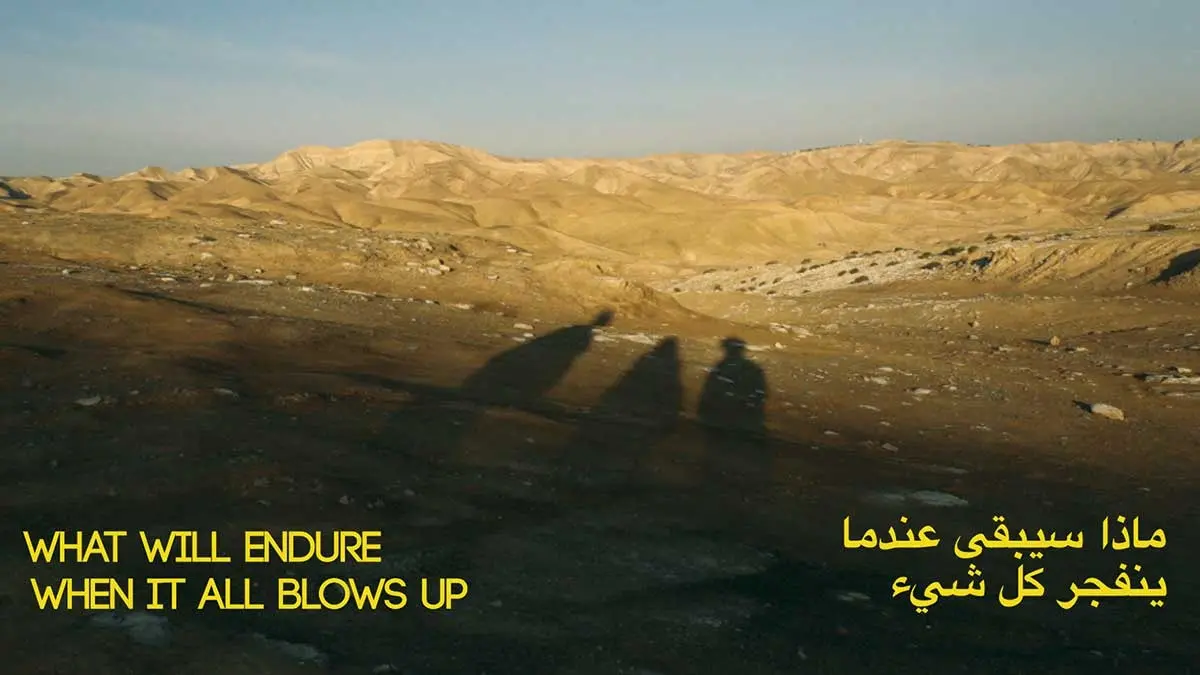
Another brilliant work conceived along the same lines was The Incidental Insurgents (2012-2015), an installation by Basel Abbas and Ruanne Abou-Rahme, which reconstructs a series of narratives that go from revolutionary Marxist discourses to science-fiction stories and Arab novels, deploying in the space a number of texts, books, photographs, objects, and quotations. The installation also includes a video journal of a trip to Palestine, with images of the desert on which phrases like “To be anonymous, to reappear as a different figure, to have many returns” are superimposed, in allusion to moments of a different kind of social insurgency. Abbas’ and Abou-Rahme’s installation is one of the best works at the Biennial because of the way it condenses an amalgam of desires and longings for the transformation of reality, making the stories of the past clash into the imagination of the future.
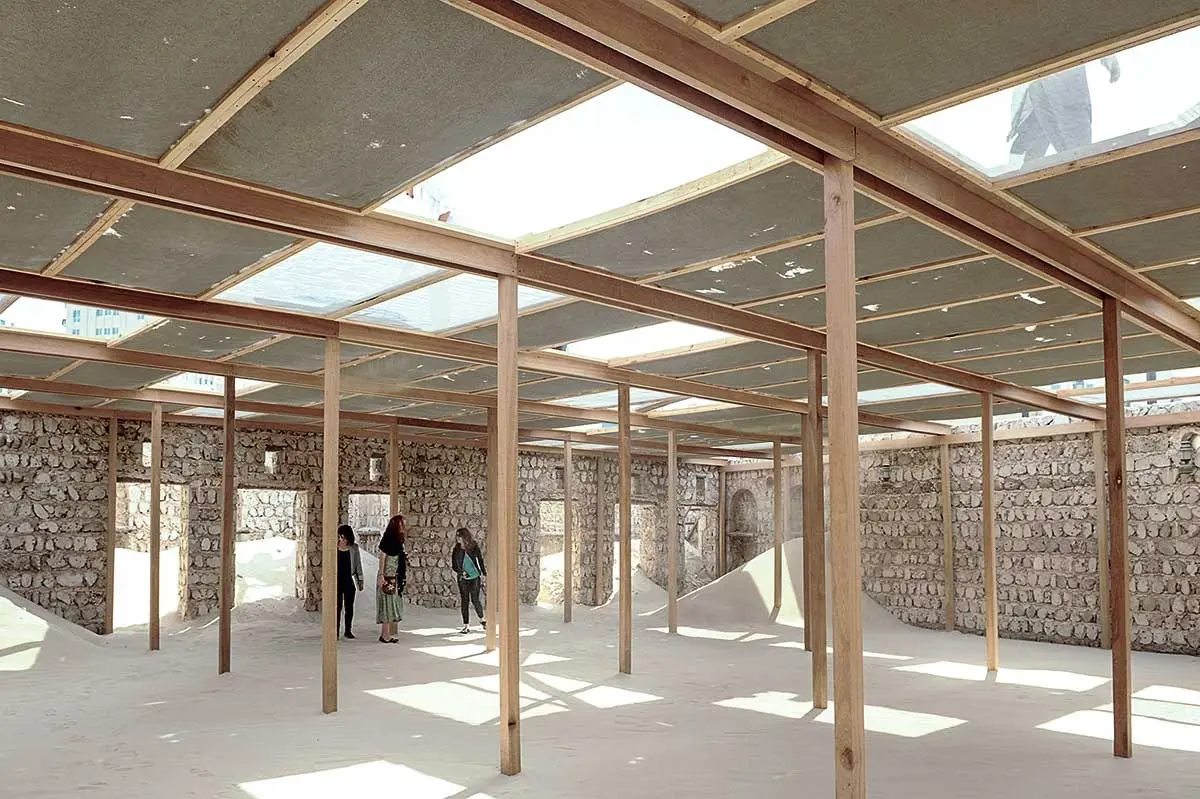
From the reverse side of these political stories it is also possible to find small allusions to the construction work, the human relationships, and the industrial production that characterize the growth of Gulf cities. Brazilian artist Cinthia Marcelle’s At the risk of the real (2015) is activated by the presence of the viewer, who enters a rectangular space covered by a structure of wood and metal beams that accumulate and support various quantities of sand. Along the day, several construction workers walk sporadically on the roof beams, their weight and motion causing small sand cascades at various points in the exhibition space. These cascades obstruct visibility and generate new accumulations of sand on the floor, permanently changing the space’s interior landscape. The work is an allegory of the invisible dialog between workers and residents, but also about the blight and ruin of a city that is currently in the process of transformation, to become a new space of real estate development.
This 12th Sharjah Biennial presented a forceful selection of artworks, many of them new commissions. Even though there is a high degree of sophistication, and while the formal resolution of many of the projects is of considerable quality, the Biennial seems to lack a dose of urgency and a direct connection with conflicts in its immediate present. Undoubtedly one of the events (and the Foundation’s) signal achievements is to have created a platform that asks what kind of public sphere is it possible to build from the arts and the cultural field in a geography as complex as the Arab world. And indeed therein resides its greatest potential: in a context where restrictions are still imposed on certain discourses and behaviors (persecution of homosexuals, gender discrimination, etc.), the Biennial could also be a space for reincorporating into the public debate those other positions, even if such task demands an extremely delicate construction of political balances and citizen consensus. Certainly, this 12th Sharjah Biennial, “The Past, the Present, the Possible,” congregated a notable selection of works that demonstrate the speculative power of art to stimulate other relationships with the world, with language, with everything that surrounds us. The exhibition is indeed a moment of pause to reformulate the critical power of imagination. The question after the pause, however, is how far can we get with this speculative imagination, what is it possible to say, and how do we need to say it, in order to engage some of the conflicts that still seem unmentionable in a context so politically complex, and so loaded with contradictions, as the one where this biennial is held.
* All images courtesy of the Sharjah Art Foundation.