
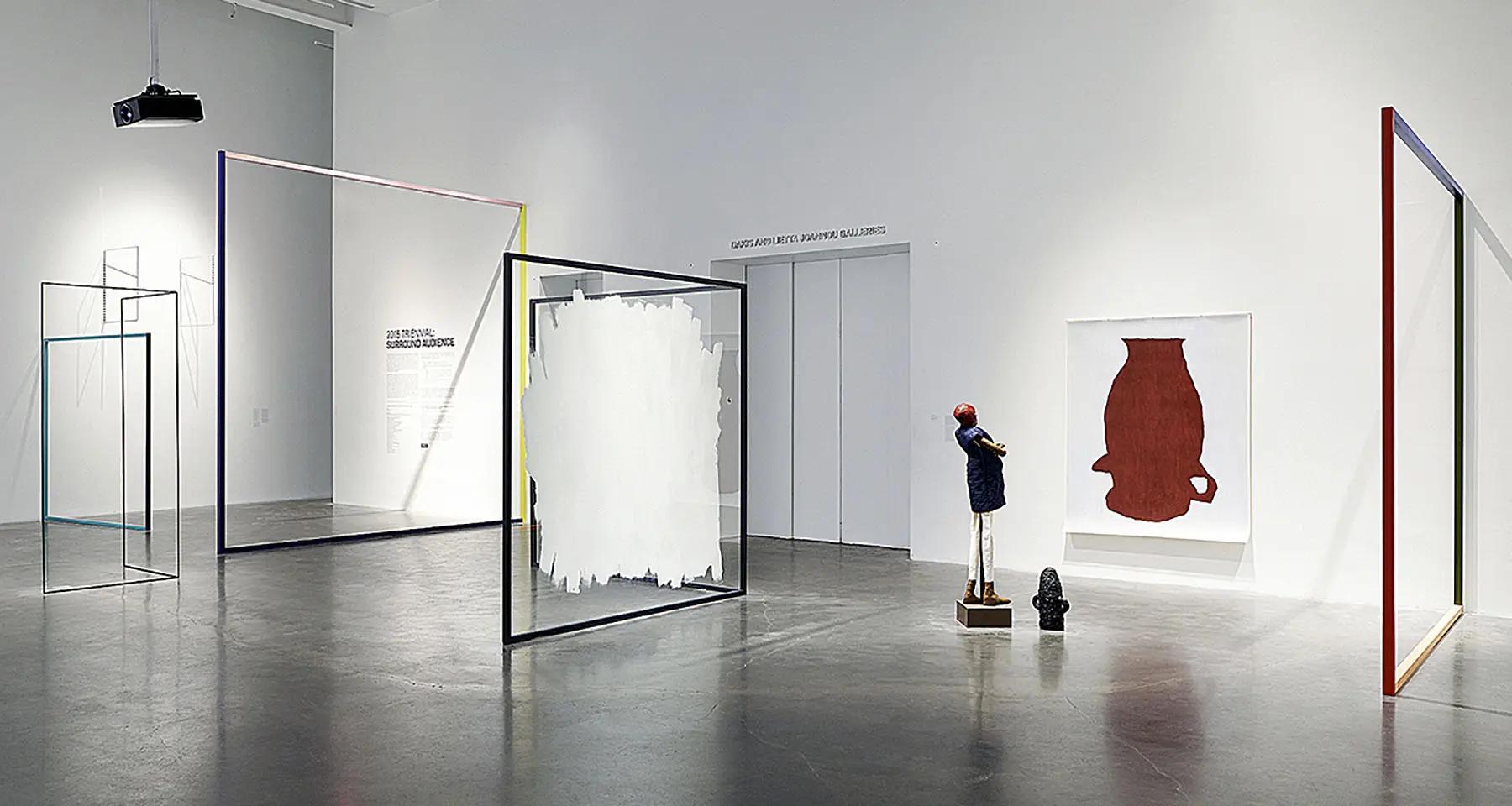
The New Museum of Contemporary Art inaugurated its first Triennial in 2009, possibly to more firmly establish its presence at its new home in a custom-built building on the Bowery. It is now currently in the midst of its third such exhibition, whose success, like so many shows of this nature, can be measured differently according to one’s criteria.
The parameters of this year’s exhibition have been set largely by age. The goal is to highlight emerging—though hardly unknown—artists whose work can be seen as shaping a sense of what is developing in the global art world and a glimpse of what is to come, rather than an assessment of what has been done. Entitled “Surround Audience,” the exhibition cannot be faulted for lack of ambition or exclusivity: in addition to exhibiting works by 50 artists, the museum is also hosting performances, publishing a poetry collection, and sponsoring residencies, research projects, and a web series. Many of these projects are commissioned and have their debut at the museum, and others are reinterpretations or continuations of ongoing series. While new media and technologies are integral to many of these works, this is not a museum full of computer monitors and video displays, and sometimes the new technology serves in a more subtle and subservient fashion. More importantly, older media such as painting and sculpture have not been ignored, and a majority of works are installation or performance-based, which are in their nature multimedia and also perpetually renewable.
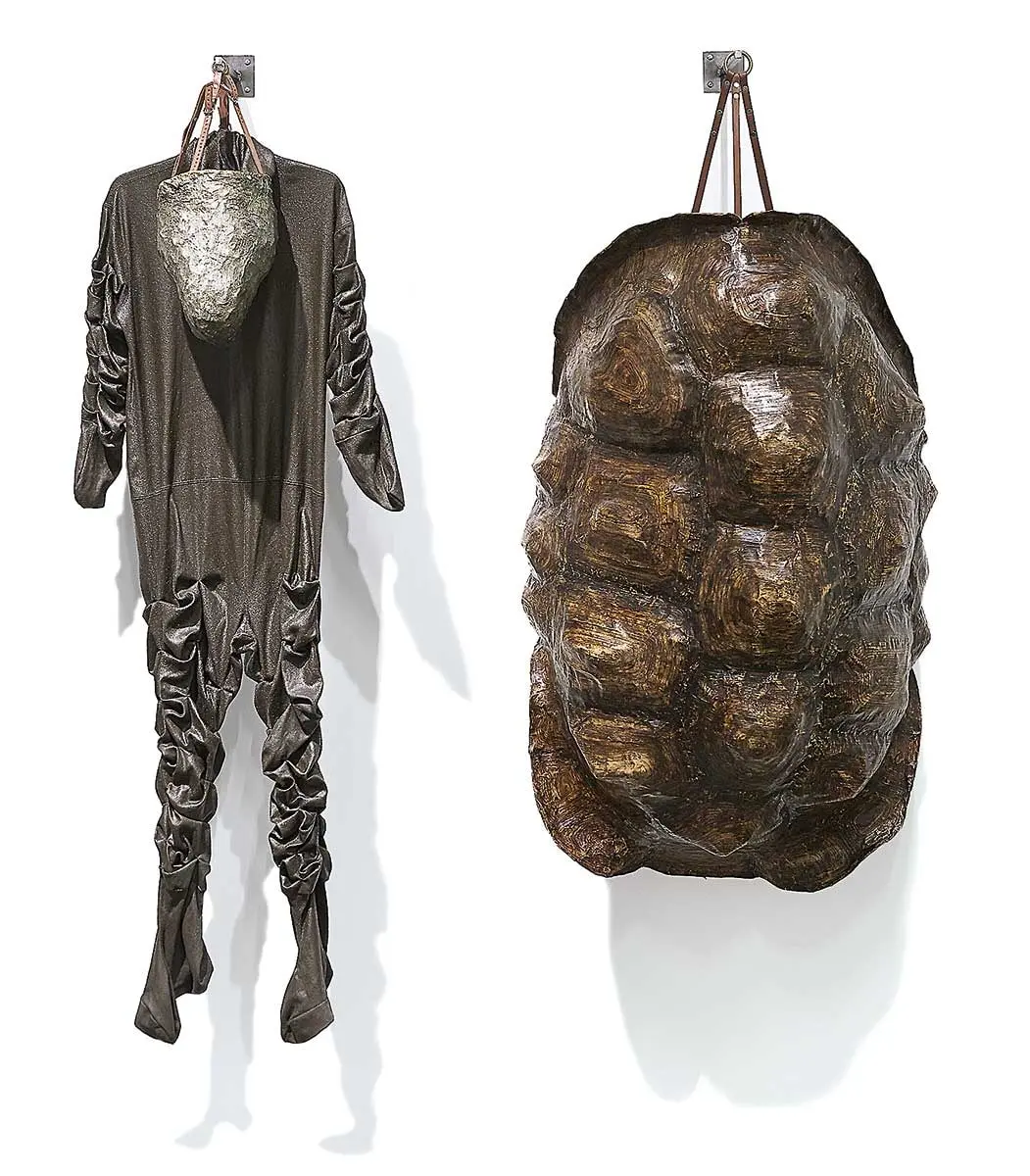
One such project is Argentine artist Eduardo Navarro’s work for the Triennial, titled Timeless Alex (2015). Navarro’s projects often involve ecological and social explorations through the construction of temporary social spaces and situations. In this case, the focus is on the human condition as filtered through the natural experience of a turtle. Recognizing the cross-cultural significance of the turtle as a symbol of tenacity and steadfastness, and its foundational role in Hindu, Chinese, and Native American cosmological myths, Navarro was also intrigued by the case of Lonesome George, the last living Pinta Island tortoise discovered in the Galápagos in 1971. The longevity of the tortoise’s existence (now rendered in another level due to its preservation through taxonomy), the mythology of the Galapagos as a space that evaded the progress of evolution, even the slow deliberation of the animal’s movements, made Navarro consider the perception of time from the turtle’s perspective, and more poignantly how radically that perception must differ from the instant-access speed of our internet-driven world. Timeless Alex is comprised of a tortoise costume complete with an outer shell made of layers of paper that is meant to be worn and utilized in performance. When inactive the costume hangs limply disembodied on the wall, which adds an elegiac quality to the work as one considers mortality and the shedding of one’s skin as another measure of time.
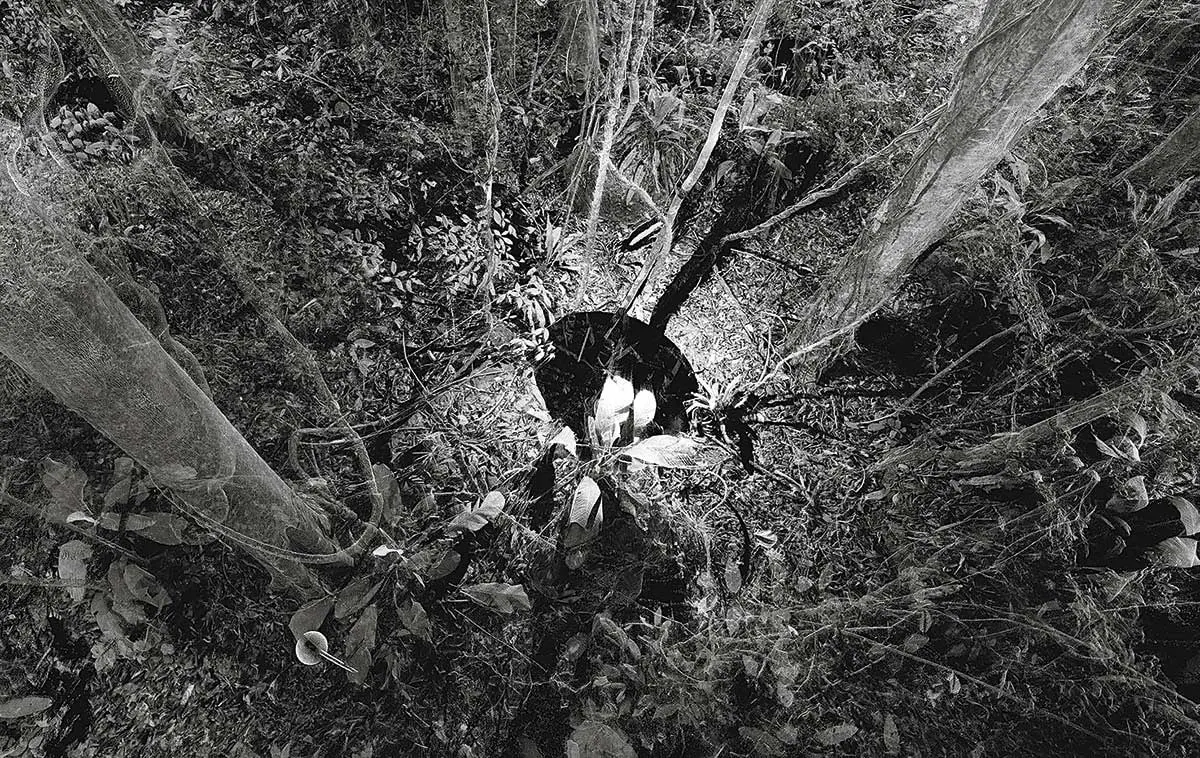
Ecological concerns are also engaged in the work of Rio de Janeiro–based artist Daniel Steegmann Mangrané. While Mangrane’s practice ranges in form from watercolor to sculpture, installation, video, and film, his project for the Triennial could be considered one of the most technologically current. Phantom, one of the first virtual reality installations utilizing Oculus Devkit2 to be presented at an art museum in New York City, combines OptiTrack motion capture technology and Oculus Rift virtual reality (VR) headsets to transport museum-goers to the rapidly disappearing rainforest in Brazil.
The idea of capturing and framing space is also integral to the work of José León Cerrillo. Drawing upon references that range from the failed utopian aspirations of modernist architecture and urban planning in Latin America to the use of schematic diagrams in philosophy and psychoanalytic theory Cerrillo’s projects often involve constructed interventions that interact with a space and its inhabitants. The artist’s installation in the Triennial is a current site-specific iteration of an ongoing series titled The New Psychology. Using metal, wood, glass, fabric, and paint the artist has constructed an interwoven series of openings, lines, and mediations that not only manipulate the museumgoer’s movements through the gallery but also literally provide different frames for their perception of the museum space as well as the artworks that share that space.
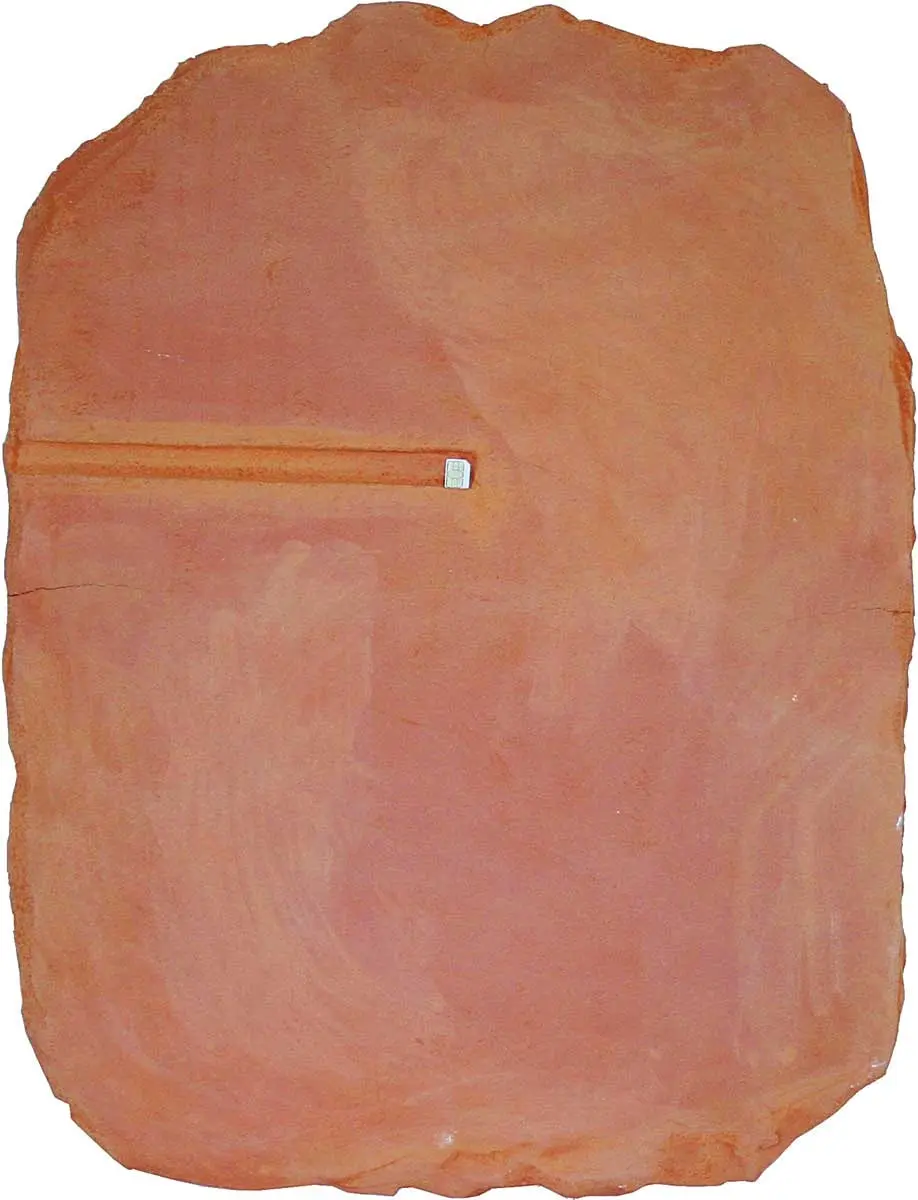
Not all of the artwork is so spatially cogent. Tania Perez Cordova is represented by some sculptures that are part of her series “Things in Pause” (2013–ongoing). With this series, Córdova has sculpted a group of abstract forms in various media and techniques, which are then completed by the addition of some object that has been borrowed from family or friends. For example, in We focus on a woman facing sideways, evening (2014), Cordova made a bronze cast of the negative space of the gallery corner, then suspended her grandmother’s earring from it. The familiar object is now uncanny in its new context, the perception of space and scale has been altered, and there is a sense of displacement as the object moves from its traditional home to a foreign, albeit site-specific, one. In Meeting a stranger, afternoon, cafés (2014) a SIM card from an iPhone 5 was placed within a rough-edged slab of red terracotta inspired by the ruins at Pompeii. Placing an object that simultaneously speaks of the cutting edge and also the imminently replaceable/upgradable within a framework that is at once redolent of a distant past that retains a sense of the eternal encourages one to consider, as in the work of Navarro, the qualities of time, and human/societal evolution. The precariousness of time is also invoked by the fact that these works only exist for the duration of their exhibition, after which the borrowed items are returned to their original owners.
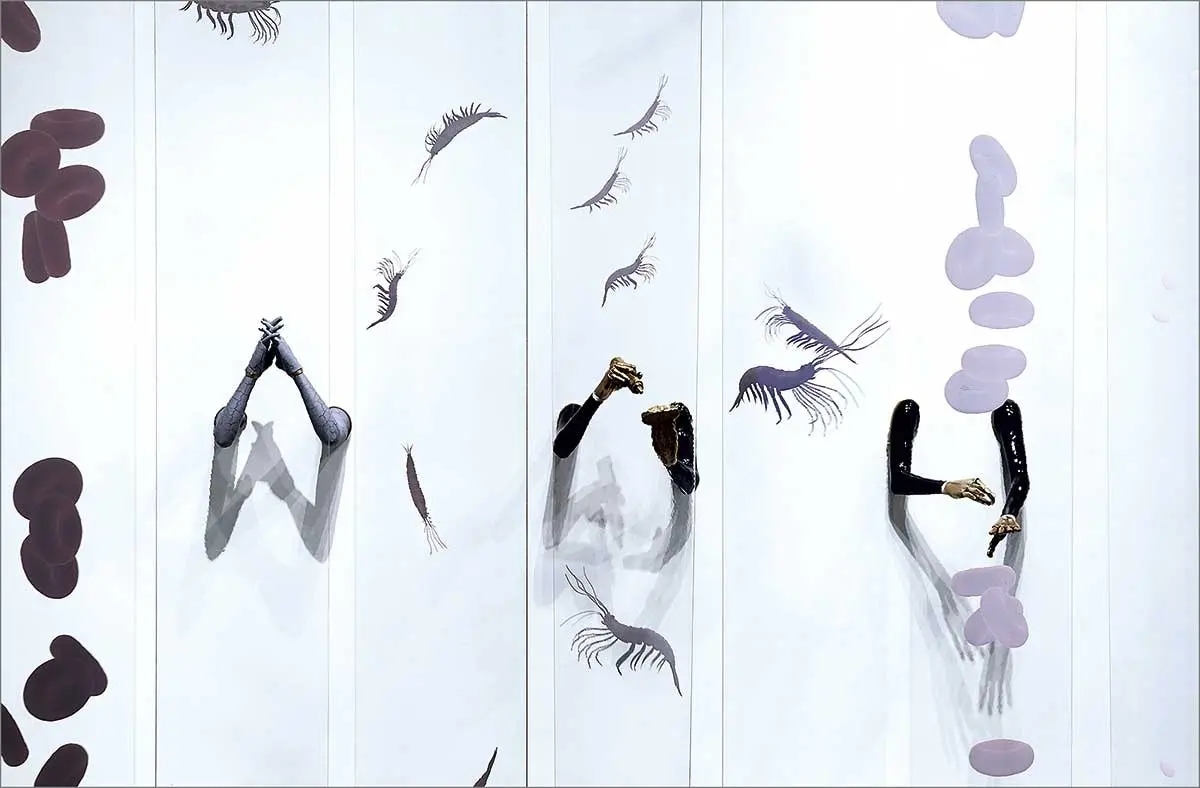
Leaving aside consideration of qualitative comparisons, which to a large degree is personal and will vary from visitor to visitor, there is the more basic question of how well the show holds together. Overlapping projects and fluid spaces, if managed correctly, can be visually exciting and help to reinforce the organizing themes of the exhibition. One area that seems to have taken these concerns into greater consideration than others is the fourth-floor spaces, wherein Cerrillo’s The New Psychology effectively frames works by Aleksandra Domanović, Avery Singer, and Kiluanji Kia Henda. Indeed, potentially the most visually cogent and stimulating passages in the exhibition are the merging of Cerrillo’s work into Domanovic’s. In SOHO, Substances of Human Origin there are three 3-D printed sculptures derived from the artist’s model of the Belgrade Hand, including arms up to the shoulder, coated in metal and polyurethane. The three sculptures mounted on the wall act out different gestures, merging the human and the technological. Each pose is imbued with meaning, one of them recreating a religious gesture and the other a labor action while the third holds a human tooth. Surrounding the space around the arms are hanging shapes of metal foil. Just as Cerrillo’s installation mediates one’s view of this work, conversely when one looks through the suspended foil prints they serve to frame and filter our experience of the Cerrillo work, as well as other projects on the floor.
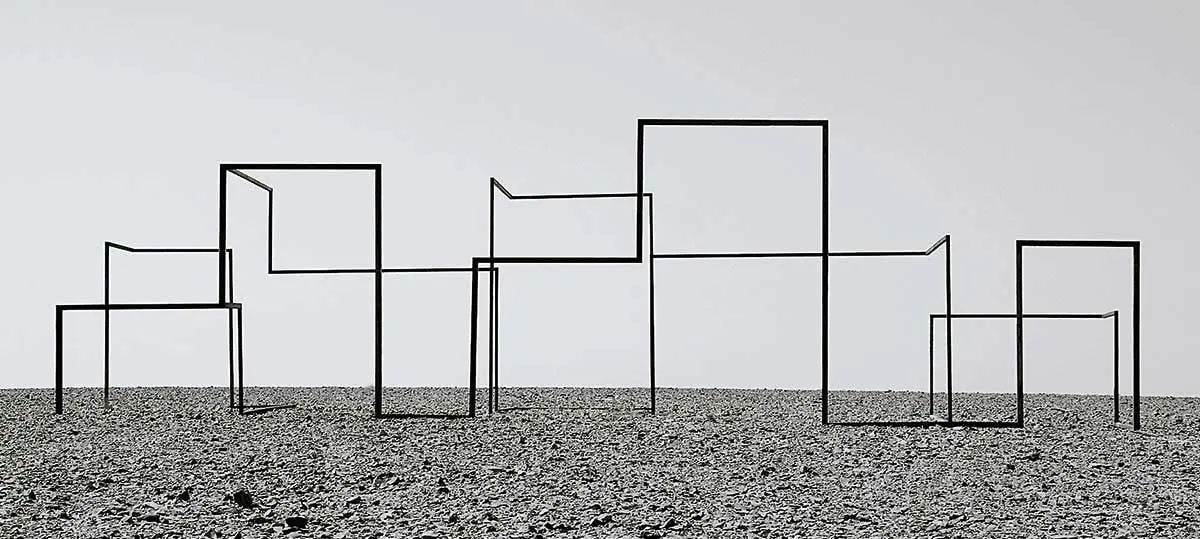
Another strong example of this overlap involves Henda’s Rusty Mirage (The City Skyline) and the series Buildings (The Palace, The Fortress, The Temple, The Ministry), which consists of silk-screen prints and photographs of sculptures created in the Maleha desert in Sharjah. The sculptures, constructions of metal lines, look like drawings standing out from the landscape or the skeletons of an imaginary city. The artist based these linear sculptures on sona, sand drawings common to the Lunda Tchokwe culture (from eastern Angola) which storytellers draw in the sand as they tell fables. Kia Henda transforms these ephemeral drawings into three-dimensional objects, imaginary structures in the desert that can either depict the remains of a destructive past or the beginnings of a new future. The open linear forms frame their landscape and resonate with the structures of Cerrillo’s project.
Not all areas of the exhibition work so seamlessly. Indeed it would be hard to imagine how they could, given the disparity of scale, media and themes presented. Far too often the projects are disparate enough or of such unequal impact that one is either subsumed by another or they compete with one another with a result that is more discordant and off-putting than galvanizing and stimulating. Given the range of practices, themes, nationalities, and media that are deployed in this exhibition it is perhaps not surprising that the parts taken as such are much more successful than the whole.
This lack of clarity extends to the putative organizing principle of the entire exhibition. “Surround Audience” is a theme that at first seems to be timely and on point with the changes made in the world with the increasing ubiquity of social media, and some of the projects seem to fit within an exploration of those concerns. In other cases one either has to strain to connect the thematic dots or, more crucially, to understand what makes these particular issues so current. To be sure, social media and certain technologies, coupled with current world events, create some scenarios and expressive opportunities heretofore unexplored. On the other hand, many of these concerns--including the expansion of the surveillance state, economic disparity, the increasing commodification of the Internet and intellectual property, and the erosion of a private self—have been pervasive since before the new millennium. The question of how new or unprecedented an artwork is can be a poor criterion for evaluation except that the entire Triennial is predicated upon the presumption of “newness” down to the relative youth of its participants. It would appear that one of the unintended lessons from this year’s exhibition is that the more things change the more they stay the same.
JOHN ANGELINE