
The work of Clemencia Echeverri centers on the exploration of particular geography populated by unseen communities and unknown regions that share a common element: being traversed by violence and the uprooting that such violence generates. The relationship with nature and the recognition of cultural traditions present in rural life allow Echeverri to accumulate unforeseen connections, delve into non-institutional archives, individual memories, and non-places where the only thing you discover is the spectral fingerprint of those who once inhabited it. As a result of the situation that has marked the country for half a century, there are many instances in which vulnerable, defenseless spaces and the memories of those who suffered in them are the only things that remain from the neglect and silencing to which the victims of violence have been subjected.
The installations by Echeverri renounce the direct images used in mass media to familiarize us with violence and instead confront viewers with the underlying factors, consequences, and other unspoken things. To do this she relies on allegories that take us away from the expected document in favor of proposing a level of engagement that reaches beyond mere media information in order to confront us with the experiences of the unsung protagonists and need for mourning and finding closure.
The installation titled Nóctulo (Noctule) consists of four fabrics that hang from the ceiling to the floor, forming a cube on whose walls video images are projected. The viewer enters a dark space in which perceptions are initially auditory as viewers gradually adapt their eyes to darkness to discover the images.
Conflict and memory are again found in remote rural areas of Colombia. An abandoned house is populated by sounds, phrases, and ghostly apparitions that dissolve before the constant flapping of the bat colony that now inhabits it. Home as a place full of symbolic connotations is a theme that has already been explored by Echeverri to highlight the way in which violence destroys that familiar space’s usual function as safe haven. The house becomes a blocked space occupied by the memory of figures who have either disappeared or that have no other choice than to wander.
The piece is worked in two levels: on the one hand, the bats’ strategy is to fly, emitting sounds that allow them to move in the dark without being perceived by the human ear, and, on the other, the spectral presence and sound of the ancient inhabitants. But the ultrasonic sound of bats is recovered; it becomes audible, as it is combined with their constant flapping. It is as if the artist attempted to recover the memory of what cannot be heard, or we do not want to hear while demanding that someone listen and that it become visible.
The viewer is outside and the story emerges from the hub seeking to recover a memory that despite being buried in our minds is nonetheless difficult to reconstruct. We are left in a dark space with voices calling us, reminding us of pain, fear, and neglect. Observers cannot penetrate the enclosed space and can only guess the meaning of image fragments and phrases that appeal to their senses; memories that do not belong to them but demand to be heard nonetheless. The voices pronouncing the sentences belong to old beings, witnesses-containers of recollections, of dwindling memories. The voices become echoes that narrate stories and the partially heard phrases describe familiar situations. The sound envelops viewers without producing a clear narrative, only partial accounts that dissolve.
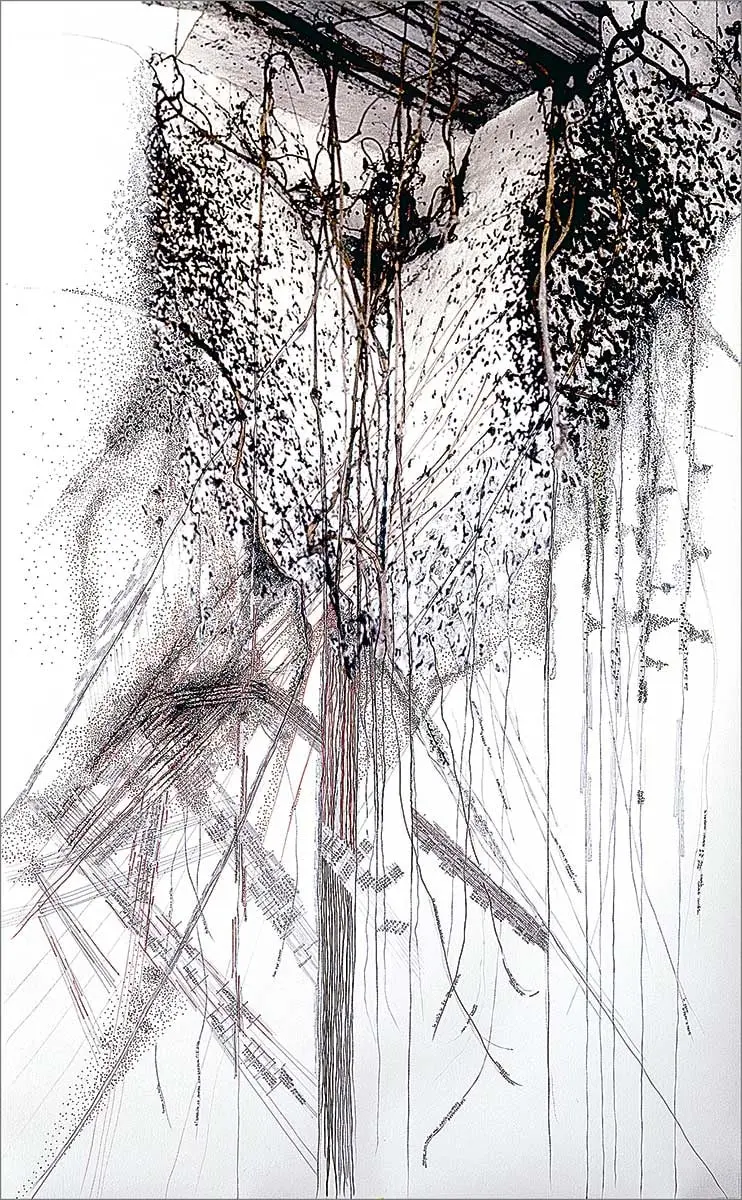
The central piece is accompanied by a series of drawings on printed paper that that register bat droppings left on the walls and phrases uttered by barely audible voices: “I was very scared,” “They took her and disappeared her” “Thirteen years ago,” “I’ve never seen anything like it,” “Why did they neglect us so much, we could not understand,” and “The girl left with the guerrilla.” These hand-written texts suggest the central themes analyzed in the exhibition.
From this dark space of vanishing images, persistent and enveloping sounds that blend the echo of voices with the flapping wings and ultrasonic sounds of bats, emerge a rain of seeds that announce the presence of a luminous nature that represents the possibility of reconstruction, glimpses of sought-after change. And the bat symbolizes those who have the ability to enter the darkness and come back from it as they scatter seeds that help fertilize the barren fields.
Echeverri relies on a series of metaphors that convey things that are not evident, as she seeks to shed light on a forgotten memory. Rather than informing viewers, her intention is to confront them with a series of visual and sound situations devoid of any narrative, but that challenge viewers to approach familiar situations from new perspectives, with the particularity of seeking to go beyond the obvious and, in the face of horror, open a cherished place for hope.
IVONNE PINI