
Australia-based Venezuelan architect and video artist Eduardo Kairuz presented his most recent work at “La Caja” of the Centro Cultural Chacao. On this occasion, the exhibition consists of four video installations created between 2009 and 2013, in which the subject of power and the breakdown of its structures is approached by Kairuz through the use of video recordings of several concerts by prominent classical musicians.
According to Kairuz, the role of these musicians is associated with the image that the figures of the power project. There is the expectation of a certain social behavior around them because, as the artist points out in his statement, the rigid and hierarchical nature of their structures reinforces the “almost sacred status” of these figures. In this work, Kairuz proposes “the dismantling” of the established social order that usually defines such figures. According to the artist, “I have dedicated myself to the implementation of disassembling and reassembling processes to reveal the dual nature of the manifestations of power and authority that interest me.” This dismantling (or deconstruction) process to rebuild from fragments is the key for appreciating each of these video installations. Kairuz references a raw and eloquent incident to understand this process: the reconstruction of the wreckage of Trans World Airlines Flight 800 (TWA 800), which exploded midair and then crashed into the Atlantic Ocean in 1996. Kairuz talks about how surprising the fragment-based reconstruction of the airplane was, given that it succeeded in creating a nearly 25 meters long object that no longer was the aircraft regardless of whether we know that it was. These fragments that resulted from the explosion—the accident—were transformed through the reconstruction process. Based on this “revelation,” Kairuz is able to visualize that same event—a situation or object—can have a double structure or that which he calls a “double discourse.” Thus, an airplane can symbolize progress but also a disaster.
In the exhibition titled “Dismantled” Kairuz generates accidents by disrupting and rearranging the videos. According to Costanza De Rogatis, curator of the exhibition, the absence of narrative shows “a sense of altered time that is no longer the real, consecutive, time of a linear action, or that of the perception of a work of art, of the here and now of representation, but rather that of the short, fictitious, time that ensues from the manipulation of the recorded moving image.”
The video installation titled Doble Discurso (Double Discourse), shows conductor Gustavo Dudamel, one of today’s most prestigious and internationally renowned orchestra conductors, on a dual screen. Kairuz alters Dudamel’s performance by silencing the concert. In this simultaneous projection, the conductor is shown frontally as he gestures practically alone amid the complete silence. Kairuz has also altered the speed of the videos so the action in one screen is slower than in the other. This means that the image of power and authority that a conductor normally projects has in effect been altered. In the intervened image, Dudamel’s gestures are devoid of any meaning. Moreover, it is inevitable to associate—although it may not be the original intent of the piece—the moral questioning of Dudamel’s character stemming from his evasiveness when asked about his political position on the current state of the country. He has repeatedly declared that he is interested in music and not politics, but in a polarized country like Venezuela to conduct a concert to a specific audience inevitably becomes a political issue. Thus, his stance becomes a double discourse.
In another vein, it should be noted the manner in which in Incremental, a 32-channel sound-video installation, the Goldberg Variations (BWV 988) masterfully performed by Glenn Gould, are seen (and listened to) in a disjointed manner. The result of the reconstruction is, as Kairuz writes, that of a “musical disaster.” In Equilátero (Equilateral) the Suite for Solo Cello No. 1 by Johan Sebastian Bach is played simultaneously by three renowned cellists: Mischa Maisky, Paul Tortellier and Mtslav Rostropovich. According to De Rogatis, Kairuz generates “dissonances at critical points of interpretation, breaking the apparent harmony of parts and modifying the perception of the work. “Nonetheless, the famous Suite is recognized as one of the emblematic works of Baroque music.
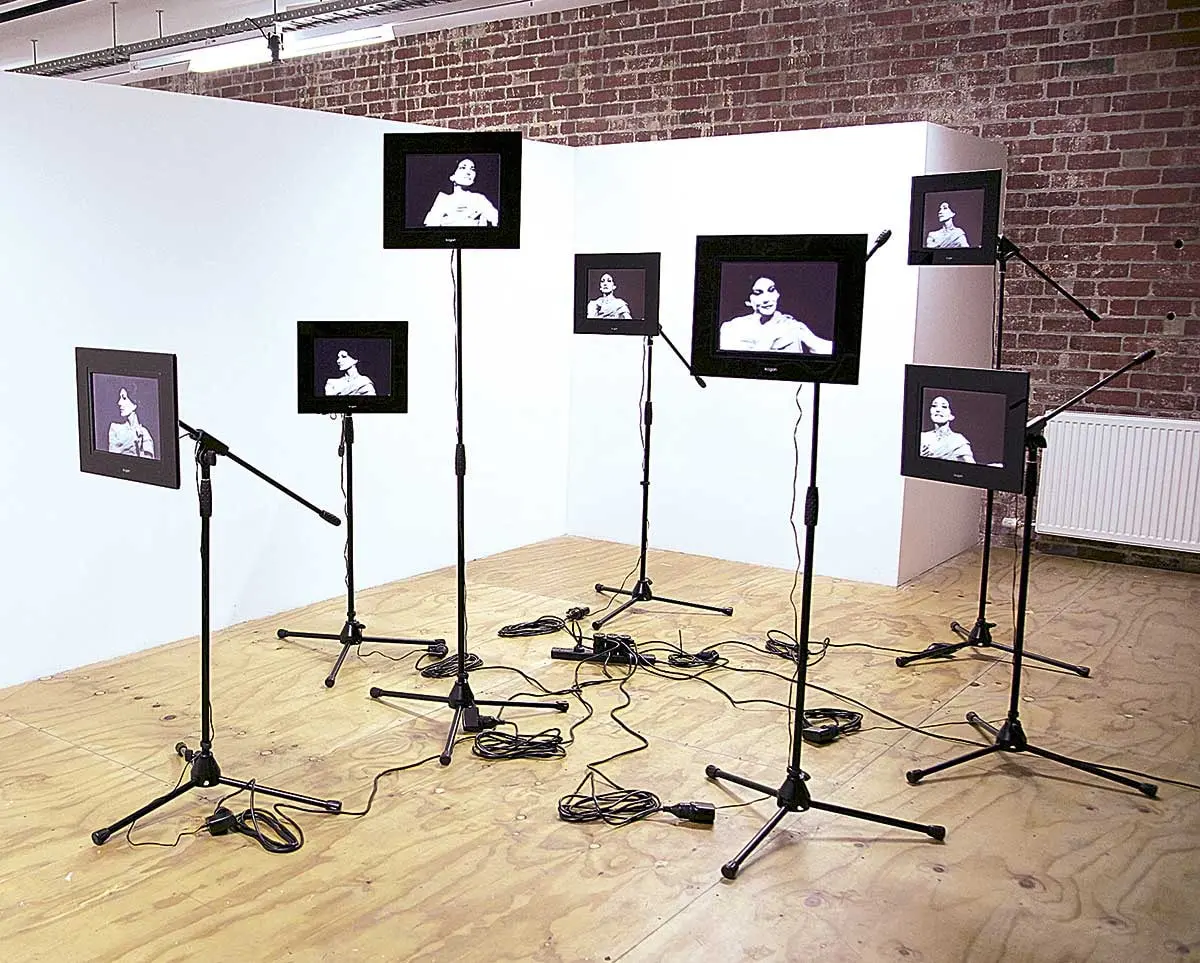
The video installation titled Delirium–Estudios sobre la Embriaguez #1, María (Delirium—Studies on Drunkenness No. 1, María) stands out for the impact and beauty of María Callas’s presence. Her image can be observed multiplied in several monitors resting on devices that look like the lecterns used by musicians to read their scores. The absence of sound and the simultaneous images of her face in different postures, gestures and singing moments, intensify her presence even as her “voice” was silent. The autonomy of each face gave the sensation of succession and simultaneity, turning the piece into a harmonious as well as dissonant experience. Precisely a paradox posed by these dismantled concerts.
SUSANA BENKO