
The Galeria Nara Roesler in Sao Paulo presented until March of this year the exhibition titled “Horizon, Desert, Fabric, Cement,” by Fábio Miguez. The show was conceived to offer a panoramic view made of modular forms. Far from a hurried approach to a definitive geometric centrality, the exhibition reaffirmed Miguez’s commitment to a type of painting devoted to the expansion of visual fields interested in another constructive project.
Each of the words selected to form the title of the exhibition made reference to a particular inflection point that became essential to Miguez when, after reading works by poet João Cabral de Melo Neto or by Samuel Beckett, he found reasons to express in words—which he sometimes includes in his paintings—a connection with those authors.
In Miguez’s work, each pictorial plane sectioned by regular contours—from vertical and horizontal slits to openings towards often faded coats of blue, gray, green or red backgrounds—allowed the visitor’s gaze to accompany a survey that grounded his presence in Brazilian art through his artistic essays and explorations at the Casa 7 workshop, in São Paulo.
An artist who belongs to the highly innovative and experimental environment of a generation that stood out in the contemporary art scene of the 1980s, founder of the Casa 7 workshop, conceived for the exchange of aesthetic concerns and the development of creative projects—which also included the participation of artists Carlito Carvalhosa, Nuno Ramos, Paulo Monteiro and Rodrigo Andrade—Fábio Miguez continues to propose visual stories associated with research that reaffirms the statutes of color.
Back in 1985, during the presentation of the group exhibition “Casa 7” at the Museu de Arte Contemporânea of the Universidade de São Paulo, art critic Aracy Amaral pointed out that from his early experimentations “Fábio Miguez (...) makes and remakes landscapes—imagined or real?—in the Cezannian concentration for the constructive resolution of the rendered image.”
Since then and through decades of work, the slits, flat shapes, modular faces and other strategies created by the artist to conceive experimentation as an irreplaceable element of creation, affirmed the trajectory of a structuring approach directed toward the construction of color; even when, drawing from Matisse and Cézanne—according to Miguez’s own account—his creative endeavor looked for orderly connections.
The exhibition, which brought together works from Miguez’s latest production, offered a group of forty creations organized around his constant search for daily records of his impressions about common scenes that we observed as they stare right back at us, always inquisitive.
The result of a long color making process in dialog with the planned environment, the works presented in the exhibition at the gallery included a group of impressions about very simple everyday situations, personal references, memories and associations—perhaps of a kinesthetic nature—with the sky, the wind, dust, lime and day; where the artist would rescue images whose compositions sometimes included painted words that served as guides for the movement of the gaze.
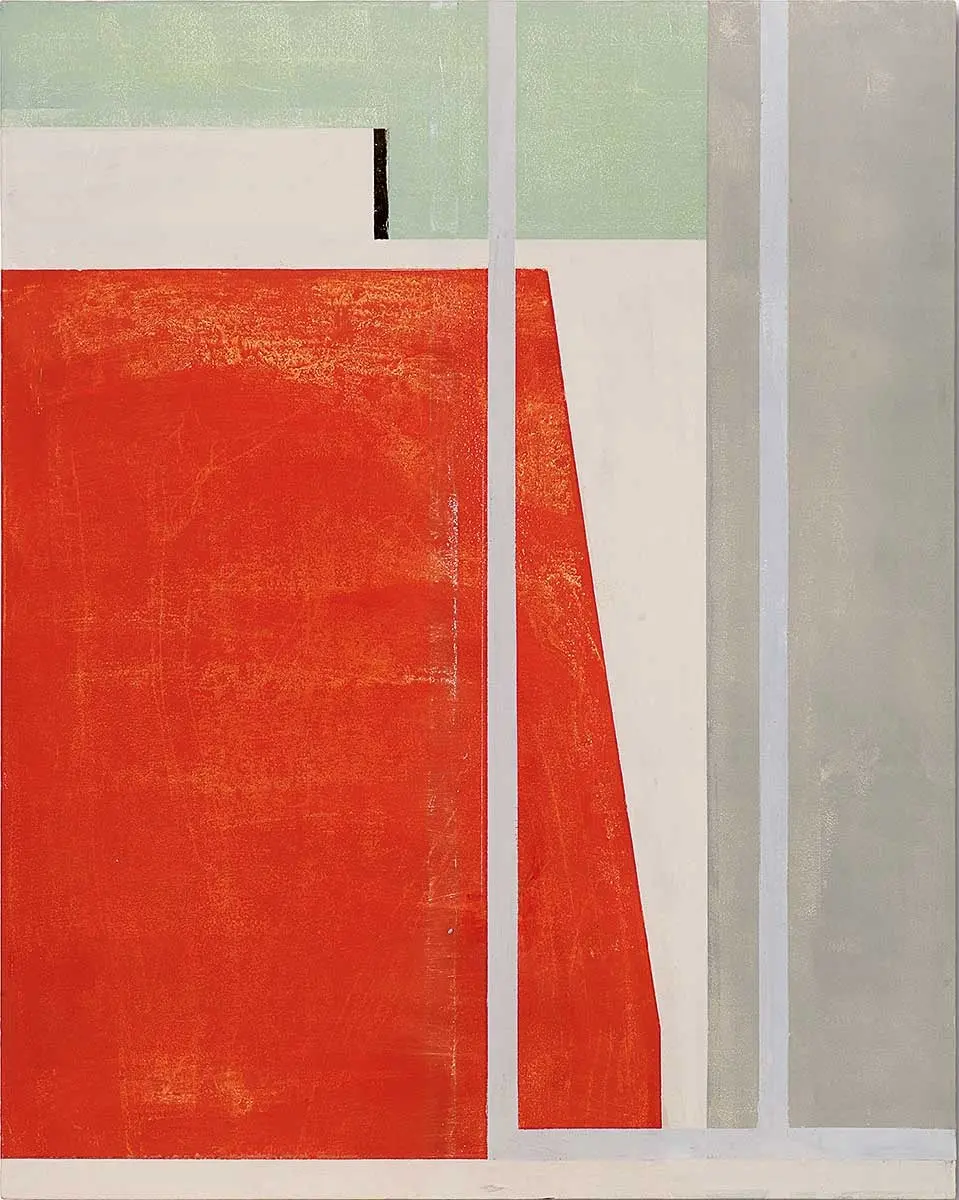
Much more than organizing a series of structural geometric combinations, in his explorations Fábio Miguez composes planes with oil painting and wax on linen that he sections in fields of color designed to draw the gaze into open areas intersected by intuitive relationships.
In Miguez’s work, these areas opened to the gaze refer to French philosopher Georges Didi-Huberman’s suggestion that: “to observe is to understand that images are structured from the outside-in: inaccessible as they impose a distance, no matter how close they actually happen to be—for it is the distance of a suspended contact, of an impossible flesh-to-flesh relationship. Namely, this means exactly—in a slightly allegorical manner—that the image is structured as a threshold.”
Given that the characteristics of Miguez’s color modulations did not allow for the inclusion of everything in a single glance, the greens, grays and blues in his planar surfaces permitted the continuity of painting in the exhibition space, beyond any support, as if it were an expanded weave.
The work Patio Rojo (Red Patio, 2014), an oil painting and wax on canvas that revealed layers of a faded, almost peeled, red, with the chromatic quality of mural painting, was at the center of a vision that added gray, green and black to an arrangement of colors that resulted from a constructive procedure organized by a vertical lattice. Of large dimensions, the painting presented the characteristics of a fresco very much in the early renaissance style of Fra Angelico.
Even the casual gaze of a visitor with no previous knowledge of the references that inspire Miguez—his acknowledged interest in Matisse’s use of color, in Cézanne’s compositional structure, in the meditative space of Piero della Francesca—could feel the atmosphere illuminated by the color glazes marked by cotton mousseline texture.
Once the walk through the exhibition concluded, the visitor’s gaze was left with the impression that Fábio Miguez had opened many horizontal, vertical and diagonal windows determined by painting in different formats, especially to facilitate our contact with the outside world, with life.