
The always renewed work of Flavio Garciandía, its conceptual projection, the caliber of the artist’s explorations, and the value and effect of his teaching at the Instituto Superior de Arte (ISA) in the 1980s, have made him a mandatory point of reference in contemporary Cuban art. The exhibition Quisiera ser Wifredo Lam… (pero no se va a poder) provided an opportunity to demonstrate this, recomposing fragments of a history connected to the critical assimilation of kitsch and vernacular elements, the development of Garciandía’s analytical vocation, offering evidence of his manipulations, of the blurring of lines between high and low culture, and of his transit through a variety of languages.
This outing was preceded by others in the past five years: Revolution No.1 (2009) and Iba a decir algo muy importante (…pero ya se me olvidó) (2010). Unlike these, however, the current show at the Wifredo Lam Contemporary Art Center had an anthology intention. More than 50 artworks, between painting, drawing, installation, and video were included in the show curated by Cristina Vives, also the author of I Insulted Flavio Garciandía in Havana (Turner, Madrid, 2009), which was the basis for the project.
An insouciant statement of principles presided over the exhibition like an epigraph, establishing rights and obligations conceived by the artist, humorous and ironic expressions connected to a similar ingredient in the jungle that is his oeuvre and implicit also in his way of assuming verbal supplements. Under review here were thirty years of work in the arts, with a focus on some specific moments. The selection made it possible to gauge the reach of Garciandía’s symbolic production on the basis of works that are key for its understanding, capable of fostering a suggestive approach to his prolific efforts, to a history that in reality is even more extended and had different geographic points as its setting.
The exhibition took for its starting point the year 1973, when the artist graduated from the Escuela Nacional de Arte (ENA), and ended in late 2014, with works made in Mexico City, where Garciandía resides. The arrangement of the galleries was used to structure segments that outlined a number of distinctive moments. The first section was devoted to Garciandía’s photo-realist period (1973-1976), featuring, among others, Retrato de Zaida (1973) and Todo lo que usted necesita es amor (1975), the latter an oil work emblematic of the period that is among the artist’s best-known productions thanks to its lyrical beauty.
Following this introduction, a selection of expressionist paintings from the series El Dorado (1976-1980)—in which the traces of photography could still be noticed (Los emigrantes and Las ínsulas extrañas, both from 1980)—contrasted with works created between 1982 and 1986, based on Garciandía’s investigation of vernacular and kitsch elements and displaying his appropriations and skillful manipulation of an arsenal of low-culture forms: swans, chinoiseries, shines, and refrains, which integrated into his symbolic production reinforced a new identity and the post-modern inclination of his work. Evidence of the latter could be found in his sketches for book-objects in several series: Catálogos de formas malas, Refranes, and El lago de los cisnes; in his painting-sculptures: Cuchillo de palo, Corazón que no siente, Pájaro en mano, and Pies de plomo, from 1985, all from the Refranes series; as well as works from the series El Síndrome de Marco Polo, from 1986, and the polyptych Cuadros de Policlínico.
An entire room was devoted to the reconstruction of Tropicalia (1988-1992) on the basis of six works and the presence of ornamental plants. Hammers, sickles, palm trees, and machetes were part of a satirical game that transformed them into a political metaphor, after turning the ideological symbols into singular protagonists of a carnival or sexual orgy. Presided over by Frijoles coloraos o Segundo viaje de Ad Reinhardt a La Habana (1994), Garciandía’s abstract paintings of beans (black, white, red) also occupied an entire room. The beginning of this series is connected to the harshest moments of survival in the midst of the country’s long crisis.
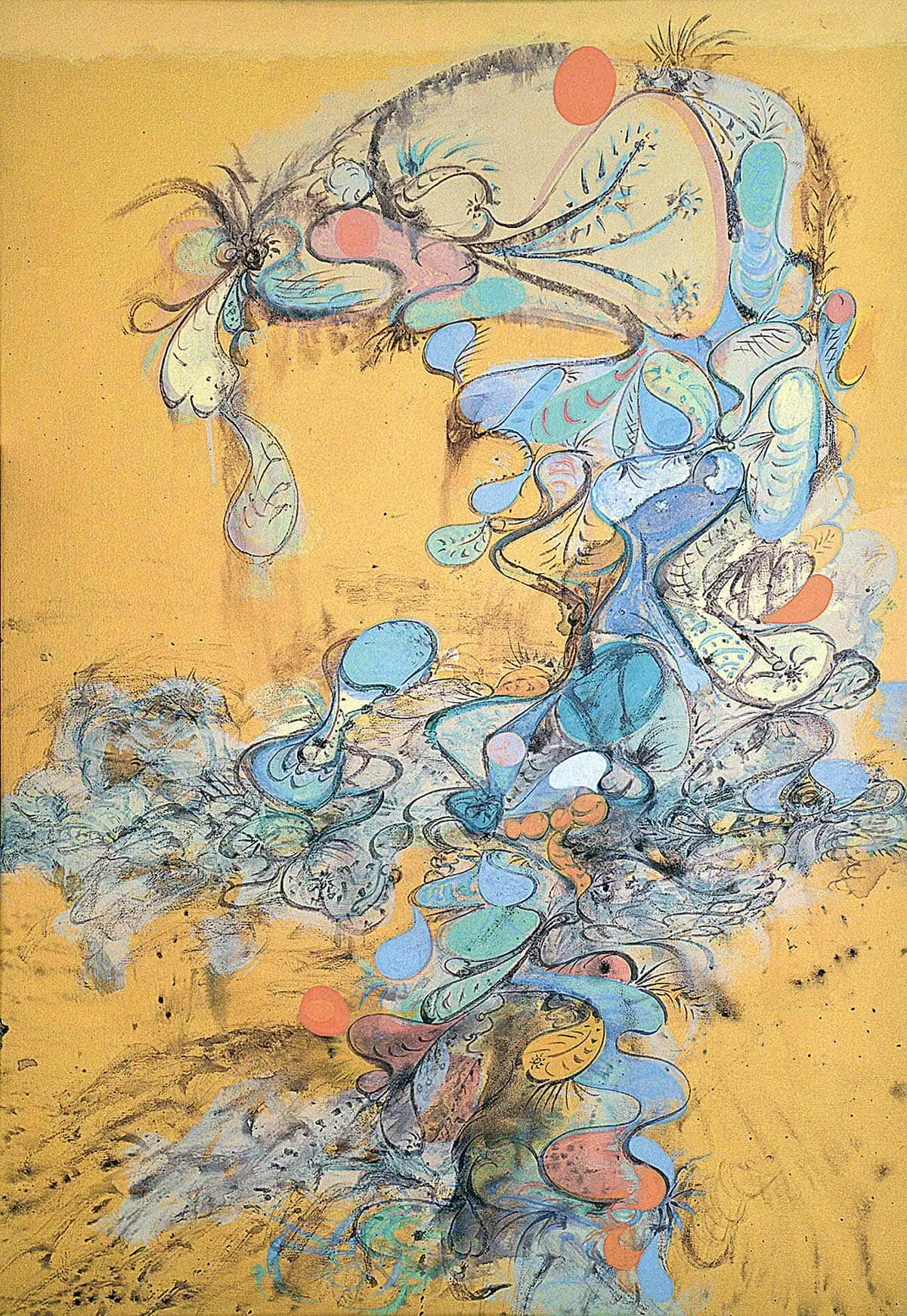
From different standpoints, two sections were intended to highlight Garciandía’s most recent work. One, featuring Auge o decadencia del arte cubano, a 2006 performance project involving, alongside Garciandía, more than 150 Cuban artists at the Museo Nacional de Bellas Artes during the 9th Havana Biennial. Another where the standout was—among other novelties—El Cuarto Mundo (el que está entre el tercero y el quinto), 2014, a large format canvas in which—as in others in the group—abstraction was populated by ambiguous figures and surrealist allusions. Quisiera ser Wifredo Lam… (pero no se va a poder) (re)discovered the meanings of Flavio Garciandía’s work and confirmed his status as en emblematic artist.
CARIDAD BLANCO DE LA CRUZ