
Isabel De Obaldía’s glass sculptures simultaneously highlight and contradict the basic qualities of her raw material: fragility and transparency. Through a long and painstaking process, she transforms a substance usually considered to be light and delicate into heavy, highly expressive sculptures that reveal an inner strength. She seems to handle glass at will: she molds, melts and carves it, converting inorganic material into energetic creatures. Challenging the traditional expectations in glass art, she creates three-dimensional works both large and small, with surfaces that range from the roughness of volcanic stone to highly sanded finishes, which are sometimes opaque and other times, glossy.
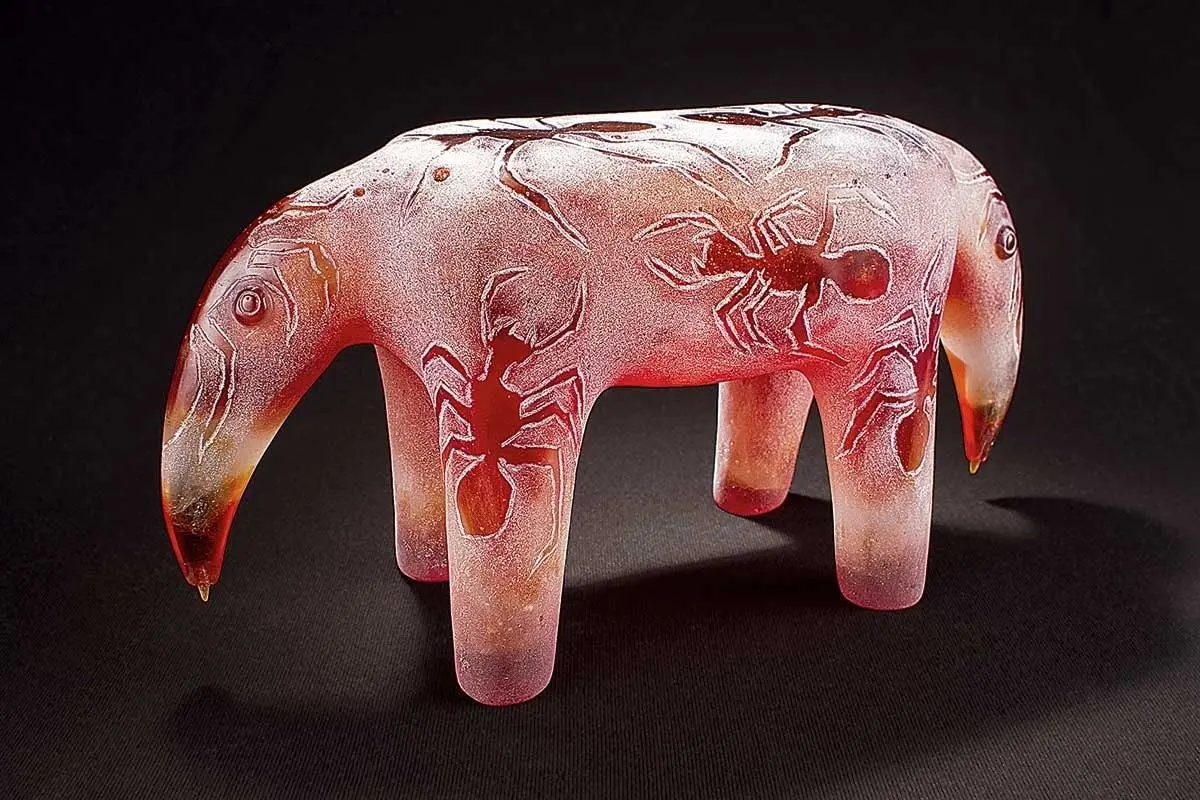
In her recent work, De Obaldía again marveled the audience with her unusual sculptures, now smaller than in previous years, when she went as far as creating a six-foot-long glass crocodile. The new pieces are mostly made of cast crystal, which offers a more refined transparency and luster than regular glass. With a different chemical composition, mainly because it contains lead, crystal weighs more, but is also easier to sand and polish, and allows the carving of complex designs, all features De Obaldía took advantage of in creating these new works. In the sculptures titled “Red Scorpions” and “Carpenters,” the artist reworked the bodies of a golden panther and a rubicund ant-eater, enriching their surfaces through relief carvings in the shape of potentially aggressive insects such as scorpions and ants. In her “Scorpion King,” on the other hand, she created a four-legged creature with a human face and the shape of a “metate” [a pre-Columbian grinding stone], into which she incorporated a scorpion that can be seen through the translucent glass of the humanoid torso.
Even more dramatic is the silhouette of a blue man who appears to be floating within the body of a small shark in the sculpture entitled “Cazón” [as baby sharks are known in Panama]. This is a particularly interesting piece due to its multiple contrasts: of colors (blue and white, with bold touches of red), of surfaces (matte and polished), and of transparency versus opacity. But above all, it reveals how De Obaldía has achieved a refined balance between organic shapes and abstract values. “Cazón” displays an ovoid form, two small circles and several softened triangles, which stand for the body, the eyes and the fins of a dangerous marine animal. It prompts a variety of possible narratives: the elongated body of a human being within the shark could remind us of death, but it actually seems to represent a spiritual marriage between man and the sea. The relationship between humanity and nature has always been a key element in this artist’s oeuvre.
This interest in animal forms is also reflected in De Obaldía’s new bronze castings, a technique she has begun to explore in recent years. In this exhibition, in addition to her glass bestiary, she presented a bronze ant-eater and a piece entitled “Throne of Alligators”, which resembles a ceremonial seat, as well as an animal with two heads, finished in a glossy and earth-toned patina. The alligators both show their fangs, although their expressions are more like smiles than threats. The artist also created a piece in glass with a similar form, which she entitled “Amber Crocodiles.” It is interesting how the more stylized glass sculpture, with its dramatic transparency and textures, as well as its combination of earthy browns, greens and reds, is actually a more expressive and provocative work.
The way in which her sculptures combine zoomorphic elements with humanoid features, in works that blend the form of a throne or a pre-Columbian “metate” with that of a four-legged animal has become emblematic in De Obaldía’s art. Her themes and subjects relate to her sources of inspiration and fields of knowledge, from classical art and pre-Hispanic cultures to modern sculpture, an understanding that goes beyond the mere physical forms. She feels a bond with the natural world that recalls the traditions of the first peoples, including indigenous Panamanians, where a deep admiration for animals goes hand in hand with a sense of fear and respect for the forces of nature. Both in ancient art and in the work of this contemporary artist, these forms reflect both psychic beliefs and a primary connection to the natural world.
De Obaldía’s recent sculptures in glass, and now also in bronze, represent crocodiles, sharks, panthers, scorpions; a variety of beasts both great and small. However, over the years, she has also created many human figures she describes as warriors, guardian-like men with powerful physiques. Her artistic production reveals a strong sense of physical reality but also a spiritual experience, a reflection on the desire to protect ourselves from death and to understand life, a feeling shared by men and women throughout the ages.