
Juan Andrés Videla (Temperley, 1958) presented the exhibition titled “Scrub II” at SlyZmud gallery in Buenos Aires. It consists of a series of large and small oil paintings based on a single black and white photographic image of a bush placed on the foreground: a group of intricate and thick unkempt bushes rooted in an unknown place and time.
Videla has already been working for some time in the following manner: taking multiple photos and then transferring them using techniques such as oil painting or graphite on Formica.
Roland Barthes compellingly encapsulated the essential qualities of the photographic medium in his emblematic essay Camera Lucida when he wrote that “the photograph belongs to that class of laminated objects whose two leaves cannot be separated without destroying them both: the windowpane and the landscape, and why not, good and evil, desire and its object…” Nonetheless, Juan Andrés Videla succeeds in deconstructing the photographic image as he peels away at its layers, bifurcates it. The artist, as the medium, displays the successive layers that appear to be forming the bodies in nature, in a process that goes from the photographic record to the concretion of the image. The scrub, a framed and photographed fragment of the natural world, grows through the multiplication of images that disrupt, not in order to disfigure, but to venture again and again in the depths of its essence. The artist intensifies the propagation of nature, exposes an intricate network that appears to be spreading with premeditation, bursting into the unknown, into the landscape. Videla reveals the uncultivated, the unkempt; presents the natural environment that opposes the world, culture, and knowledge. The scrub appears and remains throughout the exhibition as unexplored territory, a continent not yet conquered. Its untamable matter and structure move away from history time and time again. It is everything and it is fragment, a system capable of self-development, a small universe in constant expansion that dissolves in the landscape, almost always ignored. But he can also imperceptibly influence and even modify other systems.
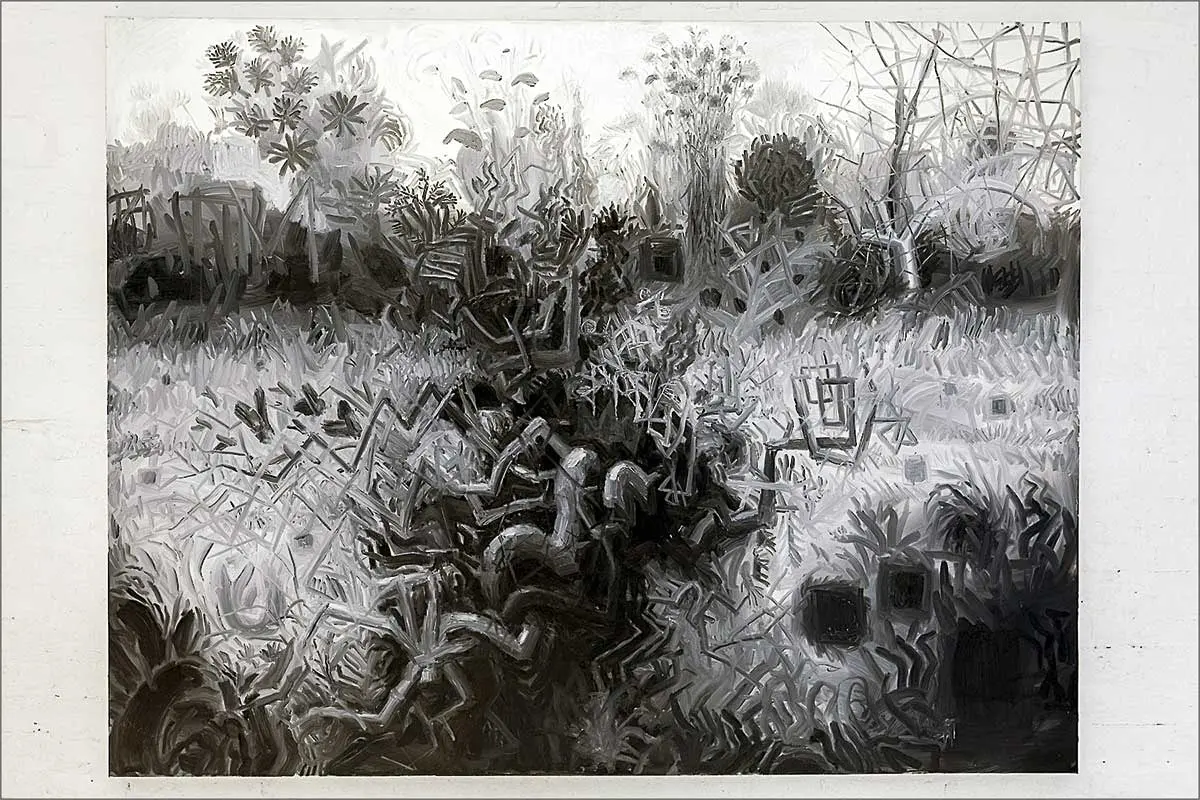
The paintings do not appear to be snapshots of the microcosms or representations of the natural world under the influence of different light intensities. They are rather meditations, resonances, images that have been achieved through the most primitive intuition, where the gesture, stripped of all symbolism, coincides in time and form with the thing itself.
This lost swarm, which at times would appear to be on the verge of desiccation, is not a neglected garden like the one Videla represented in Quintana, el Jardín (Quintana, the Garden) a large format work exhibited a few years ago; nor is it related to the lone cabin displayed in Refugio (Refuge), a graphite on board that earned him the Grand Acquisition Prize in the category of drawing at the 2014 National Salon of Visual Arts in Argentina. Those works still preserved vestiges of culture, of a city that, although bared and austere, kept the signs of a recognizable code, things learned and human endeavor. In “Scrub II” Videla no longer represents the world or what remains of it, but instead reveals the natural landscape by itself. The premeditated hand of mankind disappears, dissolves to form part of the bush as an event so it can be part of that which has not yet been cultivated. There is no account of a specific time, as if a black hole had absorbed all traces of culture. But the bush is not the representation of something not yet cultivated that is being kept in a dormant state for future development, or the subject of any potential progress. Instead, it is something that appears to contain, hidden within itself, the purest illiterate and archaic manifestation of knowledge. There, all created worlds—such as work environments, social life and even the planet and its sphere as finished definitions—no longer exist and only the untamed appears as a single eternal event.
VIVIANA SAAVEDRA