
A certain hyperbolic essence that characterized Latin American art and literature for several decades and relied on exaggeration as one of its most used figures of speech, is evident in the retrospective exhibition by Colombian artist Leonel Góngora (Cartago, 1932–1999) at the Museo Rayo. With over 70 pieces from various collections, the show glimpses at the archetypes developed by Góngora in his autonomous universe, the manner in which he enslaved the figures and the energy of drawings in which momentum is the central element of the compositions. They are an entire two-dimensional procession of contorting women with paroxysmal gestures that allude to sexual ecstasy and the artist’s own ubiquity as a person who observes and touches everything. And everything belonged to Góngora in his paintings. He used the characters to the point of molding, deforming and rendering them with compulsive scratches and traces. And Góngora always drew himself in his work.
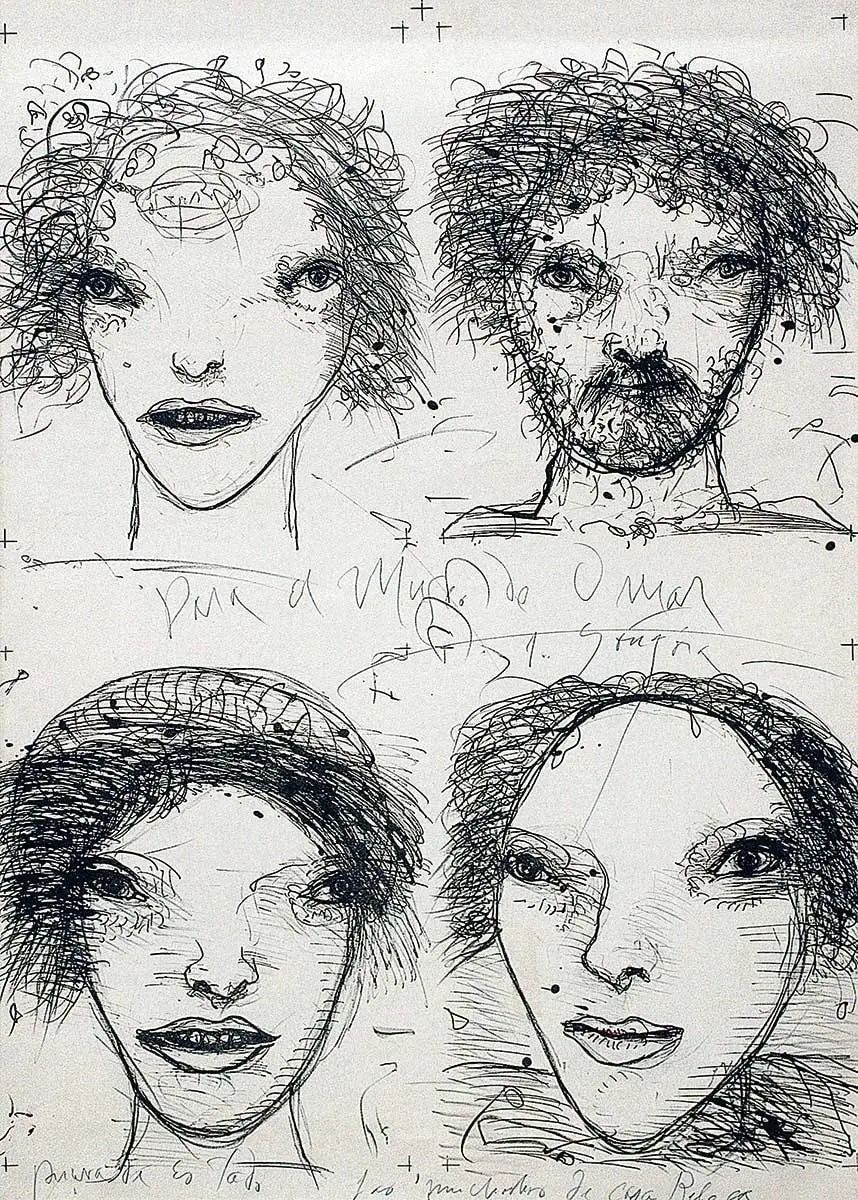
It is interesting to consider that the faces in the paintings allude to real women and that his pictorial world—whose formal characteristics are kept under one style—is inspired by the real world and particularly by his ritualized encounters with women that are drawn in a sort of parasympathetic-magical style. In this superficial sense of the term, it is interesting to think that Góngora perhaps used drawing as a way to touch his female models and to allow his imagination to be driven by desire. A member of the vanguardist Neo-Figurative movement in Colombia that emerged during the 1960s, Góngora and other artists of his generation—like Carlos Pedro Alcántara and Granada, among others—thought of art in relation to its context, specifically in connection to the prevalent violence of that time, expressed in their works through the monstrous distortion of figures; transfigurations that pointed to the exaggeration of certain aspects intended to be emphasized by viewers, as a way of underlying the macabre. This is the case, for instance, of the series entitled “The Violence” by Luis Ángel Rengifo and many of the drawings by Alcántara Herrán. However, the exhibition at the Museo Rayo mainly focusses on works created during the second half of the 1970s, with the exception of a few lithographs from the previous decade that convey the genesis of all of his figuration and his compulsion toward the dramatic, the sexual and the monstrous.
Monstrosity in Góngora’s work is a consequence of excess. But in this exhibition exaggeration is also expressed in the abundance of lines and superimposed contours, the reiteration of forms within the frame. Overlapping and chaotic delineation reflect the linear baroque that he perhaps could not entirely translate into his painting. One wonders if there are any words or texts hidden between the lines resembling letters, erasure marks or signatures. Perhaps these texts hidden in the tangled hair of his models tell the stories of the artist’s encounters with them before they are painted. Thus, the compositions may be documents and records of his affairs. The drawing titled María includes the curious note: “Young woman from Buga who told Omar Rayo in a whorehouse in Tuluá that her name was María. Just in case, Góngora 71.” The letters in this note resemble the lines in the drawing just as the artist’s signature in all the works—the self-portraits and the portraits of women alike—appear to be part of the drawing, of the curls of hair. Such writing accounts for a code that, although undecipherable, does exist nonetheless. It is a code about eroticism, a subject that requires no logical explanation.
The walk through the exhibition rooms that show Góngora’s work is seamless and his redundant style ends up convincing viewers about the strength and consistency of a strange universe populated by faces with eyes set wide apart, deformed hands and large parted lips. The gesture of death comes to resemble the gesture of orgasm. The women painted by Góngora are presented as bodies and their characteristics adapt to the artist’s archetypes, perhaps as an excuse for contact, observation and intimacy. His works are unconventional because they have their own language—and, thus, their own set of conventions. A little careless when it comes to technique, Góngora demonstrates a tendency towards permanent and impulsive creation. It should be noted that Góngora is an artist trained at La Escuela Nacional de Bellas Artes in Bogota. In Mexico, he became part of the Nueva Presencia group, which also included José Luis Cuevas, an artist that influenced him to some extent.
Góngora is one of the representatives of erotic art in Colombia. He successfully articulated shocking themes with a great poetic sensibility. Exhibitions like “Portfolio: Love Stories” and “The Book of the Deadly Sins”, included in this sort of retrospective, bring together all the virtues of this artist as a drawer and composer of scenes, master of the grotesque and channeler of eroticism (the grotesque) and poetry (the sensitive).