
Chairs crossing legs, bags made out of stones, pillows fashioned with angel wings, books with wooden covers. These are some examples of the bestiary of fantastic figures created by Brazilian artist Luiz Philippe Carneiro de Mendonça (Mina Gerais, 1957). The recent exhibition titled “Suitcases Ready” at the Marcia Barrozo do Amaral Galeria de Arte in Rio de Janeiro, offered another variety of these pieces: 18 suitcases never before exhibited. Known for his stone suitcases, the artist prepared a new artistic production along the same lines, but this time using old tiles.
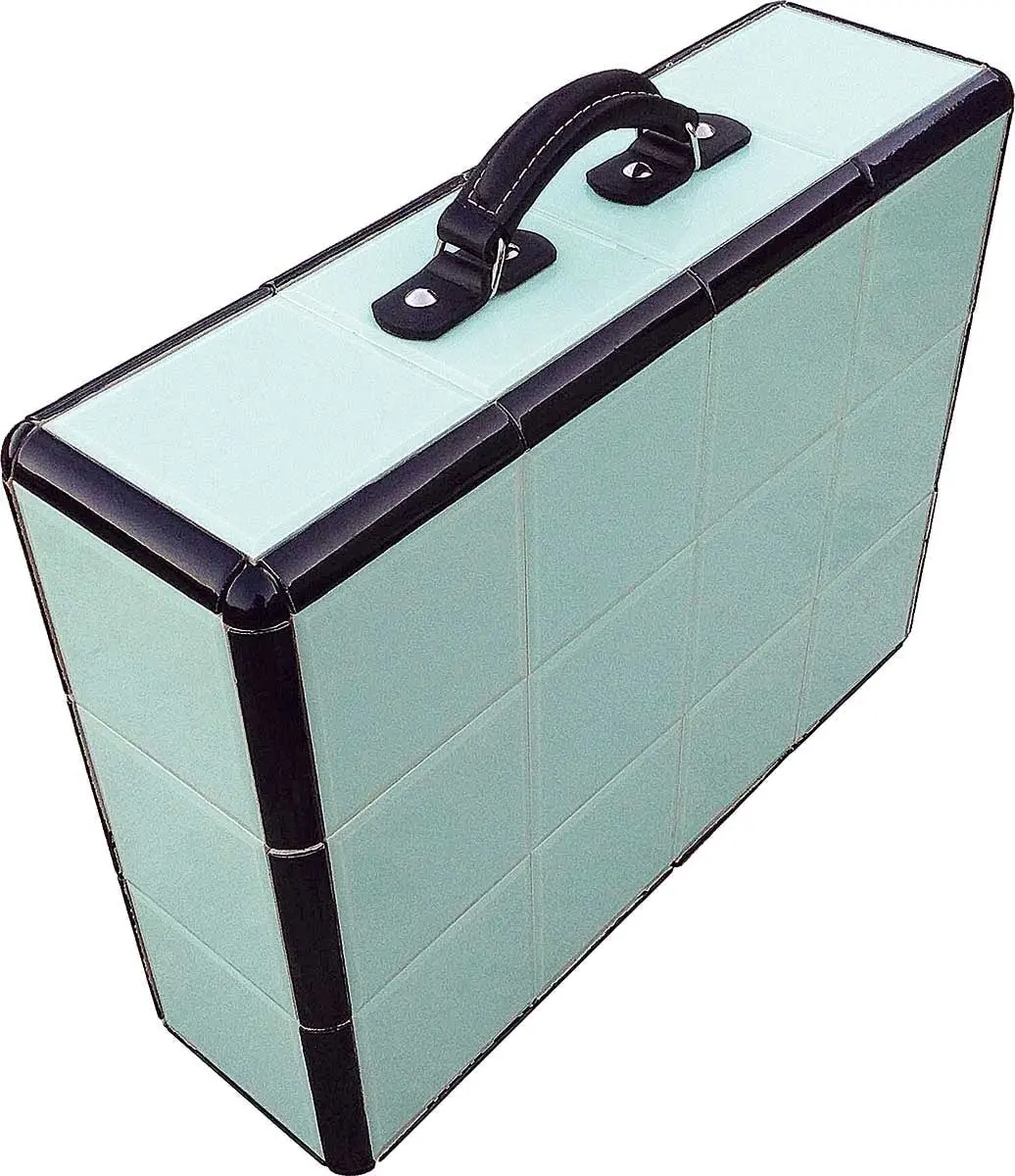
“Colors, designs and fragments inhabit our affective memory. On this journey, the suitcases carry a little of each. Aiming at conveying memories and the weight of existence through his work, Luiz Philippe affirms that the upside down house, consists of “portable walls.” According to him, the idea of the stone suitcases conceived in 1996 is connected to memory. The stone is not just the raw material for the work for its full weight acquires a disconcerting significance when attached to a single leather handle. The bags are subjected to the most varied personal interpretations. “I think that this happens through humor, pleasure and even as result of a certain relief that viewers feel upon seeing the sculpture. Moreover, humor is a constant in my work,” says Luiz Philippe.
For this series, the artist toured warehouses of old tiles to acquire the raw material that resulted in works that also allude to designer bags. Luiz Philippe adds that “The relationship with fashion is a natural corollary. Suitcases and bags combined with the colors of the tiles and mosaics inevitably result in a seductive object that can be—symbolically—confused with the object of desire in fashion. I think that the exercise of memory involves a sense of pleasure that allows for these fields to align. Fashion has always been very present in my life. In the 1980s and 1990s I did a lot of work for fashion brands as an illustrator and graphic designer.”
The exhibition also included suitcases with photographic montages that functioned as a huge postcard or an immense old photograph in an album. The artist placed handles on the suitcases that represented the Cagarras Islands and the Pedra da Gávea Mountain, two of the most emblematic natural stone monuments in Rio de Janeiro. In this manner, people would be literally taking a souvenir of the wonderful city.
Born into a family closely linked to the arts (his grandparents and parents were collectors of ancient and modern art), Luiz Philippe spent his childhood living in an ironworks that belonged to the family. During the 1960s, his father, then director of the Museu de Arte Moderna da Pamphulha in Belo Horizonte (MAP), created the first contacts with the world of the arts. In that period Luiz Philippe visited the studio of Alberto da Veiga Guignard in Ouro Preto and developed a close relationship with Frans Krajcberg, with whom he continues to be in contact with to this day.
He graduated in industrial design in 1978 at the Escola de Belas Artes of the Fundação Universidade Mineira de Arte, but always worked on projects in the visual arts field, whether through drawing, painting, sculpture or photography. For a long time he lived and worked on a nineteenth century mansion in Cosme Viejo, in Rio de Janeiro, which belonged to his grandfather the historian, and whose atmosphere directly influenced his work.
Often, Luiz Philippe’s formal proposals reveal a surreal and fantastic touch. The depiction of strange scenes punctuated with significant doses of irony are common in his work, like in the perplexing situations of his assemblies with unusual persons and objects. There is a recurrent enigmatic and charming climate that results from the symbolic, complex, imaginative and cartoonish figures. In his work titled Pensador (Thinker), for example, a can has been placed where the head of the character should be. In El Huevo de Colón (The Egg of Columbus), the wooden egg appears to be finding its balance in the contour of the molding.
Despite this expressive playfulness, Luiz Philippe’s constantly relies on realistic reflection. To define contemporary art, Brazilian art critic, Katia Canton, wrote in her book titled Os Sentidos da Arte Contemporânea (The Meanings of Contemporary Art, published by Editorial Contexto) that the artistic practice became to be regarded as “a project of endless negotiations with events and life perceptions.” This idea is at the center of this artist’s work and the suitcases that he presented in this exhibition. Their raw material comes from real routes such as tiles stores. In this manner, Luiz Philippe proposed and modified new combinations for everyday life. He constructed new possibilities of meaning from objects that circulate in the world and whose original purpose were different from those given by him.
It is in this aspect where Katia Canton’s vision fits in when defining the project of contemporary art that is no longer based on the “tradition of the new,” proposed by avant-garde and neo-avant-garde, as its driving force, but on the constant negotiations between life and art, art and life. As in the other works by this artist, these pieces are projects in which the outlines are fluid, where the artist explores identities, otherness, bodies, relationships between ethics and aesthetics, the evocation of personal memories and the demarcations points of resistance, all in search of a sense of belonging in a world where the virtual is a constant.