
“Mutations” was the title of the solo exhibition by Argentine artist Matias Duville at the Museu de Arte Moderna in Rio de Janeiro. On view between March and May, the show was a good opportunity to see together in one space works created since 2000 that represent over fifteen years of artistic research. In a corridor next to the entrance to the exhibition space, visitors are invited to direct their gaze on the piece titled Field, a charcoal on paper drawing that measures more than six meters wide.
The entire surface of the drawing brought to mind the similar format of the backdrop of a movie theater or of a film shown on a widescreen. The title of the work encourages us to initially see as a landscape. Small hills suggested towers, mountains or circular roads that set the tone for the composition and accompanied the fragments of trees. However, it was not clear as to what “field” the image—and Duville—were referring to. The accidents in the charcoal compositions made me feel, at times, as if I were in front of a battlefield, and other times, as if I were before a fantastic landscape.
The importance of the title chosen by Duville and curator Santiago García-Navarro became clear as we continued the walk through the exhibition. If the mutations that occurred in the interpretative experience of viewers were already clear with Field, coming into contact with another selection of works that showcased various techniques, scales and colors led me to the conclusion that visual experimentation and the many narrative and representational ways of approaching a work were arguably Matias Duville’s greatest preoccupations. Displayed on one of the walls of the exhibition room, the 2009 work titled Ese Fue Otro Lugar (That Was Another Place) gives continuity to the works created with charcoal. Smaller than Field, it offers a narrative unity that could be representative of the tragic contact between nature and urbanism. Again (and happily), understanding the image becomes an impossible proposition as we wonder whether we are looking at ocean waves, an earthquake or perhaps both.
Next to that image, a constellation of about twelve smaller works created with other materials—oil, pastel and clay—reveal Duville’s interest in encouraging us to perceive the mutations of these encounters between organic materials and surfaces. Standing out in this approach is the expressive animation of the images, which lead to the impression of movement and of the images being always advertised in front of our eyes, similar to frames from a film animation.
The way the museography was conceived for this project is also essential for eliciting a diverse range of movements from visitors. Considering the works on the wall already mentioned, it was noticeable the invitation, on the one hand, to get closer to each of the small works that are part of the cluster of images and, on the other, to immediately feel compelled to step back to appreciate the group as a whole. Conversely, the larger-scale works had the opposite effect in that they invited viewers to first look at them from a distance and then to close in to observe each work individually. It was this walking forward, stepping back and moving laterally to one side and or the other—always using proportional rhythms that were deferent to the height of the specific work on the walls—what drove viewers to activate their bodies.
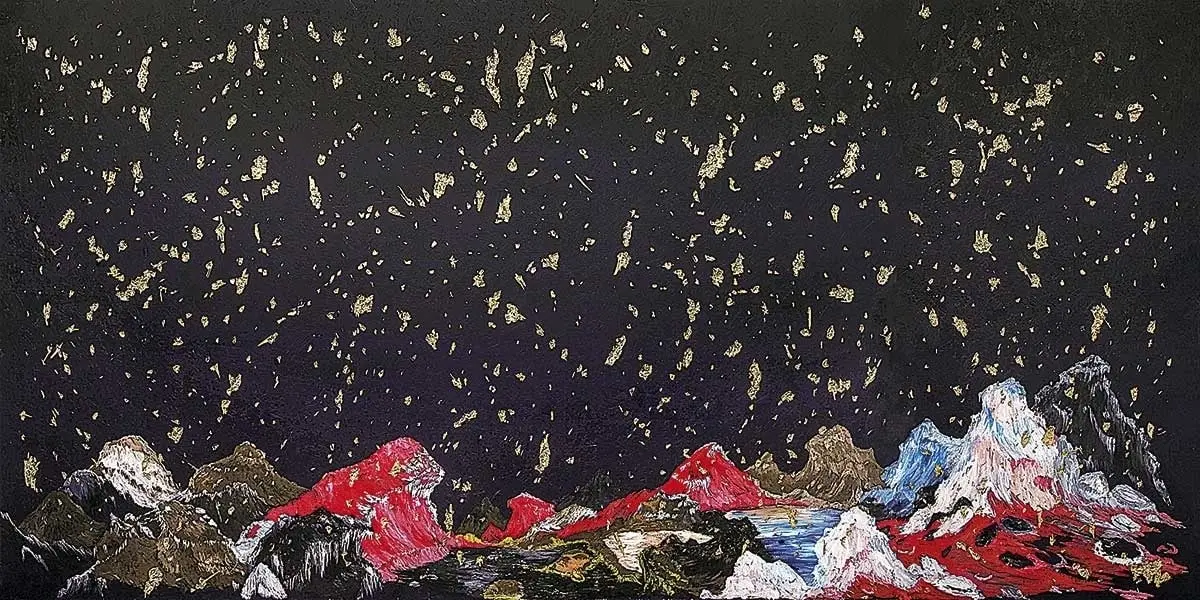
One work in particular drew attention in that regard. Disfraz (Costume), a piece characterized by a panoramic format of nearly five meters wide, appeared from a distance to be a series of color compositions on the bottom of the image that resembled a mountainous landscape. Above, in the other three quarters of the composition, a dark blue tone appeared to be accentuated by asymmetric presences of gold. Always faithful to my interpretative vice of drawing references with classical art, I immediately associated that palette with the gold and blue colors that were so dear to Renaissance art.
But how big was my surprise when, as I approached the picture, I realized that what I had perceived to be gold color was actually a series of veils of paint on chipboard that have received several incisions by the artist. The Renaissance mirage quickly shattered before my very eyes and Duville’s mutations appeared instead as an experience felt by my body. But I could not manage to completely let go of the references to the visual culture of the classical tradition and, therefore, I still draw parallels between Deville’s work and classical art. It would perhaps be more consistent to consider his proposals more in line with the trompe l’oeil art technique that can confuse the background with the foreground, painting with relief, and gold with the precarious nature of matter.
I left Matias Duville’s exhibition mindful of the need to keep a sharp gaze when looking at images. I remembered the question in W.J.T. Mitchell’s book about the relationship between the viewer and the image: “What do pictures want?” I admit that, just as that US author was unable to offer a precise answer, when it comes to Duville’s work, I also find myself (fortunately) unable to answer. For the moment, I am content with my observations so far about his work, and with pointing to the mutating nature of his artistic inquiries.
In the end, there is no doubt that contemporary production can offer powerful images through media as traditional as drawing and painting—not to mention the sculptures and other objects of his own creation. Those approaches to create art continue to provoke viewers and, more than that, they are free from any demagogic political posturing, unlike many other artists framed by a “Latin American art” international art style. Matias Duville’s work is nonetheless politically charged, in that it sometimes facilitates contact with something that is sometimes forgotten but that is essential to the human experience: beauty.