
Argentine artist Nicola Costantino (Rosario, 1964) presented in the halls of the Colección de Arte Amalia Lacroze de Fortabat a group of four works under the title of Unfinished Rhapsody centered on the figure of Eva Perón. It is a contemporary portrait that, rather than portraying an image, presents multiple facets of this historical female figure here personified by the artist. Costantino became Eva.
Using her body as a central element of a production strategy spans Costantino’s entire artistic production; in works like Trailer (2010) in which she interacted with her double, or in the controversial project Savon de Corps (2004), which consisted of the creation of several soap bars whose ingredients included 3 percent of the artist’s own fat obtained through liposuction.
These four works exhibited in Buenos Aires also represented Argentina in 2013 at the 55th Venice Biennale under the curatorship of Fernando Farina. Eva. El Espejo (Eva. The Mirror), the piece that opens the exhibition, is a video installation featuring the reflection of Eva Perón in the privacy of her bedroom as she brushes her hair, puts makeup on, and dresses in preparation to go on stage.
The viewer enters the darkened room where a large gilded frame standing mirror and the mirror of a Louis XV style dresser face each other and generate a play of reflections that render the ghostly image of Eva Perón. While the mirrors reflect her image from the front and back, she is absent in the real space in between where viewers walk through and where all the other elements of the installation operate in a real dimension—the bed, the French style furniture, the phone and the items on the dressing table—emphasizing Eva Perón’s spectral presence.
In an intelligent and subtle manner the mirrors are replaced with treated glasses that function as the screens for two painstakingly synchronized videos in which Costantino embodies Evita. The artist from Rosario performed the scene behind closed doors, without any public, and the only record of the performance was recorded by the camera.
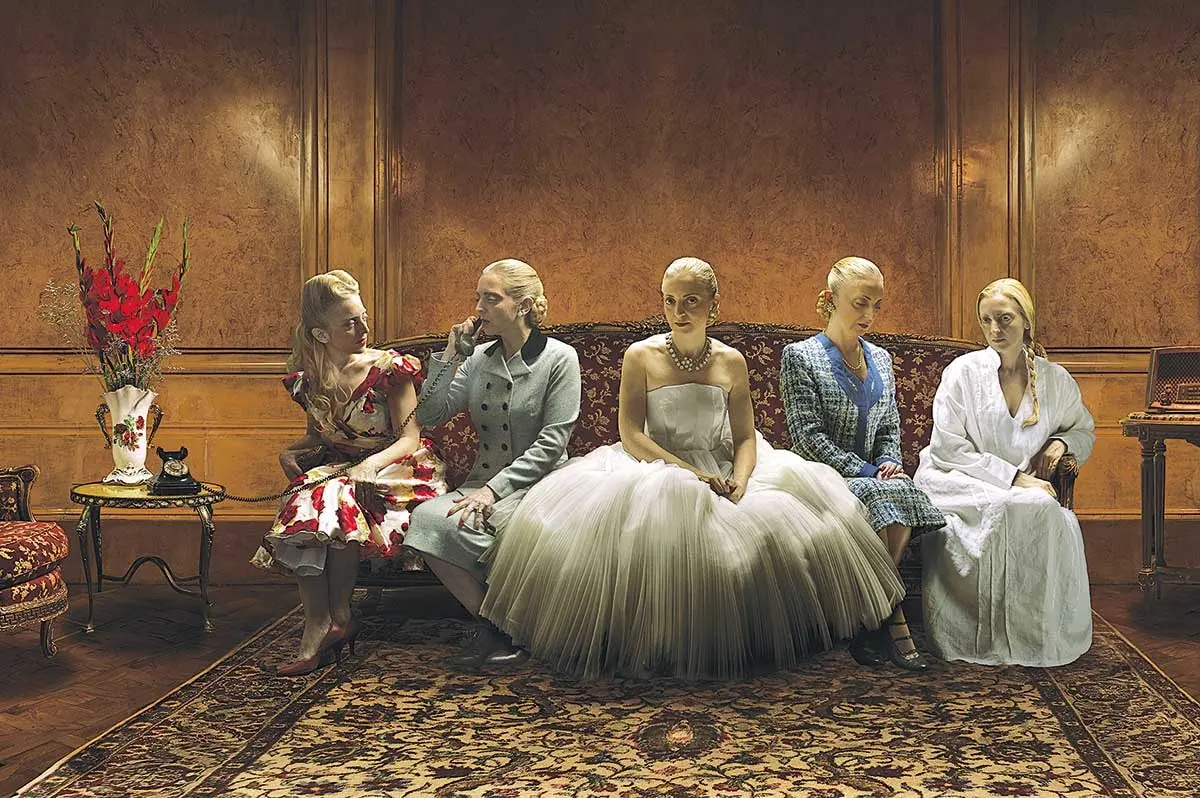
The second piece of the show is titled Eva. Los Sueños (Eva. The Dreams), a video installation projected on a 17 meters long semicircular widescreen that shows a life-size Eva Perón doing everyday activities, in a domestic setting and at different times of her life. Here again, hairstyle and clothing take on a central role in the interpretation of the character.
Through the use of seven synchronized projectors different facets of this character overlap and coexist on the same screen. Even for a few seconds, the seven images of Evita are shown resting on the couch at the same time as if they were regaining their strength to resume their tasks.
The exhibition continues with the work Eva. La Fuerza (Eva. The Strength), an object-machine consisting of a life-size iron dress with small wheels and a motor at its base programmed to move the structure around a small space whose walls are made of Blindex glass. The armored dress moves in a straight line and automatically backs up, turns around and goes on the opposite direction when it hits the wall. Viewers observe from outside the room the frustrating dynamic performed by this object that continually collides against the glass, an invisible barrier that, nonetheless, does not allow it to move forward. In addition, the noise produced by the impact has been intentionally amplified by the artist. Thus, the work relies on both visual and sound elements to represent strength.
The iron dress was inspired by one of the myths that surround the historical character of Eva Perón. According to the story, the First Lady of Argentina would rely on the assistance of a metallic structure that allowed her to stand during public appearances when she was already too weak as result of her illness. Beyond the question of whether this armor underneath her dress really existed or whether it was simply a myth, this work paradoxically refers to the most physically vulnerable moment of Eva Perón’s life as Eva. The Strength.
Eva. La Lluvia (Eva. The Rain), the last work in the exhibition, is different from the others in that it does not contain any hairstyles, faces, clothing or even a silhouette; it is an installation in which the human body is absent. The piece depicts a small operating room under two large surgical lamps. There is the large stainless steel stretcher with accumulated drops of water. These large ice droplets have a layer of LED resin that produces a light effect from within each one. In addition, when the ice melts, little water droplets fall into the bottom of the table where the drainage collects it and prevents it from spilling.
In sum, the four works here presented standout for their masterful technical execution and metaphorical nature. While each of them is sufficiently compelling on its own right and, thus, is capable of generating meaning singlehandedly, their reading as a group certainly maximizes their potential.
AYELÉN VÁZQUEZ