
In this project, conceived specifically for the gallery, the artist brings to the table, even in a literal sense, matter for thought. Like an idea lab, the exhibition, curated by María Belén Sáez de Ibarra, explores the pedagogical possibilities of art. The gallery becomes a tool, a place for learning where audiences can speculate, deciding what to learn and how much they want to involve themselves. The intervention becomes a growing rumor, expanding beyond the gallery and operating, for example, in a bakery in the Chueca neighborhood. The artist worked there with a local baker in an attempt to make bread in a perfect cubic shape. This work brings to mind Wilfredo Prieto’s Politically Correct (2009), a piece of watermelon cut in the same way. But while Prieto’s work emphasized the domesticating gesture of political correctness by giving a piece of fruit a perfect geometric form, constraining its tropical voluptuousness in the quest for a certain, imposed rational perfection, Paris is interested in the process of research and manufacture of bread: what kind of flour will produce a more compact body, what type of kneading will produce the desired consistency, how to avoid the “flattening” of the cube as it comes out of the oven…
Aware of art’s communicative virtues, Paris uses it as a key instrument for learning, while creating spaces to promote a variety of aesthetic and social experiences. He was a teacher, and it shows; he taught in a rural environment, and that also shows. There is in Paris’ work more than a concern for generating collective dynamics for learning: there is also the eloquent gesture of utilizing any available material in order to achieve it. As in Montessori pedagogy, the most obvious things and the more everyday objects are instrumentalized and questioned, generating reflection and dialog. Tree branches, pencils, and bottles are examples of this. None of them has arrived there loaded with meanings to decode; the intention is to reinvent and put them in the service of an idea, as a whole, and thanks to the audience.
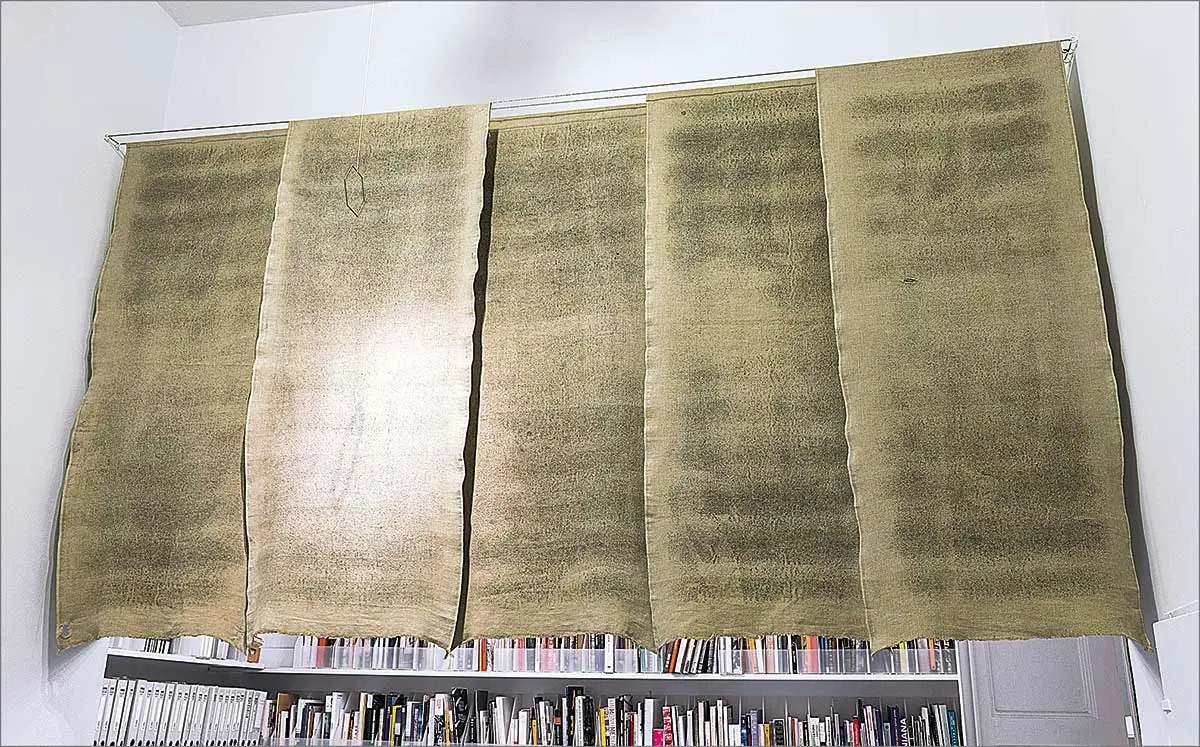
In the show, we notice the need to infuse inert objects with a breath of life, not in an animist way but through the use that is made of them. Their “living” charge is based on their functions in social circuits. Paris turns canvases into shrouds, wrapping in them not lifeless bodies, like Teresa Margolles, but fermenting dough. In reality, they are baking cloth, imprinted with the dough’s leavening and humidity. There is in a way a trace of life in these canvases. An entire reflection about bread and its relationship with life and death is projected from that simple, poetry-infused gesture. In Arquitectura para pájaros (2015), a 14-centimeter cement cube becomes a birdhouse or feeder. It is a cold minimalist sculpture that demands the warmth of a nest.
Paris’ influences are many and of many kinds. From Bruno Munari and his studies on creativity to the teaching dynamics of the Companions du Devoir—brotherhoods that operated in France during the middle ages, where youths could acquire skills in traditional crafts based on community life—and residence programs in studios throughout the country. Also inspired by Joseph Jacotot’s teaching methods, and by the anarchist tactics deployed by the Argentine bakers union in the early Twentieth Century, his projects revisit the alternative-teaching models of Latin America’s “garage universities,” in an interesting dialectic between knowledge and power.
Chorally with all these voices, Paris’ workshops pay multifaceted homage to creative activity in its manifold and inexhaustible aspects.
DIANA CUÉLLAR LEDESMA