
Óscar Murillo presents the exhibition titled Conditions Yet to Be Titled at the Museo de Arte of the Universidad Nacional de Colombia, in Bogota. A walk through the show eventually places viewers before a metal table with a hole in one of its ends that serves as a siphon. Covered with a tablecloth, the table at first glance could mistakenly be thought to be set for a banquet. Nonetheless, we are immediately reminded of those stretchers used by medical examiners to perform autopsies, especially when we discover the other half of the table. But instead of bodies there is a large black cloth fashioned with scraps. The fabric contains several shades of black and scratchers-like graphics, a distinctive element in Murillo’s work. The fabric is folded neatly onto itself and covers most of the table-stretcher, leaving the other half exposed where the siphon is. A corpse, where black is already the predominant color will be, or already was, subjected to an autopsy. Necrology is associated with art, in this particular case with painting but also with the cultural tensions that run through us. Which is the cadaver and which is the painting? Is being the colors of incomprehension a condition of black and dark hues? Are they responsible for the materialization of some idea of evil that opposes the purity and immaculate essence of white, which for centuries has symbolized the essence of racial exclusion and, in sugar plantations, the essence of wealth?
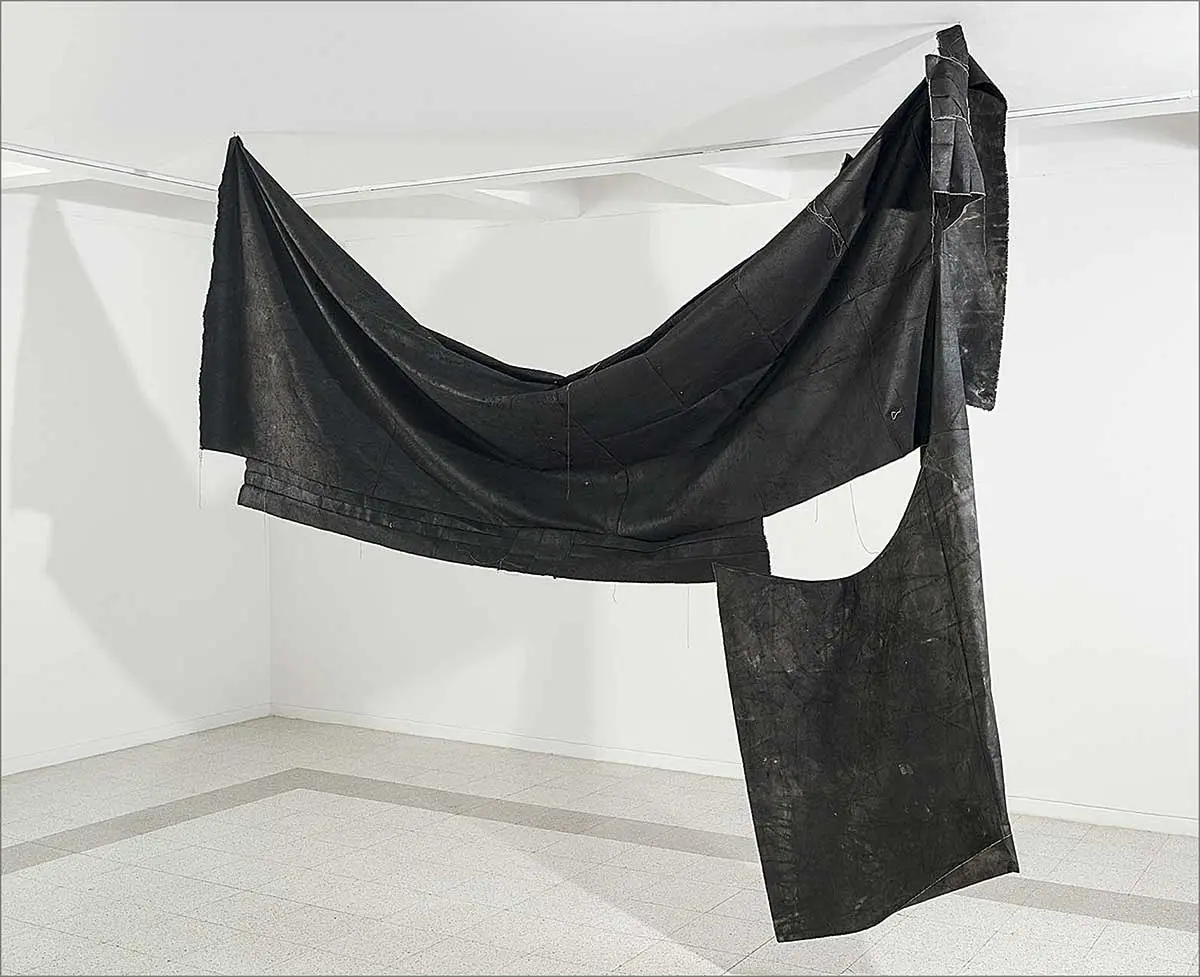
Another metallic stretcher supports a fabric similar to the one previously mentioned. At its feet, there is a large carefully folded black fabric that creates a dialogue between this object and the other one already described. A sort of linear process emerges in which the fabrics begin to take the form of skin. There is a large canvas at the back of the room fashioned with scraps and shades of black, with a rectangular cut reminiscent of a window. The fabric is suspended from the ceiling from both ends. Here, especially in this piece, the painting becomes objectual, almost sculptural. We can see both sides and the folds that it forms.
We found other canvases hanging—or rather purposely hung incorrectly—on the walls that offered a sort of challenge to the idea of painting as a decorative object, as the frames and paintings are missing. There are works here that are not intended to seduce viewers. On the contrary, they elicit rejection. Freud without a doubt would deem it sinister or, in other words, strangely familiar. It is in these terms that the work by Murillo allows viewers in: it attracts us because we find something “familiar” in it but at the same time we reject it because it is “strange” in the context of those family stories.
Retirada (Retired) is one of the works made with job application forms from Colombina SA, a candy factory founded in 1968 and located in the township of La Paila of the municipality of Zarzal, in Cauca Valley. A community with a majority black population, Murillo’s family comes from there. There is a photograph of a black woman that happens to be Murillo’s mother and who used to be employed by the candy company.
Another work alludes to the employees of the company. There are white overalls hanging from clothes hangers in a metal closet. Behind it, we observe a printed image that Murillo has already used before as his own symbol: a black heart with pink eyes that look like a mask and a red little heart near one eye. Other overalls are on the ground, carefully folded as if they were alluding to those characters already “retired” from their jobs. A series of drawings and tickets framed in safety glass lie on the floor against the wall in a corner of the room; it depicts a black chef in a commercial “Cream Wheat,” “Cheese Bread,” “Moca”. Retirada alludes to the idea of job insecurity and to a preventive exit from a difficult condition.
Conditions Yet to Be Titled is, according to Murillo himself, a slap to a “racist and classist” society. Thus, no wonder the exhibition is uncomfortable, hard to digest and even harder to assimilate and convince. An image framed by a window in the exhibition room reproduces the painting of a black child holding a plate full of fish—a highly stereotypical image of a black person. This image that Murillo found in a bourgeois place in the northern area the city, became the trigger for this exhibition. In conclusion, this exhibition is an excellent visual reflection on the status of contemporary painting and a conceptually strong take on the relationship between art and politics.
RICARDO ARCOS-PALMA