
Besides being a renowned painter in today’s Chilean art scene, Paul Chiuminatto (1965) is an academic with a PhD in Philosophy, Aesthetics and Art Theory and a member of literature study centers associated with local universities; in other words, he is also an interdisciplinary theoretician. Therefore, upon entering his exhibition titled “Landscapes of Study,” one was already expecting that the highly visual simplicity of his painting and the emphasis on the tradition of landscape were only the surface of a series of reflections.
The show offered relationships with key referents to art history and gender that appear immediately: William Turner and Caspar David Friedrich and the painting of Romanticism; Chilean teachers Alfredo Helsby and Paul Burchard, who represented the incursions by traveling artists into landscape painting—from the end of the nineteenth century to the beginning of the twentieth century—the exploration of the local natural world, the rejection of the academicism, and the emergence of modernism. Also present were, on the one hand, Adolfo Couve and his intimist and nostalgic visions of everyday reality developed during the 1980s in Chile, and, on the other, that which could generally be described as the effects of the “painterly” realism that is practically a school in Chile—which internationally may be represented by artists like Gerhard Richter and Luc Tuymans.
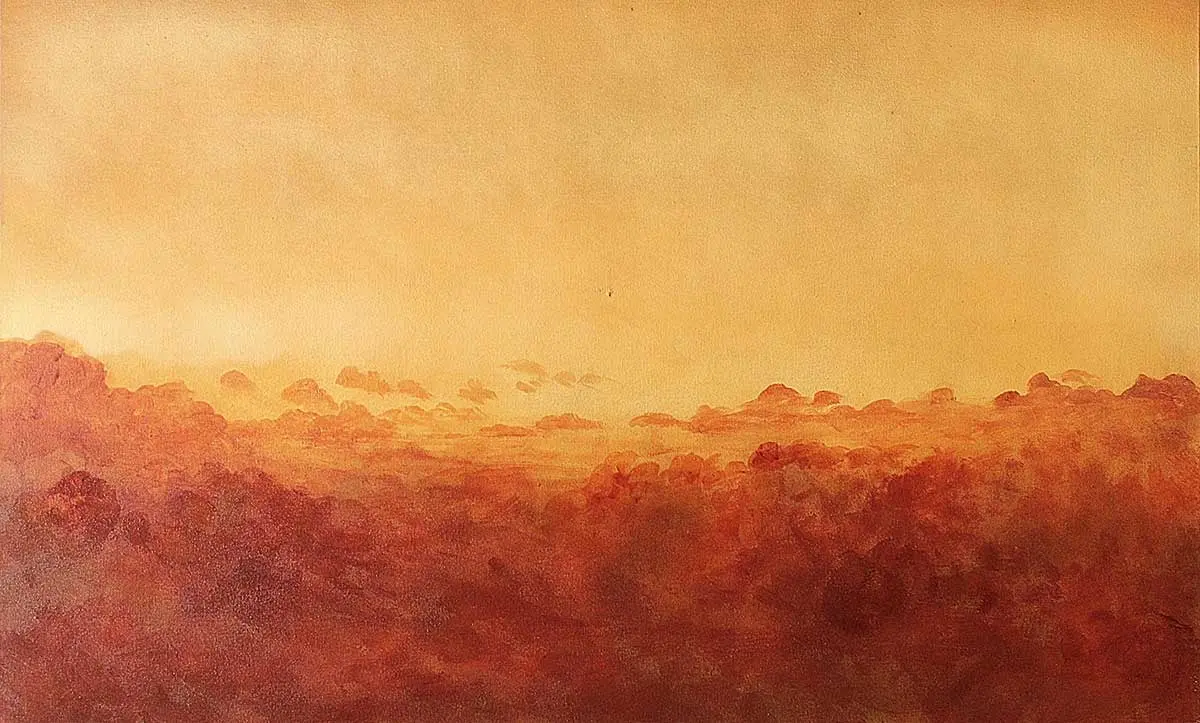
Perhaps a result of his reflective nature, Chiuminatto has spent nearly twenty years exploring an overly defined field. It is as if all this time he has been working on countless versions of the same landscape. Open until March of this year, the exhibition offered a view of a misty field—perhaps captured at dawn or at dusk— framed by a composition in which light patches and brief signs rendered the sky, the ground and the horizon; and sometimes trees and crops as well. Through graphism, panning and washes these “Landscapes of Study” were presented as if they were half done, nearing their full realization, insistent, one painting after another, through rigorous and minimalist repetition. It was landscape in its purest form, a mostly monochromatic palette restricted to gold, sepia and earth tones; atmospheres with erased boundaries and a fog that leaves everything in limbo; the vastness, the revealing light and solitude. Between subjectivity and empty gesture, the image sketched a recognizable place that was phantasmagorical any way one looked at it.
Chiuminatto clearly embodies a transition between two periods that overlap his work. It is a parallel inhabited both by the sublime and subjective landscape of the nineteenth century in Europe, or that sort of spiritual and existential landscape that preceded the emergence of a self-reflexive painting ironic of its own resources, and a contemporary art where the latter approach definitely prevails. Thus, there is no longing or novelty in the gesture of painting with skepticism.
The type of painting referenced by Chiuminatto tends to rely on artifice and illusionism: it is not mimesis but, to some extent, a way for the artist to expose his tricks. However, Chiuminatto deploys these devices so eloquently that we are deceived anyway. At the end, no matter how close it is to vanishing, the image that he has created is indeed a landscape. Thus, this work offers a reflection on the experience of the gaze or on the deceiving reality in which we live.
Forcing the senses to the current context: what could this painting be telling us? Is it about the need for silence or the intangible nature of forms? Is it a take on a national landscape or on a landscape in its purest form that no longer exists? Chiuminatto painting hides a reflection on the Chilean landscape and, therefore, on context and identity; which takes us back to the clean landscape from the dawn of the Republic that the painters of that time used to build a more autonomous language. But above all, I see in this work by Chiuminatto a strong connection to the painting and figure of Couve.
Visual artist and writer Adolfo Couve ended his life at age 57, in 1998, in the coastal Chilean town of Cartagena, where he had been housebound while struggling with depression. He was the embodiment of that convergence between Romanticism and an art devoid of ideals. During the dictatorship, Couve turned to represent minimum scenes with a gesture that appeared to grab the last breath of the forms he wanted to capture, as he assertively represented, characters and objects from everyday life. Like Chiuminatto, within the current scene of his own time, or in a dimension parallel to La Avanzada [The Chilean Neo-Avant-guard art scene that emerged in the period that followed the overthrow of President Salvador Allende], Couve worked with a similar conceptual intensity, but also delved into poetry of the most restrained kind. And it was precisely in that melancholic apathy where he touched on the impending loss of the essential; a proposition that was certainly ahead of his time. However, in Chiuminatto’s work, the gesture is anachronistic above anything else. In this spiritual and yet deceitful landscape of his, which appears to be and not to be, and where we can actually become lost in a trance, the conceptual element may prevail over the silence, while the need for explanations may also prevail over poetry.
CAROLINA LARA B.