
What at first seemed simply another installation by the well-known Mexican social philosopher and cultural theorist in visual form, Pablo Helguera, was instead a museum-quality mid-career retrospective. Curated by the gallery, “Strange Oasis” intertwined eight separate installations from over a decade of work—much of it from 2014—with two famous pieces but about ninety-percent not yet seen in the US. The two large immersive projects were physically interactive and quite fun!
Upon entering, a small innocuous doorway was to the side and covered with a black curtain, which required visitor curiosity to open it into a small, dark and candle lit séance–like room with a table and a young woman dressed to evoke thoughts of a priestess. After you voluntarily signed a contract, meaning you were temporarily initiated into whatever it is that was about to happen, your guide led you into a separate, larger room where you selected a metal talisman that was hung around your neck. Without explanation you were then led to 94 metal urns on five wall shelves, each labeled with an idea or concept and asked to choose one. I chose anarchy because for me, knowing something about both the project, which had been installed earlier in and now imported from Belgium, and Helguera’s thinking, anarchy represented both the conclusion of the project and its rejection, the two sides of the contradictions I see as central concerns for Helguera; positioned somewhere between a belief in human consciousness (as distinct from the material world) and materialism, between rationality and its supposed antipode, irrationality.
Société Civile pour l’Enterrement de Pensées Morte, the unknown title of this installation, is a reference to Belgian rationalists (also known as free-thinkers) from the early 20th century (but known by the 17th century) who were quite influential in the formation of social consciousness (in this case, liberalism) but based on Western Enlightenment values of empiricism and rationalism. From this philosophical position anarchy would certainly be one idea among many they wished dead. But thoughts don’t die; they continue on. It’s not a rational world, which is NOT to say the world should therefore be irrational. Rather it is the blend that is important, and the skepticism Helguera wants and consistently enacts is the fulcrum from which to see the components and their relationships; skepticism sets you free to think.
In a separate room we find different but relatable ideas also integrated into expansive yet specific avenues of history, past and present. These issues nest within one another in Helguera’s world view. Holding the central gallery space here is “Nuevo Romancero Nuevomejicano,” an installation originally commissioned by SITE, Santa Fe, New Mexico, for 2014, based on a 1915 book by the folklorist Aurelio Macedonio Espinosa who recorded the regions “Romances” – narrative folk ballads. At SITE Santa Fe it included musical performances by Helguera but never as merely a restaging of his historical research into the Mexican period of the pre-US state of New Mexico (1820s-1840s). There and here, Helgeura sees history as dynamic and unstable, and wants to demonstrate that the past continues into present and future, an understanding that gives him creative license to develop “new” histories, or “romances.”
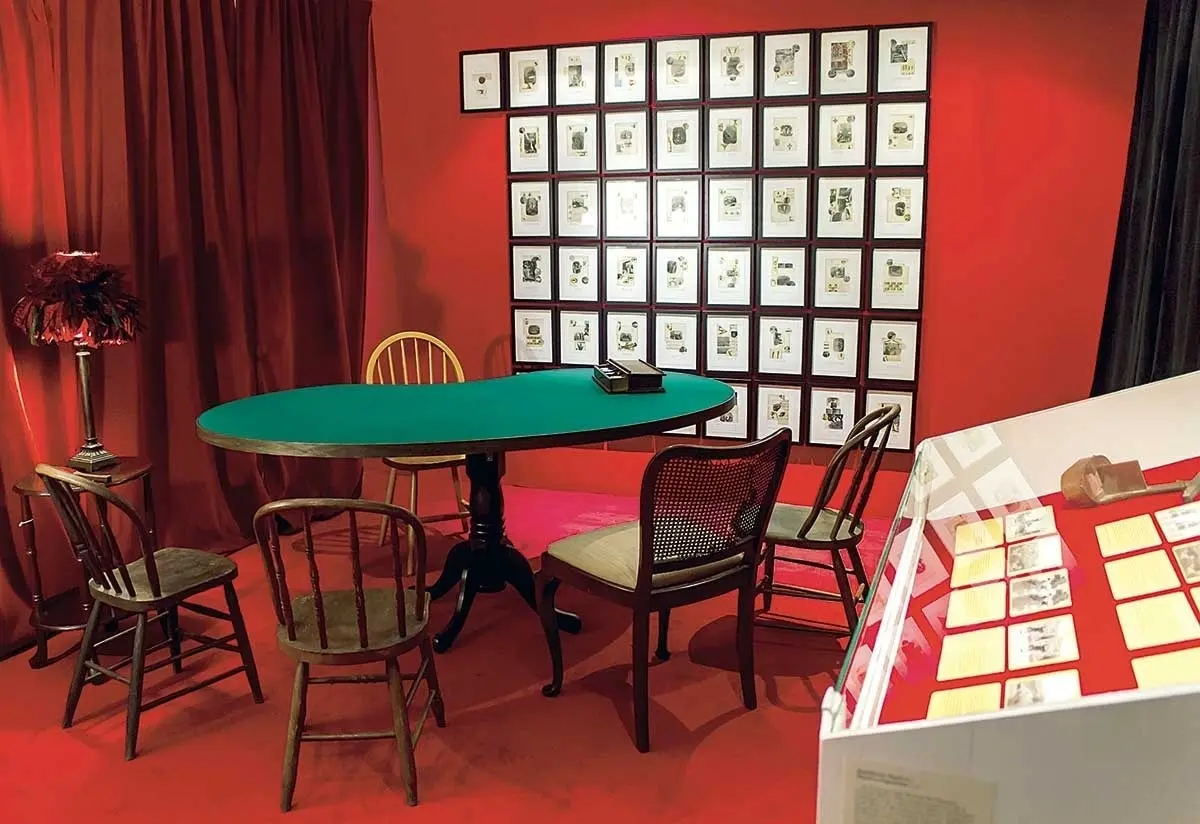
Garish red walls, a card table with green cloth, gambling chips, a self-created card deck, empty chairs and a smiling dealer await your bets in what was the most popular 19th Century Southwestern gambling house game for Mexican and Indian populations, (Spanish) Monte. Why? Because the three-time corrupt New Mexican Governor (Manuel Armijo, 1793-1853) of the territory was a gambler who also gambled away the free Mexican territory and surrendered it to the US in 1848. Games, then and with their resurgence today, are a rationalized frame to contain the truth of chance and randomness. Historical images decorate the cards derived from Helguera’s original collages, that now hang on the wall. In the same area sits a glass showcase that holds artifacts from this time period, as if the material presence of objects somehow moves us across the reverie of time. Another vitrine holds stereoscopic postcard images and their separate Spanish narrative text panels that speak specifically of the failed hunt by US army forces for Pancho Villa in 1916-17, gathered under the title for the installation “Punitive Expedition (A Topographer’s Tale)” of 2002. Unknown to the viewer the stereoscopic images that look like Southwest desert and destroyed villages are those of the Tora Bora cave region in Southwestern Afghanistan. It was here that US forces in 2001 failed to find Osama Bin Laden, who escaped to the Federal Tribal Area of Pakistan with his eventual assassination by US Special Forces in 2011. This is linear time enfolded along a synchronic scale that simultaneously compresses and expands our view of history, making it continuously relevant.
Such collapses of time and space, uniting past and present, are seen elsewhere, as in “Knoxville Summer of 2015” (2014) an edition of photographs of places experienced by the US critic, poet, writer James Agee when writing of his childhood dreamlike eternal present of summer evenings with his family in “Knoxville Summer, 1915.” That Agee’s dad died in 1916 and the four paragraph prose ode was written in 1935, and now revisited by Helguera can be called nostalgia or romanticism but seems more like the reality of life lived through the combination of physical everydayness and mental reminiscence: presence and absence co-mingled, the borders wavering like desert mirages. Such convolutions and interchanges in time flows, to show sameness and difference, simultaneously what is recoverable and unrecoverable, are a consequence of his interest in consciously bracketing the various modalities of human experience, a form of phenomenological investigation.
Thanks to Katrina Neumann of Kent Gallery for her informative discussion on the many projects in the exhibition. The reader is also directed to the Pablo Helguera archives: http://pablohelguera.net.
RICHARD LESLIE