
A couple of years after the arrival of Columbus in what would later be called America, Spain and Portugal signed the Treaty of Tordesillas, an agreement that divided the land found in the new continent among the two empires to avoid further conflicts. It established a meridian located 370 leagues from the Cape Verde islands and stated that: everything in the east is mine and everything in the west is yours.
The curious thing is that the new “legal owners” of the American territory were unaware of the location, boundaries and dimensions which they had declared as their own. It was a matter that would eventually have a profound impact on the formation of American society, given that from the very beginning of colonization, documents and the written word were used to create reality instead of just recording it.
Consisting of 17 works, the exhibition titled “Social Contract” by Rubens Mano addresses that paradox that emerged from the conflict between good and property, land and writing, fact and certificate; a collapse that leads to issues of demarcations, boundaries and borders.
Upon entering the gallery viewers encounter Lastro (Vallast, 2015), a work consisting of a map that outlines the territory of Portugal post-treaty. Further ahead, viewers find photographs from the series titled Interval (2014), Cunha (Cuña, 2015) and the installation Quinhão (Quota, 2015). This group of works focuses on a house in Sobral, a small town located 200 kilometers from Fortaleza, Brazil; a peculiar building in that it measures 1.5 meters wide by 35 meters long. After learning of its existence through a brief mention in the media, Rubens Mano decided to travel there to see it.
Indeed, the house is a paradox in itself, not solely for its misshapen dimensions, but also for being in the middle of an empty block; which suggested that its strange proportions were the product of legal limitations, of bureaucratic paperwork, rather than of physical circumstances. Rubens Mano investigated the causes that led to the space and, unsatisfied with the version that it was a gift to a friend from the neighboring lot owner, Mano researched the maps in the Office of Public Records, where he found that the house was right in the space meant for a street; a road whose first portion was added to the neighboring lot, while the second, meager, and more miserable section was assigned to the house.
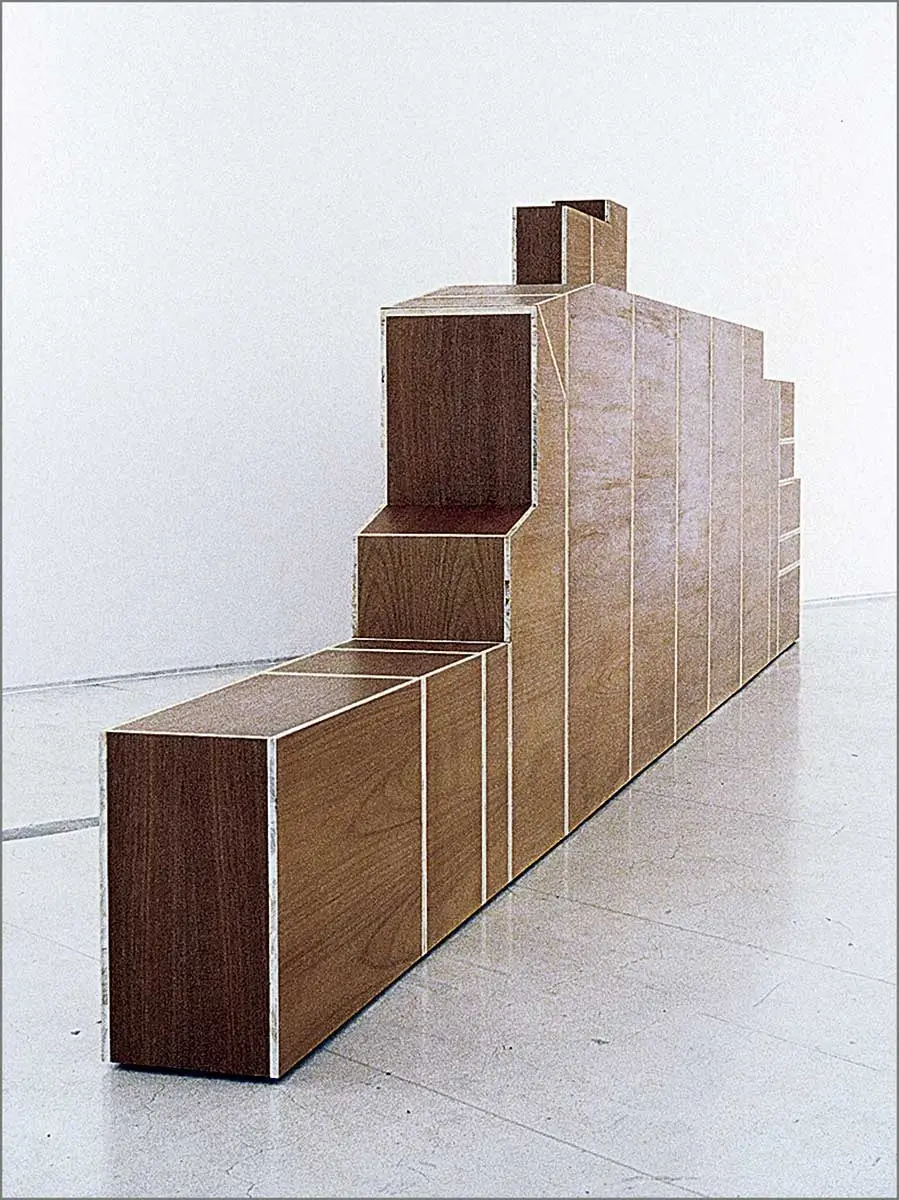
Quinhão is a wood mockup of the house on scale of 1:525; which in itself appears to denote the contradiction of its own referent: too big to be a mockup and too small to be a building. It is a geometric body that is divided into 16 pieces, a number that matches the parts in which the territory of Brazil was divided into after Tordesillas. The work will sell by the fraction, which means that each buyer will take their own piece of cake.
Other series of photographs in the exhibition include: Naturaleza Privada (Private Nature, 2014), which shows old advertising images arranged on sections of huge rocks from roads in El Salvador. The borders between the advertising images and the colossal stone have been eroded by the passing of time, along with the question of who granted the right of ownership over that piece of wall. On the other hand, there are photographs of metallic spiral staircases that occupy the platforms of the poor neighborhoods in Fortaleza; beautiful, fragile and precarious, the stairs are a clear invasion of the platform, the public space. In turn, these pictures come into play with an earlier work, Contrato Social (Social Contract), a sculpture in which two spiral staircases are fused together, an apparent attempt to save space that has been taken to a collapsing extreme, that is, to the inability of conceding space. Enigmatic object whose steps display engraved words from Rousseau’s book.
The video Análise de Sistemas (Systems Analysis, 2011) shows a very humorous and ironic scene recorded in Cuenca, Ecuador. At first glance, the work appears to be a photograph of a small building, but a careful look reveals the movement of a security camera installed on the top floor. The camera nervously looks over, monitors, back and forth as though if it were tired of its own obsession; pensive, it pauses and looks at one of the building’s walls. The scene is paradoxical, first because the guard—the camera—is being monitored; and second, because any decent thief would learn the camera’s movement in order to stay slightly behind it so he/she could not be noticed and, thus, could erase the boundaries of the property in question.
From Tordesillas to the space in Sobral, and from the spiral staircases in Fortaleza to the security camera in Cuenca, Rubens Mano explores the issues associated with contracts, with what is mine and yours, in a metaphor that successfully and conclusively shows the tenuous border between appropriation and possession, between theft and property, between misappropriation and lawful acquisition. In sum, it shows the paradoxical nature of property, given that time after time it must break its own limited condition so it can be constituted.