
The Venezuelan cultural scene has a new center for the dissemination of the latest artistic currents: the Galería Espacio 5 located in the town of Valencia, home of the Salón Arturo Michelena Biennial, where authors from different latitudes meet to compare their proposals. This novel gallery opened its doors to the public on March 16, 2013, with the first solo exhibition by Vicente Antonorsi in that city. A second exhibition by the sculptor from Caracas was inaugurated this year, from March 7 to May 2, with works created in 2015.
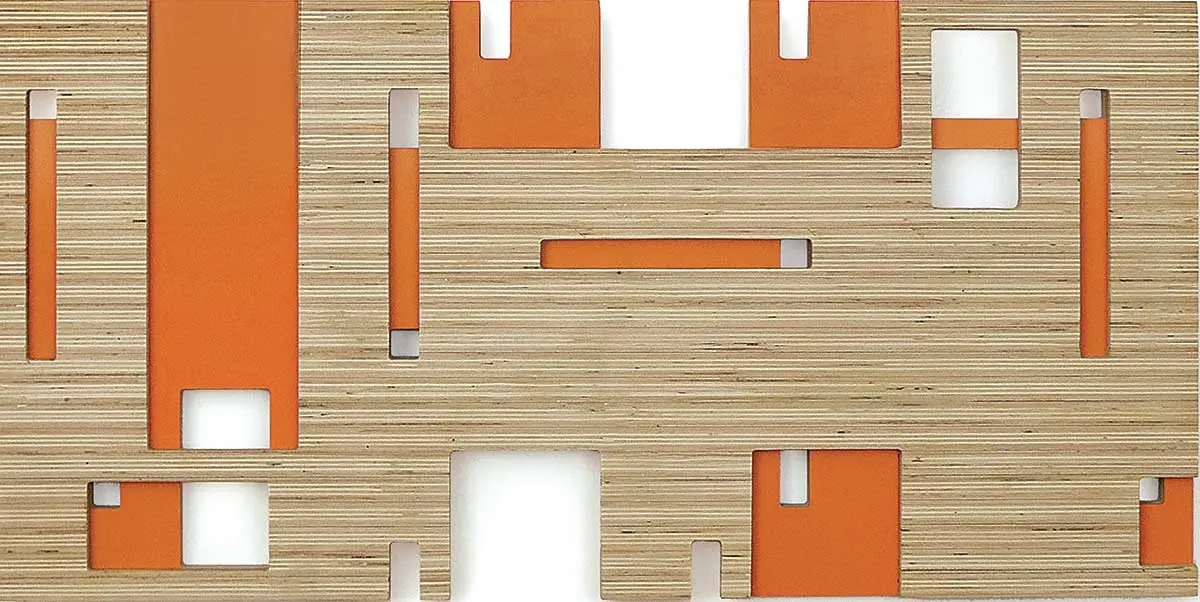
Under the curatorship of Marisela Chivico, the exhibition titled “Cutouts/Color” presents twenty-six works arranged according to techniques and themes that maintain a unifying thread through which the original facets of Antonorsi’s production are revealed. From a distance the group appears as a succession of alternating straight lines and inflections interacting with the walls that serve as support. Plywood sheets, Formica, acrylics and painted irons are the material prototypes—generally used in restorations or interior and furniture design—which in Antonorsi’s hands are conferred meanings that reveal the multiple possibilities of the creative exercise. Over time Antonorsi delves into the abstract-geometric notions associated with his practice as an architect, graphic designer, designer of furniture and textiles.
Structure is the driving force behind the practice of these professions; it defines and organizes the space—architectural, graphic or textile—and its relationship with the formal components. The exhibitions in which Antonorsi has participated since 2001 have been indicators of the direction of his aesthetic proposal. In “Season. New Manual of Natural Species” (2001), the mounting of the exhibition underscored the richness of the plant world through arrangements of flowers, fruits and seeds that evoked the Caribbean landscape in all its chromatic and informal exoticism. Later, in “Recent Structures” (2005), geometric rigor dialogued with primacy alongside the arrangement of coconuts, shells, string, etc., which the artist introduced in a play between the rational and the organic, in a duality perceived in the piece Bandeja II, Amuleto y Cocos (Tray II, Amulet and Coconuts). According to art critic J.C. Palenzuela: Antonorsi’s work offers “A strange mixture of geometry and nature, recycling and purity ....”
Through the pursuit of these inquiries, Antonorsi reaffirms the process of synthesis in which he has been working for the last decade and that some identify as reductionist, given that his discourse has increasingly become more refined, precise and minimalistic in style, but with connotations connected to the intrinsic consistency of physical elements. Hence, the grain of the wood or the clarity of Plexiglas are assimilated as aesthetic qualities that combine basic concepts between the industrial and the artistic, the utilitarian and the beautiful. In Calado a Color (Cutout in Color), for example, the rectangular base includes orange segments that contrast with the streaks of brown hues; characteristics of the multi-laminated overlaying. In the piece Calado Desplazado Magnífico (Magnificent Displaced Cutout) the superimposition of boards creates linear horizontal and vertical directions with perforations and openings that describe a sort of warp and weft that connects full and empty, figure and ground.
The dynamics of these compositions rest in the assemblage that articulates high and low modulations and planes, a sort of “texture” or “visual architecture” that results from the plywood cutouts and their arrangement in the space. This work is reminiscent of the reticular structure of the famous painting by Piet Mondrian titled Broadway Boogie-Woogie (1942), one of the most important propositions in the field of the visual arts in western modernity. Speaking about the formulation of the Displaced Cutouts series, which he is constantly researching, Antonorsi explains: “I began with three cubes with certain perforated drawings and then I unfolded them like someone disassembling a cube. I did this many times with several of them. Then I placed them next to each other, and, since they had large holes, they began forming random drawings in which it was possible to read shapes that formed for instance the letter “L,” vertical lines and several other forms…, I do not intervene in them...”
As for the reliefs in acrylic—translucent, Ray-band and ruby—his work moves towards the simplification of forms, which can be attributed to the feeling of weightlessness, translucency and immateriality transmitted by this rigid thermoplastic. This in turn originates light and shadow reflections that are diluted in an exchange that confers the pieces a note of vitality. And this is the case in Módulo de 4 Cubos (Module of 4 Cubes). Acrovinylic paint on iron is another process that allows a uniform and sober coverage, as exemplified by the piece Vigas (Beams), which consists of stripes that emerge from a corner of the space and virtually expand beyond the strips attached to the wall. According to art critic and curator, Miguel Miguel Garcia “Vicente Antonorsi invents a unique visual vocabulary that reaches full maturity and a higher volumetric realm, achieving with his peculiar vision of the concept of three-dimensionality a distinctive and unique contribution to contemporary sculpture Venezuela... “
GLADYS YUNES YUNES