
Two preparatory years and two months of intense labor at the Museo de Arte de la Universidad Nacional are behind Juventud sin divino tesoro, an exhibition that Vicky Neumann (Barranquilla, 1963) conceived, cut, glued, sew, painted, intervened, scrubbed, and rethought for the 120 meters of paint by 4 meters in height that comprise this installation specifically created for this room in the museum. The curatorship, by María Belén Saez de Ibarra, is part of the museum’s strategy of generating forward-looking exhibitions conceived specifically for its space. In this case, as Saez de Ibarra explains, the intention was to reflect on the role of painting in contemporary practice, as support that generates events and experiences. Indeed, one breathes Neumann’s installation painting as purely contemporary: photographs appropriated from the media, the Internet, and other artists, printed on or attached to the canvas, and a multitude of domestic images, both printed and painted, combined without allowing us to establish a hierarchy between them. There isn’t a truth about which we are to be convinced, because the image offers no access to it. In an almost obsessive way, the artist oversaturates us with pictorial and photographic images—as we are in our everyday lives—in order to engage the exhibition’s theme.
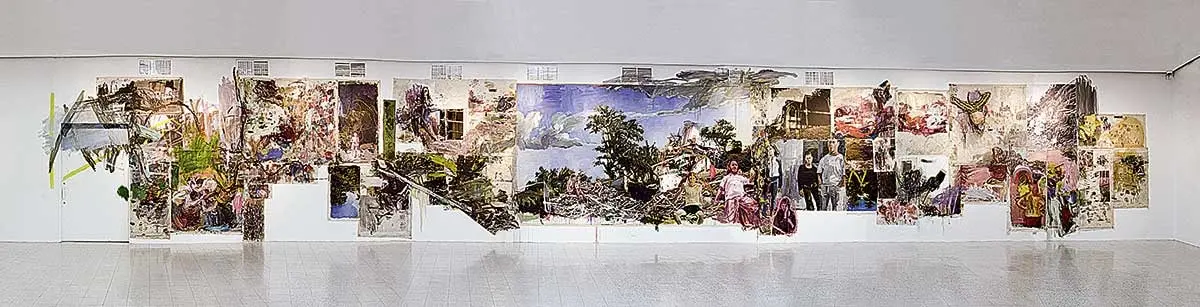
Openly and directly, Neumann introduces us to the universe of a young generation forced to live in a sick society, threatened by, among others, ethical and employment crises, as well as the destruction of the planet despite all the alarms set off by climate change. The artist situates early youth in the worst possible scenario in order to present the viewer with its poses and attitudes towards a competitive, pitiless world. As the title indicates, the youth that Neumann portrays is distant from the idealized nostalgic images cherished in adulthood and from the fashion industry that insists on evoking such nostalgia. On the contrary, what we see are images of frailty at the breaking point, on the verge of destruction. The exhibition is comprised of six pictorial compositions or “moments” of canvases directly attached to the wall, working with materials such as oil paint, acrylics, varnish, aerosol, plastic, lacquer, oil in bars, digital photography, fabric, trash, discarded items, and drawings, and another made with cardboard and two recycled doors, adding a sculptural element to the well-stocked mix of techniques in use. If we decide to begin from the right, ignoring the initial blow that receives us frontally, we find a prelude of what is to come: a youngster with a defiant look on his face, sitting on the floor next to a broken chair. Like other metaphorical images in the exhibition, this chair appears repeatedly to remind us of the despairing spirit of the message: everyday life incapacitated by the breakage of its basic structure. The explosive composition that welcomes us as we enter functions as a large-scale pictorial device where we find a thematic compendium of the exhibition. The large central canvas shows a landscape destroyed by its having been turned into a dumping site, and in it, a group of youngsters entirely indifferent to the chaos that surrounds them, some posing gaily and others concentrated on smoking cigarettes. The figure of the smoking youth, playing at being an adult with a self-confident pose, recurs in Neumann’s work as a metaphor for that tension between power games and the fragility of youth. It is important to note the preeminence of rural landscapes invaded by humans, and of gray urban landscapes with abandoned or unfinished architectures. What these landscapes articulate is, on the one hand, the desolate image of the environment degraded by Man—the inheritance left by previous generations—and, on the other, the empty, phantasmagoric presence of human existence. Neumann is pessimistic in her discourse, but she claims to be able to find hope in the end; indeed, a ray of hope glares timidly from the bluish sky of some of her landscapes.
The entire exhibition transmits an exaggeration of gestures and of the drama underlying the stories of the characters, an exaggeration purposefully sought by Neumann in order to emphasize the fact that she is presenting us with a fictionalized reality nourished by a cinematographic tradition focused on the darkest, most fragile aspects of young life. Like a filmmaker and far from intending a ghoulish, tabloid-ready image of adolescence, Neumann turns the camera off seconds before things go definitely bad, never forcing an ending on the viewer. As a painter, her energy envelops us in every pictorial stroke, accumulation of matter, and intervention on the canvas.
CARIDAD BOTELLA