
Conceptual artist William Córdova, who lives and works between Lima, Miami, and New York, presents his 24th solo exhibition, titled Yawar Mallku: Metafísica de Espacio y Tiempo. The title comes from a 1969 Bolivian film, Yawar Mallku, directed by Jorge Salinas. “The exhibition is also influenced by the themes of the Third Cinema articulated by Fernando Solanas and Octavio Getino. ‘My project has much to do with the concept of the Fourth Cinema, which is a combination of Third Cinema and vernacular sculpture.’”1
Córdova has presented four solo shows under the same title, Yawar Mallku. In 2011, he exhibited at the La Conservera museum gallery in Murcia, Spain; in 2012, at Audience Presents Gallery in Miami; in 2013, at Sikkema Jenkins & Co. in New York. These exhibitions featured different artworks, “but the continuation of a research process is always an archive of possibilities and concepts to construct new perspectives for the future with the materials of the past.”2 Córdova’s Yawar Mallku saga will continue next year with an exhibition at the Museum of Contemporary Art North Miami.
The current exhibition features 28 works: 7 sculptures, 2 installations, and 19 drawings. There is an installation with two 35mm slides and 6 Polaroid photographs. Also included is a single work comprised of 10 drawings.
The work titled S/T (Arquitectura Vernacular) (S/T, Vernacular Architecture) comprises two pieces in concrete, in the shape of medium-size vegetable cans, joined by three meters of wire. Córdova found the wire behind a gallery. The work alludes to children playing with cans connected by a piece of string. “This is something used in childhood as a communication device, but it is also related to narrative and the struggle of the everyday. The work alludes to ideas of communication, the physical form in which it is manifested, and finally it is the story of the oral traditions that Andean cultures share with other around the world.”3 As always in art, when you become aware of the artist’s intention, you like the work even better. The reading of the work is not what you see, but the meaning that the artist wants to give it.
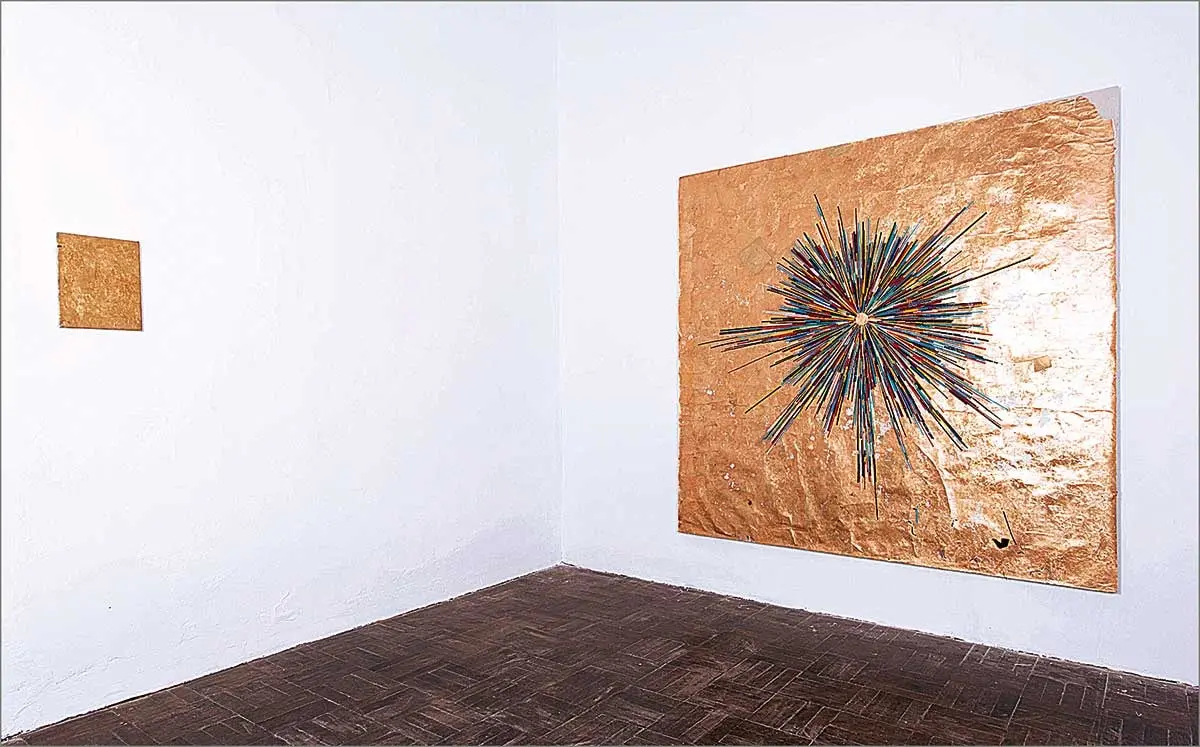
One of the most visual works in the exhibition is Pulsar (Pulsar), in large format, like an explosion of connected lines in different extensions and colors, with a small gold-colored center against a background of the same color. We imagine it as something celestial, with its star shape. The artist tells us: “A pulsar begins when the nucleus of a star is compressed into a supernova, which collapses into a neutron star. The pulsar continues to send of a ray of light for 100 million years. I was interested in interpreting the narrative of pre-Columbian cultures, Inca, Aztec, and Maya, with the language of astronomy, which these cultures understood and depended on in order to cultivate their land.”4 The materials used in this work are rather interesting. The background is artificially gilded and the lines in explosion are a collage of construction paper of different lengths and colors, mostly red, orange, yellow, and blue. According to Córdova, this work is related to alchemy, which is the transformation of matter. The transformation here is the small linear cut of the construction paper to shape the light and the explosion of the star. Córdova’s work is found in museums such as the Whitney, the Guggenheim, the Walker Art Center, the Perez Art Museum, and the New Museum in New York, among many other institutions and collections.
In his work, Córdova explores materials and the way in which they transform. He seeks to investigate different conceptual criteria; the artist does not have a visual language, and with his work he wants “for the audience to understand alternative ways of communicating and resisting from singular ways of telling stories, and how to recover and give value to the presence of that which is marginalized.”5 His goal is a plurality of ideas, materials, and themes, and he achieves it in this exhibition.
NOTES
1. Interview with the artist, April 2015.
2. Ibid.
3. Ibid.
4. Ibid.
5. Ibid.
AUGUSTO CHIMPEN